Bangladesh was never meant to be a theocratic experiment. Its founding logic ran in the opposite direction. When the country emerged from the wreckage of Pakistan in 1971, it did so not in the name of God but in the name of language, culture, and dignity. Bengali nationalism was a rebellion against religious domination, not an expression of it. The Language Movement of 1952 and the Liberation War, nearly two decades later, enshrined a radical idea for a Muslim-majority nation: that identity could be linguistic, cultural, and plural rather than doctrinal. Poetry mattered. Music mattered. The right to speak one’s mother tongue mattered more than theology.
That idea is now in retreat.
Over the past weeks, Bangladesh has experienced a series of events that, taken individually, might be dismissed as episodes of unrest. Taken together, they suggest something far more ominous: a concerted assault on the cultural and moral foundations of the state. Islamist extremism, long present but largely marginal, is pushing its way toward the centre of public life, testing how much it can destroy before the system pushes back, and discovering, to its apparent satisfaction, that the resistance is weak.
The targets have been revealing. Islamist mobs ransacked the offices of two major newspapers in Dhaka, an unsubtle warning to journalists who still believe that free expression enjoys institutional protection. Cultural institutions were next. Chhayanaut, synonymous with Rabindra Sangeet and with decades of resistance to authoritarianism, was vandalised. Udichi, a secular cultural organisation that has survived military rule and political violence, was attacked as well. These were not random acts of vandalism. They were ideological strikes aimed at symbols of Bengali humanism, places that affirm music, art, and secular public life.
Then came the killing.
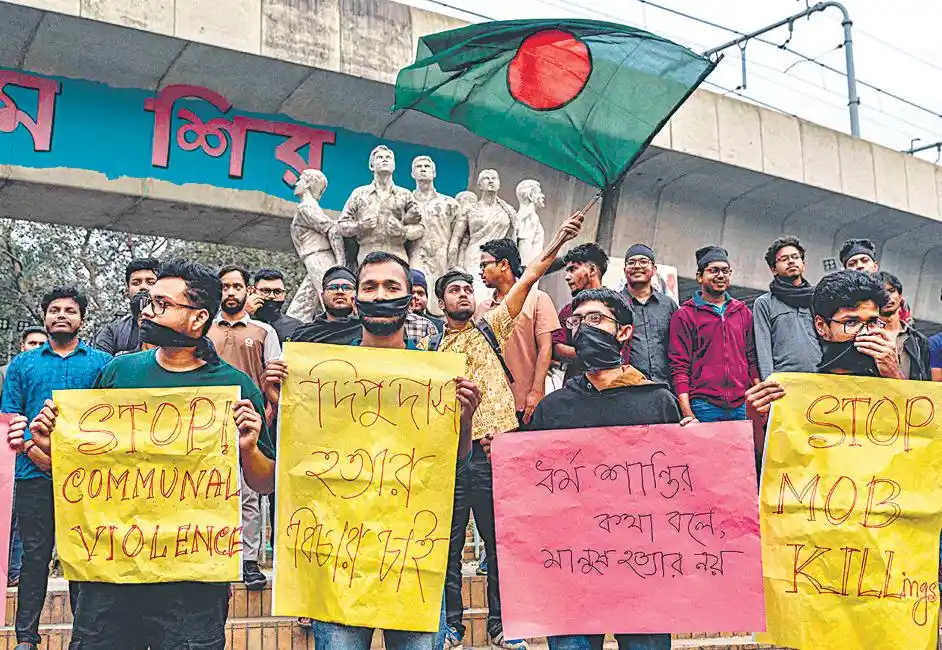
Dipu Chandra Das, a young Hindu man, was accused of blasphemy, an allegation that has become the most efficient accelerant for mob violence in South Asia. He was lynched and burned alive in public. Video footage later showed police officers handing him over to the crowd. For nearly three days, the state said nothing. When the Rapid Action Battalion finally spoke, it acknowledged that there was no evidence against him. By then, the message had already been delivered: accusation alone is sufficient for execution.
The brutal murder of a Hindu man called Dipu Chandra Das in Bangladesh by a Muslim crowd – for so called blasphemy allegations – proves the unacceptable grave danger of Hindus in Bangladesh (and Pakistan), and the barbarity of Islam. #DipuChandraDas #Bangladesh #StopIslam pic.twitter.com/qL8X2h7Kpj
— Geert Wilders (@geertwilderspvv) December 20, 2025
The chants that accompanied Dipu’s murder, religious slogans shouted with performative fervour, were not incidental. They signaled that this was not spontaneous rage but a ritualised act of intimidation. Blasphemy, here, functioned not as a religious grievance but as a political tool. It always does. In Pakistan and Afghanistan, similar accusations hollowed out civil society, terrorised minorities, and silenced dissent long before the international community grasped the scale of the collapse. Bangladesh, which once prided itself on being different, is beginning to resemble those cautionary tales.
What followed only deepened the unease. Islamist groups began appearing openly in the streets, waving the flags of transnational jihadist movements and chanting slogans that would once have triggered swift arrests. Hindu neighbourhoods were attacked. Demonstrators attempted to storm foreign diplomatic missions. The National Parliament complex itself was breached, an act that would be unthinkable in any functioning democracy. The Indian High Commission eventually suspended visa services indefinitely, citing security concerns. Diplomacy rarely speaks so plainly, but this decision amounted to a vote of no confidence in Bangladesh’s ability to maintain basic order.
Perhaps most disturbing was how quickly the logic of persecution expanded. Within forty-eight hours of Dipu’s killing, another Hindu man, a rickshaw-puller in Jhenaidah, was accused of being a foreign spy. His alleged offense was wearing a religious wristband and chanting a Hindu devotional phrase. The accusation itself was absurd; its implications were not. When visible religious identity becomes grounds for suspicion, a minority is no longer merely vulnerable; it is criminalised by default.
These developments raise a question that now circulates quietly, and sometimes not so quietly, among Bangladeshis: is the country being pushed toward something resembling a Caliphate? Groups such as Hizb-ut-Tahrir make no secret of their ambition to dismantle nation-states altogether. Their rejection of borders, constitutions, and cultural particularism is explicit. What is new is not their ideology but their confidence. They act as if the state is either unwilling or unable to stop them.
The interim government has done little to dispel that impression. Muhammad Yunus, internationally celebrated as a technocrat and moral reformer, now presides over a political vacuum in which radical groups operate with near impunity. His silence, or caution, has created space for actors who thrive on fear and spectacle. The absence of a decisive response from Western governments is equally striking, given years of warnings from their own agencies about jihadist expansion in South Asia. When cultural institutions are attacked and minorities are murdered in public, diplomatic understatement begins to look like abdication.
At its core, this is not merely a crisis of law and order. It is a cultural emergency. Islamist extremism does not simply target religious minorities; it targets the idea of Bengal itself. Music, dance, poetry, women in public life, linguistic nationalism, these are not peripheral features of Bengali identity. They are its spine. To reject them is to reject the country’s founding narrative.
Bangladesh stands at a narrowing crossroads. If the assault on culture and minorities continues unchecked, the country will not become more pious or more stable. It will become something far more familiar and far more dangerous: a fragmented society governed by fear, exporting extremism beyond its borders, its original promise reduced to a memory. The tragedy would not only be Bangladeshi. It would belong to anyone who once believed that a Muslim-majority nation could define itself without surrendering to absolutism.