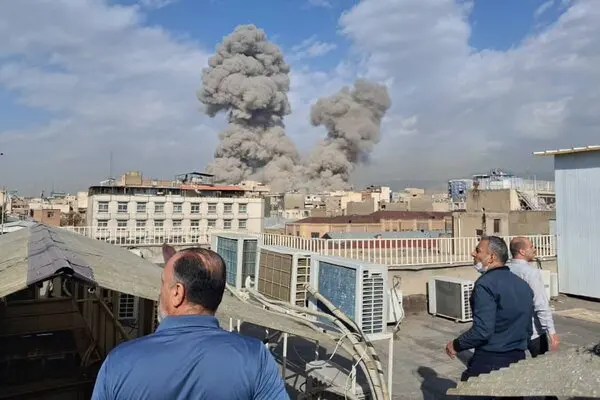
US-Israel has carried out joint strikes on Iran in multi-phased operations codenamed Rising Lion, Shield Judy, and the US’s Operation Epic Fury. The objectives were, as usual, to address the nuclear threat and degrade Iran’s strategic and nuclear capabilities. Amid talks that were gradually progressing, there was a sudden, steep drift for all obvious reasons just before the strikes. First, an IAEA report raised concerns about Iran’s nuclear enrichment in Isfahan. Second, Iran’s nuclear talks were progressing but not on US terms, as US President Trump signalled the day before the strike. While these two developments prompted immediate, pre-emptive action, it was more than swift action; it was also a credible preventive deterrence to signal Iran about the consequences and the seriousness of the talks and demands.
However, more than the Joint US-Israel strike, the Iranian response is worth observing, which perhaps crossed the red lines by striking around 8 targets in the Middle East, especially the US’s naval and strategic positions. While US-Israel joint air strikes appeared to be a routine escalatory deterrence, this time, perhaps the escalation-deterrence games may be riskier.
Last year, the US carried out direct strikes on Iran’s nuclear sites, signalling a shift in the US’s deterrence strategy from general deterrence to credible offensive deterrence against Iran, a more direct approach than the former’s indirect one. Similarly, Iran appears to be signalling a shift in its deterrence strategy, which is perhaps more surprising but also riskier. In changing the deterrence calculus at both ends, how much success does the US-Israel gamble on, or does Iran’s deterrence hold for their respective strategic interests?
US’s Gamble and Strategy in the Middle East
Operation Midnight Hammer, under which the US carried out airstrikes in Iran, marked a significant shift in its presence in the Gulf, as it was the first time the US had directly targeted Iran since 1988. The US made its strategic priorities clear, stating that any nuclear development activities would prompt an overwhelming response at escalating costs, shifting from indirect deterrence to a more direct, credible, and offensive deterrence strategy aimed at imposing greater compulsion than a simple caution. The US’s risk in the Middle East was the tactical success of imposing strong, direct deterrence on Iran.
The US’s security assurances and strategy in the Middle East have been under heavy scrutiny since the region nearly spiralled into conflict, especially during the Israel-Iran war and after the October 2023 attacks.
The most recent example was Israel’s strikes on Qatar, which again led to renewed tensions and severe criticism of the US’s strategic and security influence or assurances in the Middle East.
Primarily, the US has two strategies in the Middle East: containment and deterrence. The first focuses on preventive action against strategic or long-term threats or interests, and the second is immediate, punitive action to deliver swift deterrence and punishment, thereby jeopardising regional stability while imposing tactical deterrence against Iran.
The US’s strategy carried risks, but it did yield tactical success, if not strategic. The only risk in the US’s containment and deterrence strategy was triggering Iran’s retaliatory response, which does not follow a tit-for-tat pattern but instead triggers horizontal escalation that risks regional stability. In other words, Iran escalates to de-escalate and strikes US allies to send a strong deterrent signal to the US.
The classic example came in 2019, when tensions with the US were rising. Iran did not sink a U.S. carrier; instead, it struck the Saudi Aramco facilities at Abqaiq, temporarily knocking out 5% of the global oil supply and halting 5.7 million barrels of crude oil production per day, which represented over half of Saudi Arabia’s daily output. The attack was a signal from Iran against the US’s maximum pressure campaign. The message was clear that any attempt to contain or deter Iran would carry high costs not only for the US but also for the whole region. However, when the US shifted to more direct, credible offensive deterrence in Operation Midnight Hammer, Iran resorted to its traditional strategy—indirect and asymmetric, threatening regional stability. In recent times, even this seems to be losing its effectiveness, as any attempt to impose caution on the US through indirect deterrence has led the US and Israel to escalate their response and directly strike Iran and its regional interests.
Iran’s Possible Shift In Strategy
As the value of Iran’s indirect deterrence against US-Israel actions targeting Iran’s strategic and tactical interests began to decline, Iran seems to have placed greater emphasis on its preventive deterrence. The recent, perhaps first-time, partial closure of the Strait of Hormuz, which controls 20 per cent of global oil trade, under the banner of an Iranian security exercise, should not be dismissed as normal or routine. There was a broader message behind this partial closure, signalling that Iranians are preparing to shift their deterrence tactics as the US mounts pressure for nuclear talks and an agreement. Three distinctive departures from traditional deterrence underscore the shift.
First is Iran’s more direct deterrence, where US interests are directly threatened. Second is credible and offensive escalation, meaning Iran can take risks for more dramatic escalations, not limited ones. Third: the US’s misadventures are now met not with a message but with direct and heavy costs. The partial closure of the Strait of Hormuz, against the backdrop of talks and Trump tightening its grip with warnings of strikes if a deal is not reached, showed that Iran’s strategic will to endure and counterstrike is increasing in response to the US’s arm-twisting. This appears glaringly visible after the US-Israel joint action.
The reason for this gradual shift is, first, Iran’s weakening counter-response to US-Israel direct actions. Second: Iran’s strategic interests are under pressure in the backdrop of the US’s doctrine, which has made its both kinetic and non-kinetic responses more swift and risky. Third: Iran’s internal crises and losing confidence and credibility crises- The recent Iranian protests.
Iran’s decision weeks ago to carry out multiple air strikes in the region targeting the US’s strategic presence and to partially close one of its vital strategic chokepoints must not only be read as a show of force but also as a demonstration of preventive deterrence, more offensive and credible. The last time Iran used the Strait of Hormuz as strategic leverage was during the Tanker War in 1980, when Iran launched swarming drone attacks, seized oil tankers, and disrupted the oil trading route from this strategically vital point for global oil trade.
Although the US is not entirely dependent on this route, any risks to it would harm the US economy. Analysts at Goldman Sachs and Kpler estimate that a full closure of the Strait could send oil prices soaring to between $110 and $150 per barrel, which would significantly shock the U.S. economy despite the US being the world’s largest producer.
There are risks for Iran, too. Many analysts often describe any closure of this strait as economic suicide for Iran. However, over decades, and even during the recent partial closure, Iran has, to some extent, developed the capability for smart handling of the strait through the Jask terminal, where “smart” controls imply a capacity for selective, rather than total, closure, allowing Iran to permit specific, allied traffic, including its own, while blocking others. Even if a partial closure can lead to a massive tax on the US economy, it would likely cause a spike in gasoline prices, crash the stock market, and inflict severe economic pain on the US.
Even for shale producers, it won’t be easy to offset losses quickly due to time constraints and mismatches in refining capacity. Iran has learned its lessons from the Tanker War, where disruption alone would not cause significant damage to the US energy market. Still, credible and preventive actions that involve high costs, rather than reactive and indirect deterrence, would be preferred. Iran knows the risks of facing US-Israel massive retaliation in the scenario of a closure, even a partial one, of extended duration. Still, at least Iran would be able to project and, to some extent, match the deterrence that the US and Israel have always imposed on it, along with its power projection of credible offensive deterrence through non-kinetic and kinetic means.
US Gambling With Iran
The US escalated its offensive deterrence last year by launching direct air strikes, via bombers, on Iran’s key nuclear site. In the past few months, a massive military and naval build-up has been underway around Iran. An alleged regime-change plan involving massive protests, along with a warning from the US president of possible intervention if Iran didn’t stop killing protesters. Iran has been under strong strategic and tactical pressure from the US for the past few months, and a fresh one is emerging amid nuclear and missile negotiations, with a possible air strike threat looming if a deal is not reached.
At least some reports suggest that the US is planning to strike Iran within a week, but the larger question is how long the US can gamble with force and still succeed in imposing a strong caution on Iran. Last year’s actions by the US-Israel reflected that room for caution is gradually shrinking and that compulsion is now the new way of dealing with Iran. The US’s increasingly assertive stance under the renewed Monroe Doctrine suggests so.
Operation Midnight Hammer’s strategic success remains debated, and Iran responded by rapidly increasing its ballistic missile stockpile and range, with some reports suggesting 300 missiles per month. The deterrent value of the US against Iran is now under critical question, especially as Iran is gradually shifting its deterrent tactics, perhaps with a partial closure of the Strait of Hormuz as the first glimpse, along with missile stockpiling. As Iran escalates its escalation risks and shifts towards direct deterrence, it remains unclear how much impact US-Israel strikes against Iran would have this time and how much risk the US is willing to take further, given that in the recent past and even now, it appears that Iran is not only recalibrating its non-kinetic strategies but also its kinetic strategies, especially the deterrent one.