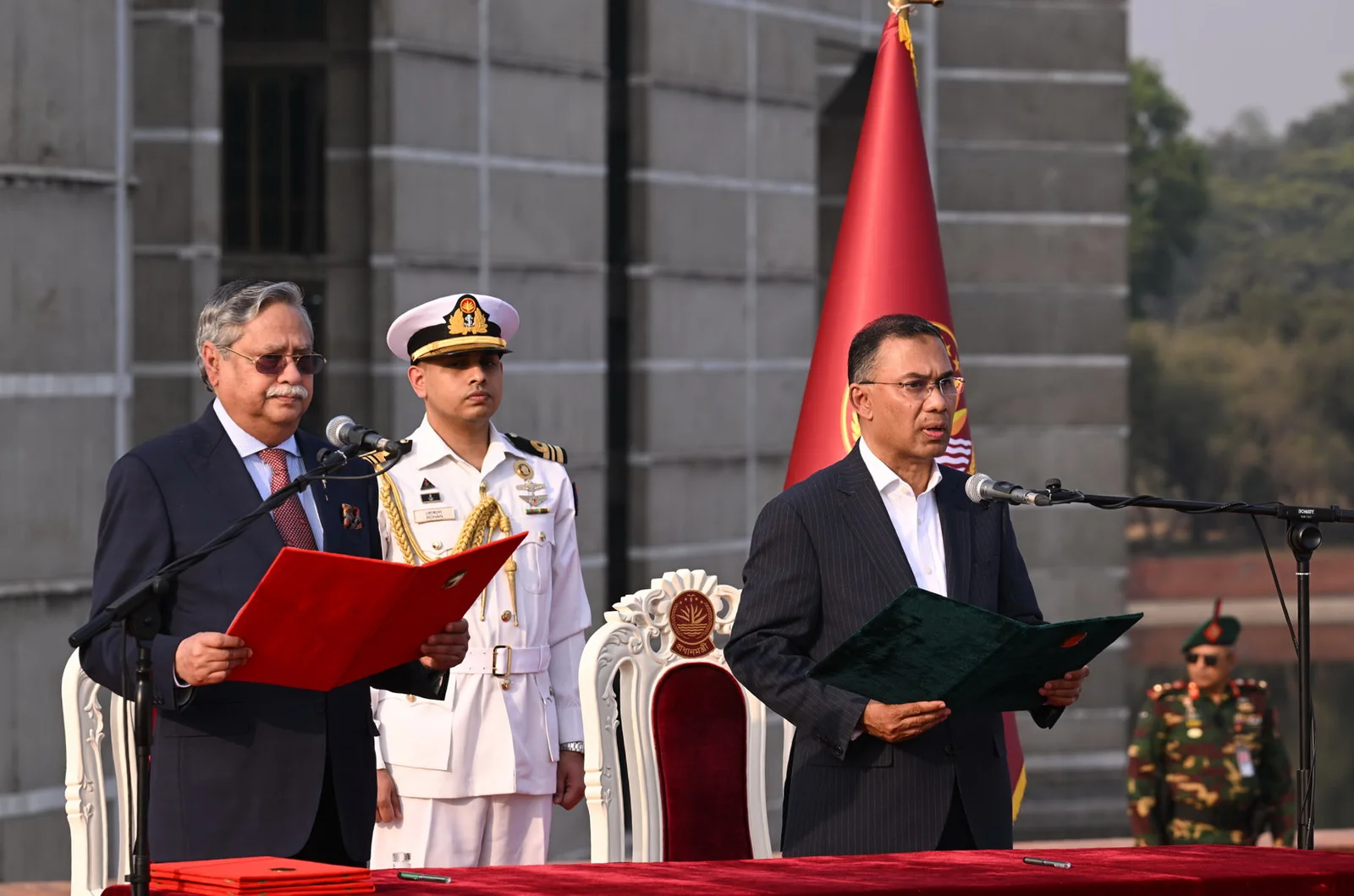
As Tarique Rahman was taking the oath as Bangladesh’s eleventh prime minister on a pleasant spring evening of 17th February, he was setting the dawn of a new era. The landslide victory of the Bangladesh Nationalist Party (BNP) in the significant election last month underlined the trust of the people in experience over experiment, but also the public sagacity against unhinged diatribes in the name of nationalism, even under socio-political duress. When the Jamaat-e-Islami put out all stops to inveigle the public with its wiles, the voters astutely chose the experienced BNP to power. The disappointing result for the debutant National Citizen Party with 6 seats, conceited with its role in ousting former premier Sheikh Hasina in the 2024 uprising, also underlined the challenge to turn street momentum into votes.
The defeat of Jamaat indeed relieved many who do not wish to see Bangladesh governed by Islamist radicals like Taslima Nasreen, who feared Jamaat, if elected to power, would push the country to theocracy. The public mood was also abhorrent to Jamaat’s growing power, given experiences of harassment over keeping long hair or shows of Baul singers being cancelled. However, one should not be content that Jamaat has fared poorly in this election. On the contrary, the party that never won more than 18 seats has galloped to 63 seats this time. Most importantly, it will be the main opposition in the absence of the Awami League. In that sense, the Islamist party has gained more than it has lost in this election, which was more like a warm-up event for it, hoping for now and preparing to skip to the final jump.
The fact that BNP severed ties with the Jamaat and opposed its radical rhetoric during this election campaign helped it consolidate its position among a larger section of voters. A nationwide pre-election survey had also hinted at voters’ inclination for the BNP, enjoying overwhelming support among older voters, with nearly 47% of Gen X and Boomers II respondents favouring the party, besides 42% rural and 40% urban voters’ support. This was an expected outcome since BNP is an experienced party as administrator, and its added advantage was the sympathy vote following the demise of its former leader and ex-premier Begum Khaleda Zia last December. The victory speech of BNP Chairman Tarique Rahman, emphasizing national unity for nation building, also reflected its sense of responsibility amidst the tense transition period Bangladesh is passing through.
BNP’s victory also relieved India since New Delhi has experience, however negative, working with it as the government. As is said, a known ‘enemy’ is better than an unknown ‘friend’, and India, practically, does not have any friends in the current Bangladesh politics. Besides, BNP is not aligned with Jamaat anymore and has an obligation to retain the support of the liberal-minded voters who chose the party over Jamaat. Prime Minister Tarqiue’s emphasis on national unity irrespective of communal identity corresponds with a secular Bangladesh vision, which was its foundational ideology. Nevertheless, time will prove the level of BNP’s integrity to such a resolution, but for now, India has reason to be sanguine.
Yet, this is a ‘new’ Bangladesh India will have to deal with. This election was conducted amidst strong anti-India emotions prevalent, especially among the youth. ‘Dhaka, not Delhi’ splashed on the walls and stitched into saaris denouncing the alleged ‘hegemony’ of India over Bangladesh during the previous Hasina era. Toeing with this fervour, the BNP election banners when read ‘shobar aage Bangladesh’ (Bangladesh First), the newly elected prime minister also underlined this slogan as his foreign policy motto. However, such anti-India sentiments seem strategically maneuvered for immediate electoral gains since public opinion on India still remains admiring. As BNP emphasizes protecting the interests of Bangladesh in its foreign policy approach, it need not necessarily have to be confrontational, however. The new prime minister’s key responsibility is to clear the debris of the transitional phase and to heal the wound inflicted. His priority to tackle the economy requires non-confrontational relations with India. Bangladesh’s geographic location compels it to enhance relations with India for its economic survival. In FY2024-25, Bangladesh’s exports to India went up by 12.1%, reaching $1.76 billion, amidst a strong anti-India ambience. Also, the medical tourism to India is important for the patients in Bangladesh, which is reviving slowly. Nevertheless, Prime Minister Rahman will have to do ‘justice’ with the emotions of his electors for autonomy in handling foreign relations and thus walks on a tightrope balancing between domestic and foreign policy compulsions. His ‘Bangladesh First’ policy approach reflects this balancing tactic, which satisfies the priority preference of the voters without turning the policy confrontational abroad.
India needs to handle this situation, accepting the reality that ‘new’ Bangladesh might be assertive in its approach. Also, the rise of Jamaat as the main opposition adds to India’s concern, which will be vigilant of BNP’s India policy. However, India has already started recalibrating its policy vis-à-vis the opposition party by reaching out to the Jamaat. What India now needs is not a friendly but neutral government in Dhaka. However, the immediate thaw in the relationship is the Hasina factor as BNP plans to formally request India for the ex-premier’s extradition. The new prime minister will be under pressure on this issue as it will remain a lethal weapon in the opposition’s quiver. However, BNP’s assurance, prioritizing commercial ties over the extradition issue in bilateral relations, reflects practicality. Nevertheless, BNP as the government will be compelled to erase the general perception in Bangladesh over India getting favourable political, security and business deals (as allegedly happened in Hasina era) and thus challenges will be for both while renewing the Ganga Water Share Treaty (set to lapse this year) and addressing alleged border killings by BSF. India, conversely, will expect Dhaka’s help to curb anti-India activities, especially following Jamaat’s victory in the border districts. Besides, when the nature of Dhaka’s recalibration of Pakistan policy decides India’s Bangladesh policy following Tarique Rahman’s plan for SAARC’s revival, the future Dhaka-Beijing relations will also decide the fate of BIMSTEC. The inauguration of the Tarique Rahman government, which unveiled a new era for post-Hasina Bangladesh, also dawned a new age on India-Bangladesh relations with echoes rumbling across South Asia.