AI vs AI (Artificial Intelligence vs Author Intelligence)
In this section, every trending story goes through two lenses: first, Grok—the AI—summarizes the news that’s shaping the headlines. Then, an expert contributor weighs in with analysis, context, and clarity to help readers separate signal from noise.
Grok AI Summary
The Trump-Xi summit at the 2025 APEC in Busan signals a US-China détente, with a temporary trade truce reducing US tariffs on China to ~30% from 57%, easing rare earth export curbs, and boosting soybean purchases. Trump’s “G-2” framing heightens India’s anxieties, potentially diluting US commitments to the Quad and Indo-Pacific balance against Beijing. Facing steeper 50% US tariffs, India’s exports may suffer amid rising China dependency ($100B+ trade). Delhi must accelerate a US trade deal, diversify supply chains, and deepen Europe-Asia ties for strategic autonomy.
Expert Commentary by Sanjay Kumar Verma
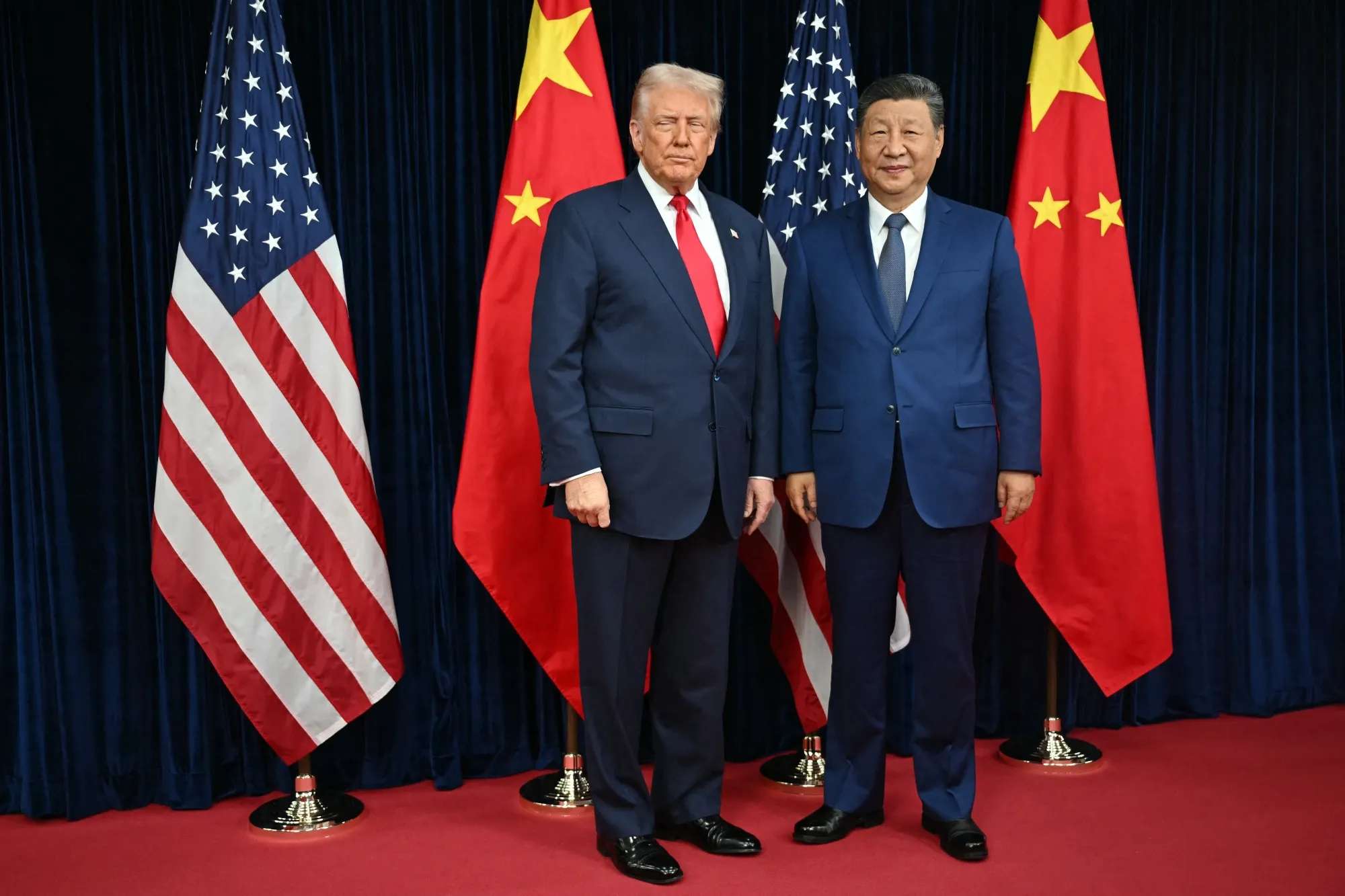
Amid the flashing cameras and anxious analysts, Donald Trump and Xi Jinping have concluded their closely watched meeting on the sidelines of the APEC Summit in Busan. It may appear just another high-level handshake in a world crowded with summits, yet beneath the choreography lies the possibility of reshaping Asia’s balance of power.
For India, the Trump–Xi encounter is not a diplomatic sideshow between two geopolitical giants with technological and military muscles. It is a moment that could determine how New Delhi’s equations with both Washington and Beijing evolve in the coming years. What transpired in Busan will ripple through India’s trade strategy, its security calculus, and its sense of strategic autonomy.
The Busan Outcomes: Between Truce and Transition
The Busan encounter produced what both sides have described as a “framework understanding”—not a formal agreement, but a structured truce designed to stabilise a volatile phase in U.S.–China relations. The framework, confirmed by U.S. Treasury Secretary Scott Bessent, outlines provisional steps toward cooperation on select economic and law-enforcement issues.
China is expected to resume limited purchases of American agricultural products, including soybeans, while Washington has agreed to defer the imposition of additional tariffs that had been under consideration. Discussions also covered export controls on rare earths and collaboration to curb the trafficking of fentanyl precursors—a priority for the U.S. administration.
The Busan understanding falls short of a trade pact, yet it represents the first structured dialogue between the two governments since tensions escalated earlier in the decade. While neither side offered public comment on security issues such as the South China Sea or Taiwan, diplomatic sources indicate that both leaders underscored the importance of managing competition responsibly and maintaining communication channels.
For India, this limited thaw suggests that U.S.–China rivalry may enter a phase of controlled friction rather than outright confrontation. Such an evolution, though tentative, carries implications for New Delhi’s strategic and economic space across the Indo-Pacific.
A Reset in the U.S.–China Equation?
For years, the United States and China have been locked in an economic and ideological contest. The trade wars, technology sanctions, and strategic posturing of the past decade created an assumption that rivalry between the two was structural and enduring. Yet shifting domestic priorities on both sides have now opened a small window for recalibration.
The current U.S. administration faces a politically divided domestic environment and economic pressures that demand stability in global markets. China, meanwhile, is coping with slowing growth, youth unemployment, and debt. Both leaders need breathing space, and both have the political incentive to seek one.
If the Busan meeting yields even a modest easing of tensions, it could alter global alignments. A managed rivalry between Washington and Beijing would undermine the premise that has underpinned India’s external strategy since 2017—that the world is moving toward hard bipolarity, and that India’s opportunity lies in being the credible alternative to China.
The Economic Dimension: India’s Tightrope
Trade Winds and Manufacturing Ambitions
India’s recent economic narrative has leaned heavily on supply-chain diversification. As global firms grew wary of over-dependence on China, India offered itself as an alternative manufacturing destination—backed by Production Linked Incentive schemes, industrial corridors, and pragmatic trade diplomacy.
Should Washington and Beijing find a temporary truce, this narrative could lose some momentum. A more stable relationship between the two might reduce the urgency for global manufacturers to relocate capacity from China. The expected wave of relocation that India has counted on could then decelerate, compelling New Delhi to rely less on geopolitical tailwinds and more on deep structural reforms to create domestic efficiency, reliable logistics, and competitive value chains.
Tariffs, Trade Balances, and Technology
Washington has shown a willingness to use economic leverage even with friendly partners. During the previous administration, India’s preferential trade access under the Generalised System of Preferences (GSP) was withdrawn in 2019, affecting about US$5.6 billion in exports, and reciprocal tariff measures followed on both sides, adding a layer of friction to an otherwise expanding trade relationship.
If the new engagement between the U.S. and China tempers the tone of confrontation, technology controls could soften, enabling partial collaboration in sensitive sectors such as semiconductors and artificial intelligence. For India, this presents both opportunity and competition. Its digital economy has grown impressively, yet it remains dependent on access to both American and East Asian technologies. India must thus accelerate domestic R&D, foster trusted-technology partnerships with Japan and Europe, and build digital resilience rooted in its own innovation capacity.
Energy and Resource Politics
Energy remains India’s Achilles’ heel. Over 80 per cent of its crude oil and much of its coal and natural gas are imported. Washington’s discomfort with India’s ongoing energy trade with Russia continues to simmer quietly, while Beijing secures long-term contracts across Africa and the Middle East.
If the U.S. and China move toward greater accommodation, shifts in global energy prices and supply routes could directly affect India’s planning. The imperative for New Delhi is clear: expand strategic reserves, diversify procurement, strengthen renewable investments, and deepen cooperation with Gulf partners and Australia. Energy security is now central to India’s foreign policy calculus—not merely an economic goal but a strategic necessity.
The Strategic Dimension: Between Washington and Beijing
U.S.–India Compact
India’s strategic partnership with the United States remains one of the defining features of the post-Cold War order. It has delivered unprecedented access to defence technology, intelligence cooperation, and maritime coordination. Yet every partnership rests on shifting priorities.
If Washington and Beijing find a measure of understanding, India’s perceived value as a counterbalance could appear reduced. The U.S. may then pivot toward more transactional cooperation—issue-specific collaboration rather than deep strategic alignment. India must anticipate this evolution and ensure it is not treated as a bargaining chip in America’s broader global repositioning.
India’s task is to continue engaging the U.S. as a partner of convergence, not dependence—retaining both strategic intimacy and strategic distance.
The Chinese Checkers
For Beijing, the Busan engagement was a calculated tactical move. With growth slowing, private confidence ebbing, and external criticism mounting, Xi Jinping sought to stabilise China’s external environment long enough to address domestic fragilities. The meeting allowed him to project composure abroad while buying time at home. Having secured a measure of respite with Washington, Beijing may now test the limits of this new equilibrium—whether through calibrated pressure on its neighbours or renewed diplomatic activism across Asia.
Alternatively, should the détente prove fragile, China could seek limited rapprochement with India to prevent isolation. Beijing has long alternated between confrontation and conciliation as tools of statecraft. India must therefore maintain clarity of purpose—engaging China where interests align, but remaining vigilant where sovereignty and security are concerned.
The Regional Theatre
Across Asia, the outcome of the Trump–Xi encounter is already shaping regional calculations. ASEAN nations are hedging cautiously, Japan is watching Washington’s reliability, and Russia is seeking new openings to remain relevant. India must ensure it is not a spectator in this evolving regional architecture but an active participant shaping the rules of the game—whether through the Quad, the Indo-Pacific Economic Framework, or broader maritime coalitions.
America’s Transactionalism and China’s Patience
Beyond economics and strategy lies temperament. Washington’s foreign policy is marked by short cycles of assertiveness and retrenchment; Beijing’s by long arcs of persistence and control. India must navigate both.
Where the U.S. acts with agility and unpredictability, China moves with methodical patience. One uses tariffs and regulations as tools of pressure; the other wields markets and investments as instruments of persuasion. For New Delhi, the lesson is to remain steady—polite without being pliant, cooperative without being credulous. Nations pursue interests, not affections, and India must always anchor itself in that realism.
The Banyan Tree in the Storm
As the cameras fade from Busan, India looks on with composure, not anxiety. The Trump–Xi meeting neither erased rivalry nor secured peace; it was a brief pause in a contest that will shape this century.
India’s task is to stay steady — pragmatic, self-assured, and rooted. Like the banyan tree that bends but does not break, it must draw from its own roots while reaching outward to the world.
Whether Washington and Beijing lean toward confrontation or conciliation, India’s rhythm must remain its own — traditional in wisdom, modern in method, and confident in purpose. For a rising India, discernment is not detachment. It is a strategy, refined by patience.