
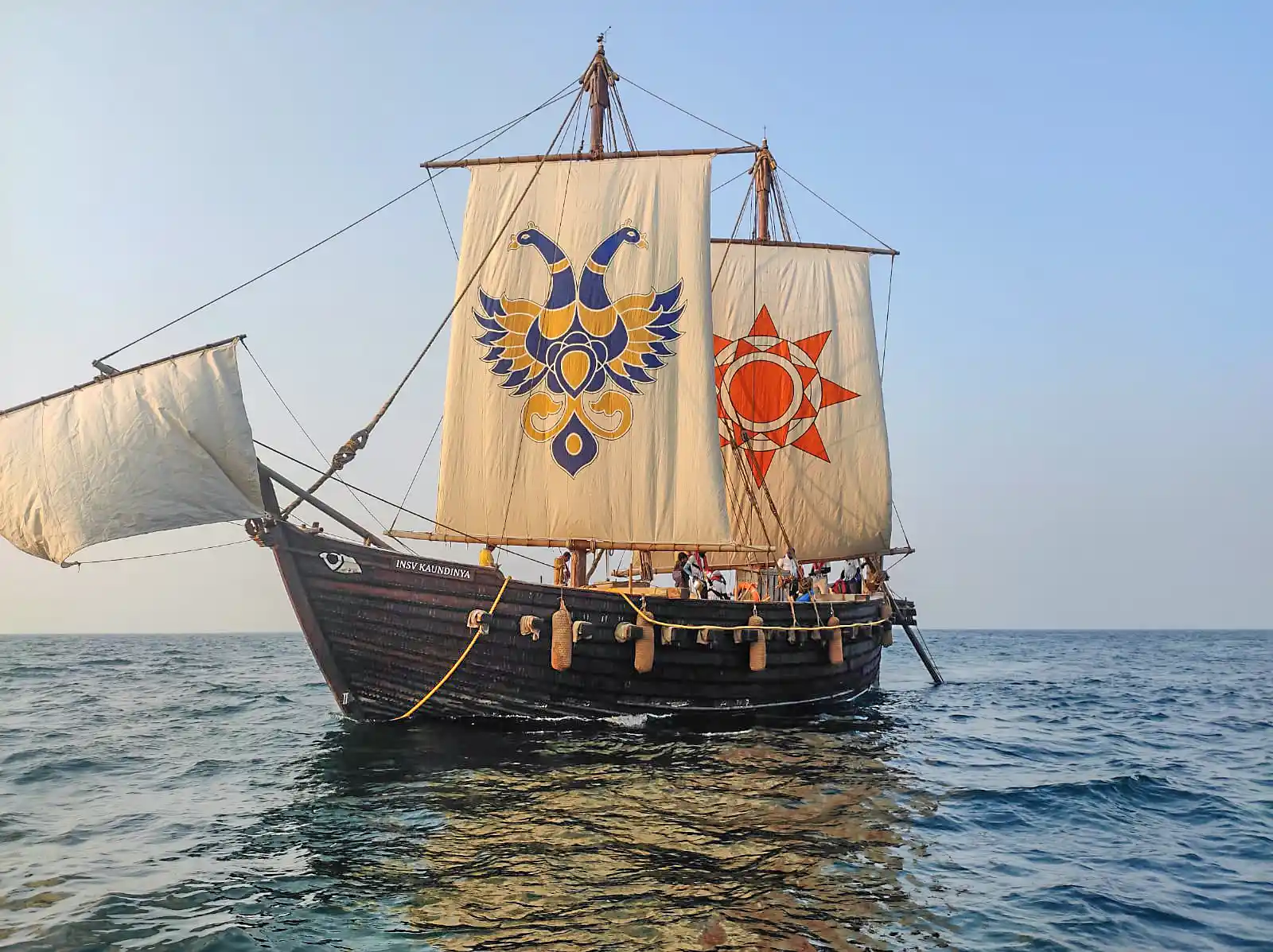
INSV Kaundinya’s stitched wooden hull is more than a nostalgia project; it is a floating argument that India’s maritime story did not begin with Vasco da Gama and does not end with the Royal Navy. By retracing pre‑colonial trade routes to Oman in an engineless sailing vessel built with indigenous craft traditions, India is making a pointed claim: the seas of the Indian Ocean are once again a civilisational space, not a colonial frontier.
INSV Kaundinya is India’s first naval sailing vessel built using a stitched‑plank technique, where wooden hull planks are literally sewn together with coir and sealed with natural resins, reviving methods used on the western coast for centuries before European shipyards arrived. The ship was conceived through a tripartite project between the Ministry of Culture, the Indian Navy and a Goa‑based yard, with artisans from Kerala leading construction, and commissioned into the Navy at Karwar in May 2025. Now on its maiden overseas voyage from Porbandar to Oman as an engineless, wind‑powered vessel, it symbolically follows an ancient corridor that once connected Gujarat’s ports to Arabia and East Africa.
This is happening against a wider backdrop of India trying to escape the inherited mental map of “continental India plus a colonial Indian Ocean,” a frame that reduced the seas to security chokepoints under Western stewardship. New Delhi’s vocabulary has shifted—“Indo‑Pacific,” “SAGAR,” “civilisational connectivities”—but Kaundinya turns that vocabulary into wood, rope and sail, visually asserting that the ocean was India’s highway long before it became someone else’s shipping lane.
Maritime decolonisation as narrative warfare
Maritime decolonisation is not about expelling frigates from foreign navies; it is about dislodging colonial narratives from charts, archives and imaginations. For two centuries, the British imperial story cast Indians as passengers or coolies on European ships, erasing earlier epochs when Indian merchants, monks and mariners tied together East Africa, Arabia and Southeast Asia on their own terms.
K. M. Panikkar, writing in the mid‑20th century, warned that India’s loss of “sea frontiers” in the Vasco da Gama epoch had turned the ocean into a geography of threat, making colonial domination from the sea qualitatively different from landward invasions. His remedy was not nostalgia but a return to a maritime consciousness in which India again thinks of itself as a seafaring civilisation, not a landlocked empire glancing nervously at the coast. Kaundinya’s voyage, framed explicitly by officials and commentators as reclaiming “centuries‑old maritime legacy” and challenging Eurocentric accounts, is a direct descendant of that intellectual project.
By sailing an Indian‑designed, Indian‑built stitched ship crewed by Indian officers along historic routes, the Navy is quietly undermining the notion that sophisticated seamanship in the Indian Ocean was a European import. The expedition doubles as public pedagogy: every photograph of the ship under sail is an invitation to revisit schoolbook history that jumps from Harappan seals to the East India Company, skipping a millennium of Indian ocean‑faring states.
Civilisational legacy: from Kalinga to Karwar
The civilisational layer of the Kaundinya story runs deeper than the design of its hull. The vessel is named after Kaundinya, a Brahmin sailor‑warrior associated in Southeast Asian traditions with Kalinga’s maritime ventures and the founding of early Indianised polities like Funan, a reminder that Indian religious, linguistic and legal ideas once radiated across the Bay of Bengal not through conquest fleets but through merchant‑monk networks.
Pre‑modern India’s seaborne footprint—from Buddhist trade routes to Chola naval expeditions—created archipelagos of shared culture without annexation, a pattern some contemporary Indian strategists describe as a “non‑coercive” maritime continuum. Modern Indian diplomacy increasingly references these linkages when speaking to Southeast Asia, the Gulf and East Africa, framing today’s partnerships as a resumption of older rhythms rather than a fresh rivalry with China in a sterile “Indo‑Pacific” geometry.
Kaundinya’s Oman voyage fits this template of cultural statecraft. Muscat was once a familiar stop for Gujarati and Malabari sailors, and the present expedition has been cast as cultural diplomacy that foregrounds shared trading histories and diasporic links rather than merely a flag‑showing exercise. A stitched sailer at an Omani port does something a frigate cannot: it invites conversation about memory, not just deterrence.
Atmanirbharta at sea: technology and tradition
There is also a hard‑power subtext. Over the last decade, the Indian Navy has become the most aggressive of the three services in pushing Atmanirbhar Bharat, with over 60 indigenous ships and submarines under construction and high‑end programmes like Project 15B destroyers and Kalvari‑class submarines forming the backbone of its fleet. Platforms like Kaundinya sit at the intersection of this industrial push and a civilisational story, using indigenous materials, design and craftsmanship while serving as a training and seamanship platform.
The Swavlamban innovation seminars—whose 2025 edition emphasised “strength and power through innovation and indigenisation”—have become the Navy’s flagship forum for plugging start‑ups and MSMEs into its technology ecosystem. In this sense, an ancient‑looking stitched vessel shares the stage, conceptually, with AI‑enabled combat systems and autonomous underwater vehicles: all are presented as expressions of a sovereign technological will that refuses dependency on foreign design templates.
Critically, Kaundinya is engineless by design, relying only on wind power, which Navy officials and media have framed as both a return to traditional seamanship and a nod to sustainable navigation. For a service that otherwise bet its future on gas turbines, nuclear propulsion and networked sensors, devoting resources to an archaic technology only makes sense if its symbolic value—training a new generation of officers to respect the ocean as a living medium and not just a grid on a radar screen—is judged strategically useful.
The risks of romanticism
Yet there are risks if this maritime decolonisation story collapses into curated nostalgia. The stitched‑ship project has already faced practical challenges, including weather delays and early technical hiccups during its voyage, underscoring that translating archaeological reconstruction into operational sailing is not a simple heritage exercise. These are reminders that the past is not easily reverse‑engineered; selecting which fragments to resurrect inevitably reflects present political choices.
There is also a geopolitical minefield. The more loudly India speaks of civilisational spheres in the Indian Ocean, the more neighbours will watch for any slide from benign cultural leadership into exceptionalism, especially in regions where Indian communities arrived as indentured labour under British rule rather than as autonomous traders. Maritime decolonisation cannot be a unidirectional story of Indian resurgence; it must leave room for other littoral narratives, including African, Arab and Southeast Asian experiences of the same waters.
Finally, the narrative must connect to material redistribution of power at sea. If maritime decolonisation simply coexists with continued reliance on Western insurance markets, chokepoint policing and technology dependence, it risks being reduced to heritage tourism with tricolour sails. Only if the stitched planks of Kaundinya are seen as metaphorical for stitched‑together indigenous value chains—from yards and electronics to training and doctrine—will India’s claim to be reclaiming its oceanic past carry real strategic weight.
In the end, INSV Kaundinya is a test: not of seaworthiness alone, but of whether India can speak of itself as a maritime civilisation without mimicking the hierarchies of the empires it seeks to leave behind.

