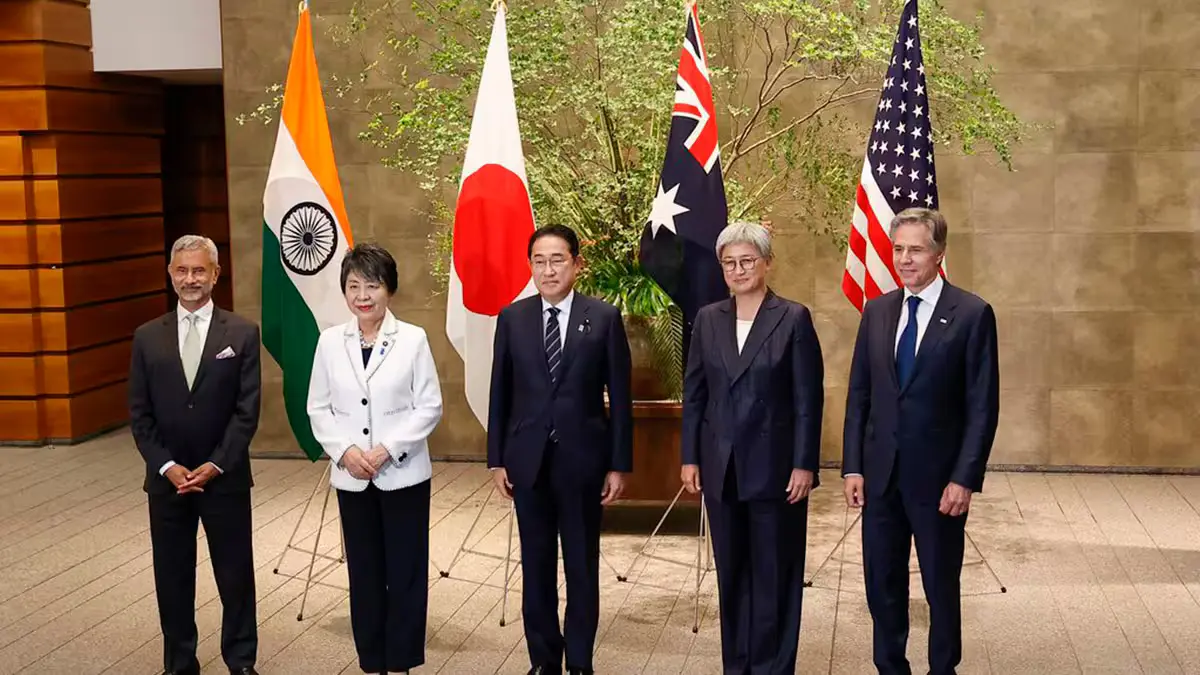
Two developments this week have offered a revealing window into the strategic shifts taking place across the Indo-Pacific. In Washington, a bipartisan resolution titled ‘Recognizing the Strategic Value of the Historical Partnership Between The United States and India’ was introduced in the United States House of Representatives by Ami Bera and Joe Wilson, reaffirming the depth and long-term importance of the India–US partnership. At the same time, Australian Foreign Minister Penny Wong arrived in New Delhi to co-chair the Foreign Ministers’ Framework Dialogue, an institution that has become central to the rapidly expanding India–Australia relationship. Looked at separately, each event carries its own weight. Seen together, they signal how major powers in the Indo-Pacific are aligning around a shared vision of a free, open, inclusive, secure, and resilient region, with India placed increasingly at its core.
The bipartisan resolution in Washington is notable. Even in a sharply divided American political climate, one of the few areas of continuity has been the US approach towards India. This bipartisan instinct rests on decades of cooperation in defence, high technology, education, counterterrorism, and people-to-people ties. The resolution underscores that India is not only a valued partner but a strategic necessity for Indo-Pacific stability and the broader rules-based order.
In the American system, congressional signalling has practical implications. Congress shapes resource flows, influences export licensing decisions, and affects the tempo of sensitive co-development and defence initiatives. When the legislative and executive branches speak in harmony about India’s strategic role, friction reduces in precisely the domains where major joint initiatives can otherwise slow down. This matters immensely in areas such as defence industrial cooperation, emerging technologies, space, critical minerals, and supply chain resilience. All of these require steady political support and sustained bureaucratic focus.
Australia’s engagement offers a complementary picture from the other side of the Indo-Pacific. The India–Australia relationship has undergone a fundamental transformation over the past decade. What was once a cordial but understated partnership has become an ambitious and wide-ranging Comprehensive Strategic Partnership. Today, both countries cooperate in defence, maritime security, cyber, strategic technologies, trade, education, minerals, and energy. The Foreign Ministers’ Framework Dialogue has become the mechanism that ensures that this expanding agenda remains coherent and on course. It provides both sides with a structured, predictable format for reviewing progress, aligning priorities, and translating political intent into operational reality.
Its value lies in its ability to turn shared assessments into concrete cooperation. Maritime domain awareness has already become one of the strongest areas of coordination, with efforts underway to expand information sharing and joint monitoring. Naval exercises are becoming more regular and more sophisticated. Innovation ecosystems are being encouraged to connect universities, research institutions, and start-ups. Supply chain resilience, especially in critical minerals and clean energy technologies, offers immense potential. In a region that bridges the Indian and Pacific Oceans, the India–Australia track serves as a connective tissue, supported by a growing culture of practical cooperation.
India’s broader maritime philosophy provides context to these developments. Through SAGAR, India positions the oceans as a source of shared security and prosperity. MAHASAGAR expands on this view by acknowledging that maritime challenges span regions. The Indo-Pacific Oceans Initiative turns these ideas into an organised framework for action across seven pillars, including maritime security, ecology, commerce, capacity building, and technology. These are not abstract principles. They guide India’s operational commitments.
These commitments are visible across the region. India works with partners to ensure secure and open sea lanes. Coastal radar networks are being expanded, and information fusion centres are being strengthened. Training programmes for sailors, surveyors, coastal police, and disaster response teams continue to grow. India has enhanced its capacity for search and rescue, evacuation, and humanitarian assistance through pre-positioned supplies and rapid-deployment teams. Hydrographic surveys, meteorological cooperation, and early warning systems have helped several island nations improve maritime planning. A strong focus on sustainable fisheries, coral protection, and mangrove restoration reflects the understanding that the health of the oceans shapes livelihoods and food security for millions.
Yet the Indo-Pacific remains a region marked by significant contestation. The most visible challenge is the strategic rivalry among major powers. Tensions in the South China Sea and the Taiwan Strait, and periodic crises in West Asia, can affect sea-lane stability and energy flows. India will need to manage these risks while protecting its strategic autonomy. Upholding freedom of navigation, respect for sovereignty, and peaceful resolution of disputes will continue to anchor India’s approach.
The second challenge lies in weaponising interdependence. The pandemic exposed serious vulnerabilities in global supply chains. Recent export controls, technology restrictions, and economic coercion have further highlighted these fragilities. India requires reliable access to critical minerals, semiconductor machinery, trusted telecommunications networks, and diversified transport corridors. Building buffers in essential trade flows and financial systems is now a strategic necessity.
Climate stress is another major challenge. Rising temperatures are damaging coral systems and altering fish stocks. Cyclones are becoming more intense. Sea level rise poses existential threats to several island nations. The ocean economy, which holds enormous promise for future growth, is under strain. India is working to incorporate climate resilience into its Indo-Pacific engagements, ranging from resilient ports and greener cargo systems to early warning coverage and climate risk insurance.
Governance gaps also persist across the region. Many institutions in the Indian Ocean Rim countries lack adequate resources, trained personnel, and technical capacity. Emerging domains such as subsea cables, autonomous shipping, and maritime cybersecurity lack explicit norms. India can help address these gaps by seconding experts, funding pilots, providing training, and convening coalitions to develop practical standards.
India is not without its own constraints. Naval and coast guard fleets need expansion. Shipbuilding, repairs, and maintenance infrastructure require more investment. Maritime domain awareness systems must become more integrated. Training for maritime personnel must scale up significantly. Procedural delays often continue to slow progress even when the policy direction is clear. This makes prioritisation important. Focusing on high-impact projects, sharing technology and costs where feasible, and ensuring time-bound reviews at senior levels can help deliver better outcomes.
The Indo-Pacific in the coming decade is likely to remain multipolar. Countries will increasingly rely on flexible, issue-based coalitions rather than rigid blocs. Public goods such as maritime security, disaster relief, health preparedness, and connectivity will shape trust and influence. Technology will be at the heart of strategic competition, extending beyond semiconductors and telecom to AI standards, clean energy technologies, ocean science, and digital governance.
Supply chains will diversify, creating new hubs of innovation and manufacturing. Economic corridors linking India westward to West Asia and Europe, and eastward to Southeast Asia and the Pacific, will shape trade and technology flows. The ocean economy will expand through offshore wind, green shipping, marine biotechnology, and sustainable aquaculture.
In this evolving landscape, India’s centrality will be measured by outcomes. When New Delhi aligns ASEAN and Indian Ocean priorities, deepens operational cooperation, builds trusted technology partnerships, strengthens resilient supply chains, and consistently provides regional public goods, it sends a clear message. India is not only present in the Indo-Pacific. It is quietly shaping its future. It is one of the steady architects of the region’s next chapter.