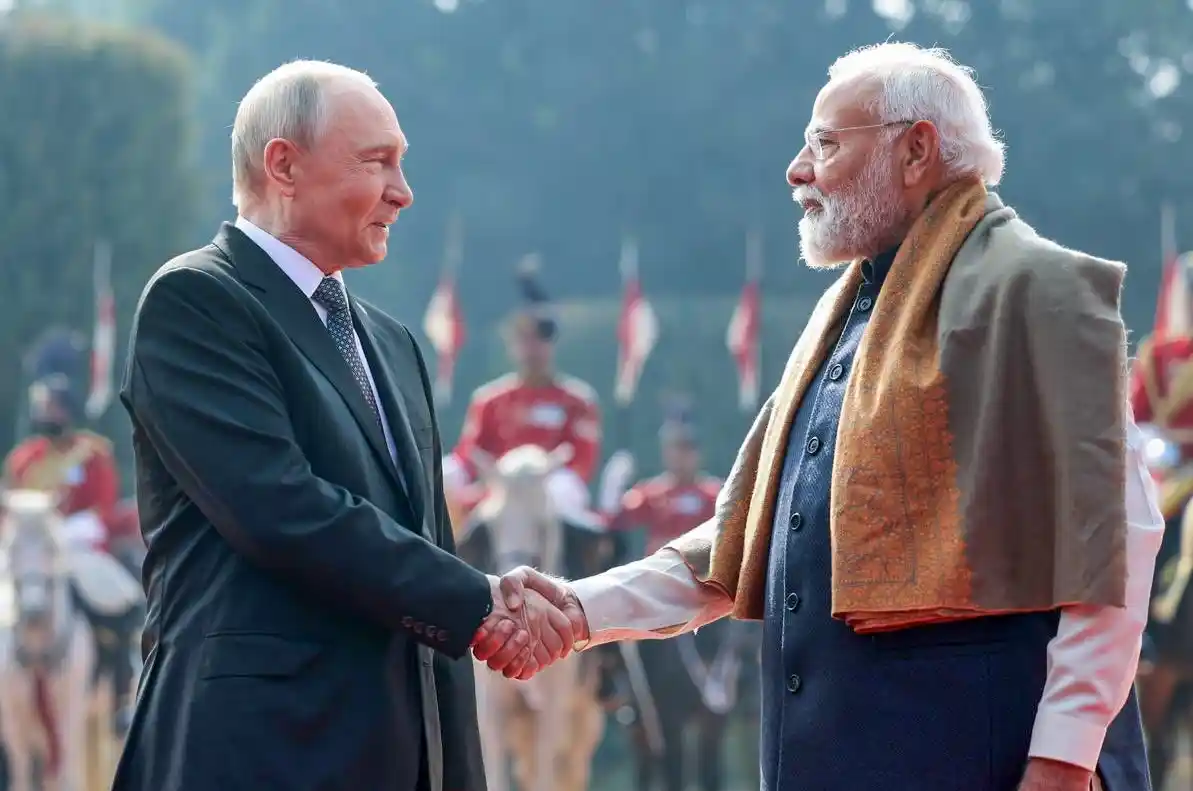
When Prime Minister Narendra Modi broke established protocol on the evening of December 4, 2025 to personally receive Russian President Vladimir Putin on the tarmac of Palam airbase, the gesture lasted a full eight seconds on live television. Eight seconds is an eternity in diplomacy. It was long enough for the world to register that India had just detonated a quiet thermonuclear device in the heart of the Western sanctions regime. The hug was warm, unhurried, and entirely deliberate. It was also the loudest silence Washington and Brussels have heard in years.
The choreography that followed was pure theatre with steel beneath the velvet. An Indian-made vehicle ferried the two leaders from the tarmac. A private dinner at Hyderabad House stretched well into the night. President Droupadi Murmu toasted “eternal friendship” under the chandeliers of Rashtrapati Bhavan. The joint statement spoke of a $100 billion trade target by 2030, nuclear reactors at Kudankulam, joint AI research, and Arctic shipping through the warming Arctic, amongst many other initiatives. Nothing revolutionary on paper. Everything revolutionary in context.
The world reacted in real time, and rarely has a single diplomatic visit produced such a kaleidoscope of official statements, leaked briefings, anonymous quotes, and social-media meltdowns.
Uneasy Washington
Based on U.S. media coverage, Putin’s visit to India has been widely framed as a demonstration of India’s strategic autonomy and a challenge to Western pressure. Outlets such as The New York Times and Washington Post highlighted the symbolism of Modi personally receiving Putin, portraying the gesture as a signal that India continues to engage with Russia despite sanctions and Western expectations. Coverage emphasised the practical dimensions of the visit, expanding trade, energy, and defence ties, while noting the limitations it revealed in U.S. leverage over India. Some analysts stressed that Washington will need to treat India as an equal partner in managing geopolitical issues, particularly regarding China, and that moral exhortations or threats are unlikely to alter India’s independent foreign-policy trajectory. The underlying sentiment in U.S. media was clear: the visit underscores that India pursues its interests on its own terms, compelling the West to recalibrate its approach.
Wintery Europe
Just days before Putin’s arrival, the British, French and German envoys to India published a joint article in The Times of India (1 December 2025), accusing Russia of prolonging the Ukraine war through escalated air attacks and ruthless tactics despite ongoing peace talks. It states that India’s voice on the matter is “loud and clear,” quoting Prime Minister Modi who said, “A solution cannot be found on the battlefield.” Delhi reacted: the MEA called it “unusual and unacceptable,” former diplomats labelled it a breach of sovereignty, and the Russian ambassador fired back with his own counter-article. In the end, the coordinated European broadside achieved the opposite of its intent: it made Modi’s tarmac bear-hug on 4 December look even more defiant, turning a routine bilateral summit into a highly public rebuke of Western pressure politics.
European media reactions to the visit have been a blend of strategic concern and sober recognition of geopolitical reality. The Guardian cast the visit as significant “simply because it is happening at all,” arguing that Moscow is using New Delhi to signal a return to normal diplomatic life despite its broader isolation. The Financial Times focused on the substance, deeper cooperation in defence, energy, nuclear and high-tech sectors, alongside a push toward $100 billion in bilateral trade, while underscoring that this expansion comes at a moment when Europe would prefer India to lean away from Russia. Across much of the European press, the underlying sentiment is the same: the visit demonstrates India’s willingness to chart its own course, and Europe’s diminishing ability to shape that trajectory through pressure or persuasion.
Beijing’s Calculated Calm
China’s overall reaction to Putin’s visit to India has been low-key, cautious and largely filtered through state-aligned media rather than any official statements. Beijing has avoided any criticism of the trip, instead leaning on its familiar line that countries are free to develop independent bilateral relationships — a stance echoed indirectly in Chinese commentary emphasising “non-interference” and strategic autonomy. State media such as Global Times framed the visit as evidence that both India and Russia remain resilient to Western pressure and capable of pursuing their own geopolitical agendas. Chinese analysts quoted in these outlets described the India–Russia partnership as “highly strategic” and “extremely stable,” while hinting that deeper India–Russia cooperation, especially in energy and defence, is something China watches closely but will not publicly contest. In essence, the official posture was restrained diplomacy; the media posture was pragmatic acknowledgment that India is playing its own long game, and that China will calibrate its response accordingly.
Japanese Zen Silence
Tokyo’s reaction was characteristically understated yet unmistakably cool. Prime Minister Sanae Takaichi and the Foreign Ministry issued no public comment, allowing The Japan Times and NHK to do the talking with headlines that framed the summit as “warming ties that have angered the U.S.” and “a test of India’s Quad commitments.” Behind the silence, Japanese diplomats quietly reminded their Indian counterparts, through Quad backchannels that deeper military logistics with Russia, especially the new RELOS pact giving India access to Vladivostok, complicates Tokyo’s own security planning in the North Pacific and risks slowing trilateral defence technology projects. In short, Tokyo neither lectured nor sulked; it simply tightened its embrace of New Delhi while making clear that the bear-hug in Delhi had been noted and logged.
India’s Strategic Clarity
Amid this global tempest, India itself read the moment with quiet clarity. This was not a rebellion against the West, nor a nostalgic nod to old Cold War certainties. It was New Delhi signalling that its strategic autonomy is not a slogan but a lived doctrine: India will partner widely, disagree politely, and choose without apology. The hug distilled what the world has struggled to admit—that India no longer adjusts to geopolitical weather; it shapes it. This strategic confidence was mirrored in tangible economic leverage: India has built a sanctions-proof supply chain with Russia, from discounted crude to defence spares and emerging Arctic routes, giving it influence that no threat of tariffs or export controls can easily dent.
West’s Dilemma
The policy implications for the West are brutal but clarifying. Threats no longer work. Tariffs backfire. Moral lectures produce only eye-rolls. If Washington wants India’s help managing China (still a near-unanimous bipartisan goal), it will have to treat India as an equal. That means accepting defence-industrial ties with Russia, energy ties with whoever offers the cheapest barrel, and technology partnerships chosen on merit, not ideology. Brussels faces the same choice, or it will watch India glide toward an expanded BRICS where its vote carries more weight than the entire European Union combined.
The old order limps on, wounded but still dangerous, while a new one announces itself not with treaties or manifestos but with small human gestures: a handshake that lasts too long, a ride in an electric cart, a bear-hug in the Delhi winter. And in that quiet shift, two men who understand threats and history stand smiling, arms around each other’s shoulders, knowing that the story is no longer being written in Washington or Brussels.