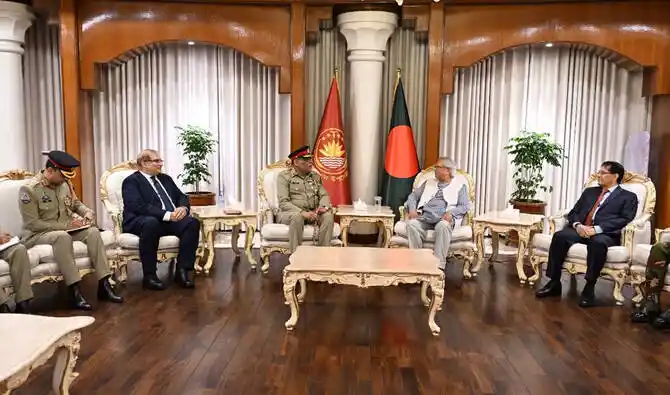
Security dilemma, amidst the existential condition of uncertainty in international relations, is a familiar predicament experienced by the decision makers of states. The recent decision of the interim government of Bangladesh to buy 20 J10-C fighter jets from China as part of its air force modernization mission raises the question of what existential condition Bangladesh faces that prioritizes its air force modernization over its economic development. With India as a neighbour, without territorial or sovereignty disputes, why is there this emphasis on augmenting the military power among the country’s political and military elites? And also, will these initiatives eventually trigger a security paradox situation for India?
Power elites pander for defence preparedness
The power elites in Bangladesh lament that their country’s defence policy remains underdeveloped, with no formal document outlining the country’s security vision. One defence strategy report of the country underlines the capability gap of Bangladesh’s armed forces, with limited armoured capabilities, an air force lacking outdated fighter jets, and a navy lacking a modern missile system. The report counsels modernizing the air force with 12-15 squadrons with advanced fighter jets and the navy with an advanced Vertical Launching System (VLS) with domestic missile production. A quick glance at the report might confuse a reader regarding its country of origin. Such emphasis on military preparedness is seen in countries like India, with multiple strategic challenges, which is not the case with Bangladesh. Besides, its ‘friendship towards all and malice towards none’ principle-oriented foreign policy does not fit in well with its urge for such forceful military preparedness.
The reason Bangladesh’s defence policy is underdeveloped is that it does not have any strategic challenge vis-à-vis its neighbourhood. However, Bangladesh unveiled the ‘Forces Goal 2030’ mission in 2009, enforced in 2017, to upgrade its armed forces with a view to meeting the challenges of the 21st century.’ What challenges does Bangladesh currently face that require missiles and fighter jets to counter by 2030? It is said Forces Goal 2030 wants to modernize Bangladesh’s armed forces to effectively safeguard the country’s sovereignty and territorial integrity. Is the country’s neighbourhood a threat or a potential threat to its existence? Unlike Pakistan, Bangladesh does not suffer from any existential threat perception. However, as Rousseau said, even if a state wants to remain at peace, it is forced to augment its defence since the international system is an anarchy.
Bangladesh’s strategic objective vis-à-vis India
After being installed through an uprising, reports surfaced that the interim government of Bangladesh was increasing ammunition and explosives imports from Pakistan. Its chief advisor, Mohammad Yunus, has expressed a desire to have ‘stronger ties’ with Pakistan. When it is natural and desirable for countries to promote regional cooperation, it is concerning when such cooperation aims to harm a third country. The reports of Bangladesh’s intelligence agency seeking to strengthen its ties with Pakistan’s ISI to counter India are utterly concerning. Indeed, the interim government is committed to undoing the alleged ‘pro-India’ policy of the previous Hasina government, but the motto to harm thy neighbour is obnoxious. Besides Pakistan, the interim government is wooing China as well. There are high expectations in Bangladesh of Chinese economic assistance in the form of investments, business, and credit facilities. However, reports of Bangladesh planning to revive its Lalmonirhat air base (20 km away from the Indian border) with Chinese and Pakistani help do trigger trepidation in India.
The wiles of the interim government to mortify India, in the guise of this ‘friendship with all’ gesture, are quite comprehensible. Notably, the interim government is composed of anti-Hasina factions who accuse the former premier of being too pro-India and intend to undo this trend in Bangladesh’s foreign policy. Thus, this anti-Hasina ardour easily dovetails with anti-India fervour. The interim government’s strategy is to keep India under pressure by poking at New Delhi’s strategic sensitivity. This is a pressure tactic on a giant neighbour that it otherwise cannot ‘handle’.
Is Bangladesh creating a security paradox situation for India?
Dhaka’s strategic cooperation with Pakistan and China is factored by its sense of common anxiety over Indian dominance in South Asia. Situated next to a giant neighbour, a smaller state has two options: either balancing it by aligning with parties who oppose it, or bandwagoning it, that is, insinuating to the neighbour itself. Dhaka has opted for the former to contain India. And by doing so, it is creating a security paradox situation. Chief of Defence Staff General Anil Chauhan is rightly anxious about possible China-Pak-Bangladesh collusion impacting India’s security dynamics. The growing strategic affinity between them might force India to augment its own security in the east, thereby pushing fearful Dhaka more to the Sino-Pak camp. This will resultantly a decrease in the security of both India and Bangladesh.
Cooperation is safer than confrontation
The foolhardy approach of balancing India is an inane resolution of Bangladesh. The 2024 uprising has severely impacted its economy. World Bank reported that the country faces significant economic challenges, while the International Monetary Fund has made a downward revision of Bangladesh’s GDP-growth prospect for this fiscal year, saying that its economy may grow by 4.9 per cent in the fiscal year 2025-26 against its earlier projection of 5.4 per cent, made in June last. Notably, the IMF has imposed a ceiling on foreign borrowing on Bangladesh for the first time. The country’s foreign debt has also reached a historic high, $112.15 billion as of June 2025.
In this situation, this febrile military modernization mission of Bangladesh, without any real strategic challenge, appears frivolous. On the contrary, overcoming its India-centric myopic security anxiety, Dhaka should opt for economic cooperation with India, like what many Southeast Asian countries have profitably done with China, notwithstanding their sinophobia. Rather than investing in a strategic alliance with Pakistan and China, Bangladesh can opt for economic collaboration via BIMSTEC. Military prowess without economic prosperity is fragile. The liberal international order has shown that security lies in economic cooperation rather than strategic contention. The sooner Bangladesh realizes this, the better for it and the region.