
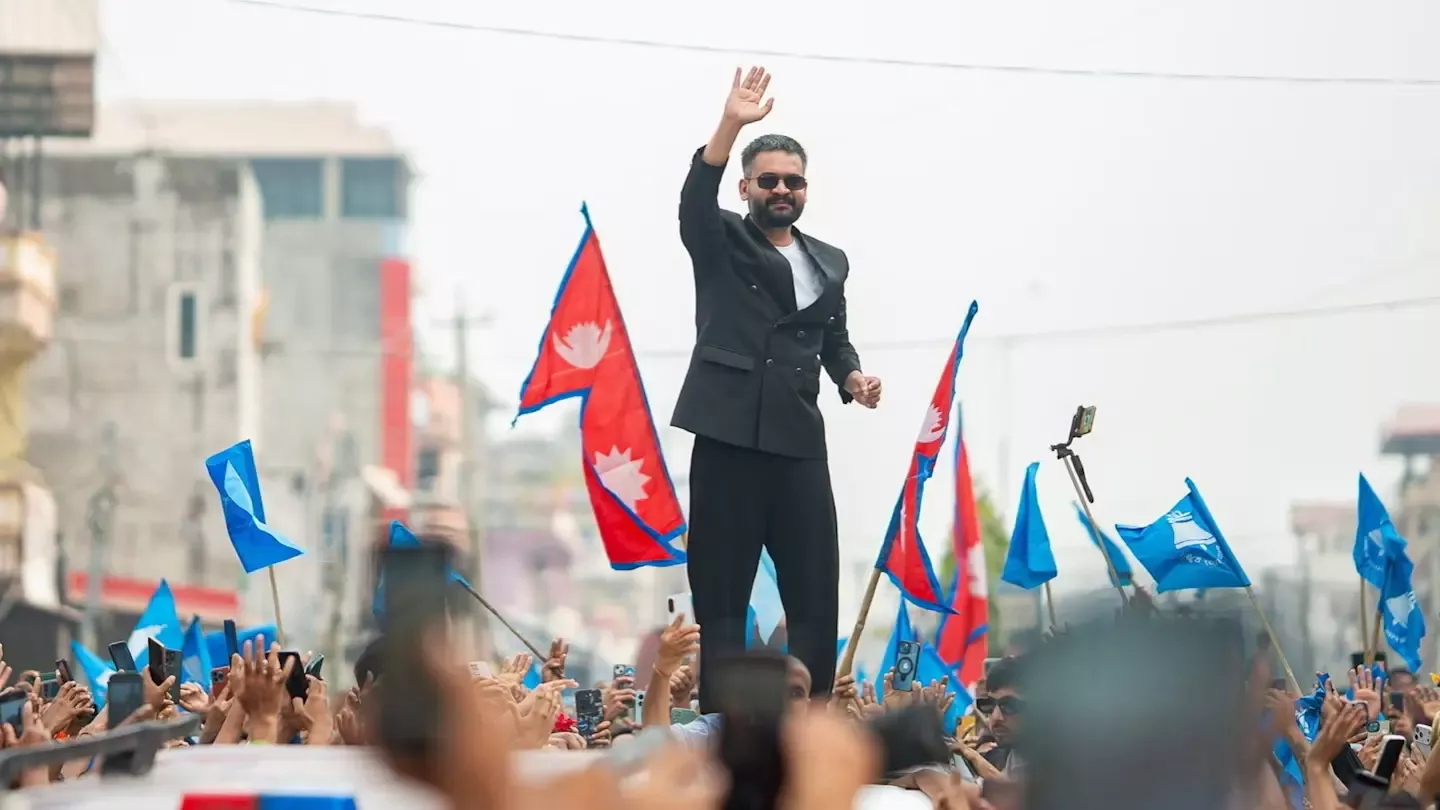
Nepal’s election outcomes have shattered the myths and left the majority of Nepal watchers wondering whether they underestimated the Balen wave, particularly by giving the Rashtriya Swatantra Party (RSP) close to a two-thirds majority—a party that entered Nepal’s political and electoral space in 2022. Since the advent of democracy in 2008, it has been the traditional parties—Nepali Congress, Maoist Centre—now Nepali Communist Party (CNP), and the Communist Party of Nepal-UML (CPN-UML)—and their respective leaders, Sher Bahadur Deuba, Pushpa Kamal Dahal alias Prachanda, and KP Sharma Oli—who have dominated Nepal’s political landscape for decades.
Balendra Shah, popularly known as Balen, an engineer and rapper, entered politics in 2022 by running for the Kathmandu mayoral race and won as an independent candidate, defeating stalwarts from different parties. But with just three years of experience as an administrator and politician, no family lineage in politics, no party backup, becomes the Prime Ministerial candidate of a party he joined just two months before the elections, and created history by winning such a huge mandate and in line to be the youngest Prime Minister in Nepal’s electoral history. For a country divided by strong regional loyalties, ethnicities, and religious communities, such a mandate reflects how well-executed policies could dismantle the divides and unite the electorate around issue-based politics.
Historical Elections
Interestingly, the snap elections of March 2026 were prompted by a Gen Z movement in 2025, in which disenchanted youth protested the government’s decision to ban 26 social media websites on September 05, 2025. Post-Gen Z, the need for new elections arose after an elected Prime Minister, KP Oli, resigned amid protests, and the President of Nepal dissolved the parliament and appointed a new interim Prime Minister, Sushila Karki, following popular youth support for her candidature. As a result, the youth dominated the election agenda and party manifestos, with some offering 10 GB of free data and a $100 support card for youth, and almost all parties promising good governance and employment.
What seemed like an urban phenomenon, where youth aged 15-25 took to the streets of Kathmandu to protest the social media ban, triggered the underlying issues like nepotism, corruption, political instability, ageing leadership, employment, and poor governance, not only toppled an old-guard, stroke cords, not just with young voters, but with voters of all age groups. The Balen-led government will now have 182 out of 275 seats in the lower house of the parliament—Pratinidhi Sabha —short of two seats to secure a two-thirds majority, which may not be too difficult to manage, especially with independent candidates.
This is a historical mandate, as in the past, no party has secured a majority of its own, and it was the element of coalition governments that kept politics unstable and led to frequent changes of the prime minister. This will also be the first time that parties in the opposition will have no choice but to sit in the opposition, and the room for mid-way bargaining to form governments will vanish. The compulsion of coalitions will also no longer be part of the policy-making process and will no longer enforce biases and interests in national development planning.
But what made the duo of RSP and Balen Shah give such a large mandate?
The Balen Wave
While many refuted the Balen wave as a social media phenomenon, it certainly had a ground, leaving observers amused. However, among the various factors for mammoth mandate, the first would be the combination of all—the Gen Z, Balen Shah, RSP. The youth raised issues that were neither new nor unknown, but ones that a different government had promised in the past four elections—2008, 20143, 2027, 2022, but failed to deliver. Hence, while Gen Z triggered the wave of angst, it struck chords with the larger electorate, and letting the moment pass could have been a lost opportunity for a lifetime. Second, neither RSP nor Balen brought baggage, and despite being just four years old in Nepalese politics, RSP, as a party, and Balen, as a leader, offered the prospect of a stable leader and a forward-looking party open to youth and their merits.
Third, the mandate also reflects people’s frustration with an ageing leadership in Nepal. Except for the Nepali Congress and the RSP, Prime Ministerial candidates from parties like CPN-UML’s KP Shamra Oli and NCP’s Pushpa Kamal Dahal alias Prachanda were 70-plus, making it hard for youth to connect with their functioning and approach to national development. While both leaders enjoyed strong rural support, it seems the youth persuaded their family members to vote for change and elect the RSP to form the new government. Also, although Nepal does not have a postal ballot system like Bangladesh and Bhutan, the Nepalese diaspora is seen as an active player in convincing their families back home to vote for Balen Shah and RSP, and they actively express their support on social media platforms.
Implications and Road Ahead
The first and foremost implication of the election outcome is that a big mandate will do away with the excuse of politics, especially in reforming institutions and governance, and in bringing in more transparency. Because RSP has the majority of its own in the house, passing laws and carrying out reforms will not be difficult for the party. Second, RSP’s victory might also see opposition become more united and play a more constructive role than continuing to bargain for a place in the government. Third, while there will be political opposition in parliament, RSP’s biggest opposition will be on the streets, which have eventually advocated for their role and supported them to power.
If RSP and Balen fail to deliver, the youth and the general population could again take to the streets to demand accountability from them. What brought RSP and Balen to power could become grounds for criticism if they do not deliver. Fourth, Nepal will, for the first time, see its domestic and foreign policy conducted more publicly than in the power corridors of the Singha Darbar—a historical complex housing the Prime Minister’s Office and major ministries. Transparency will also be a key component of the government’s functioning, especially in delivering on its election manifesto promises.
As a way forward, the Balen Shah-led government, though lacking administrative experience, would have to ensure financial and administrative transparency and that elements of nepotism are not entertained. Employment and educational opportunities at home could prompt political leaders to invite more foreign direct investment from countries other than the two neighbours—India and China. Also, ensuring that justice is served to the victims of the violence during the Gen Z Movement in a timely and accountable manner. Besides domestic issues, foreign policy would require a sensible, strategic overhaul rather than being driven by populist agendas, as anti-India movements have picked up in Nepal in recent years. As a landlocked country between India and China, the new government could see this as an advantage, enabling it to benefit from the growing trade of its two neighbours rather than choosing one over the other.
Nepal’s Gen Z movement is not a Nepal-specific phenomenon but has found support worldwide. Countries like the Philippines, Congo, and Peru, too, have seen such movements shaping up around similar issues, but Nepal is the only country to have brought about swift political change. Nepal’s movement and election outcomes are also closely watched by countries of the sub-continent, as the rising gap between youth and traditional leadership and parties makes a best case for change. While countries like Bangladesh and Sri Lanka have already witnessed it, countries like Pakistan and the Maldives could be the next in line.

