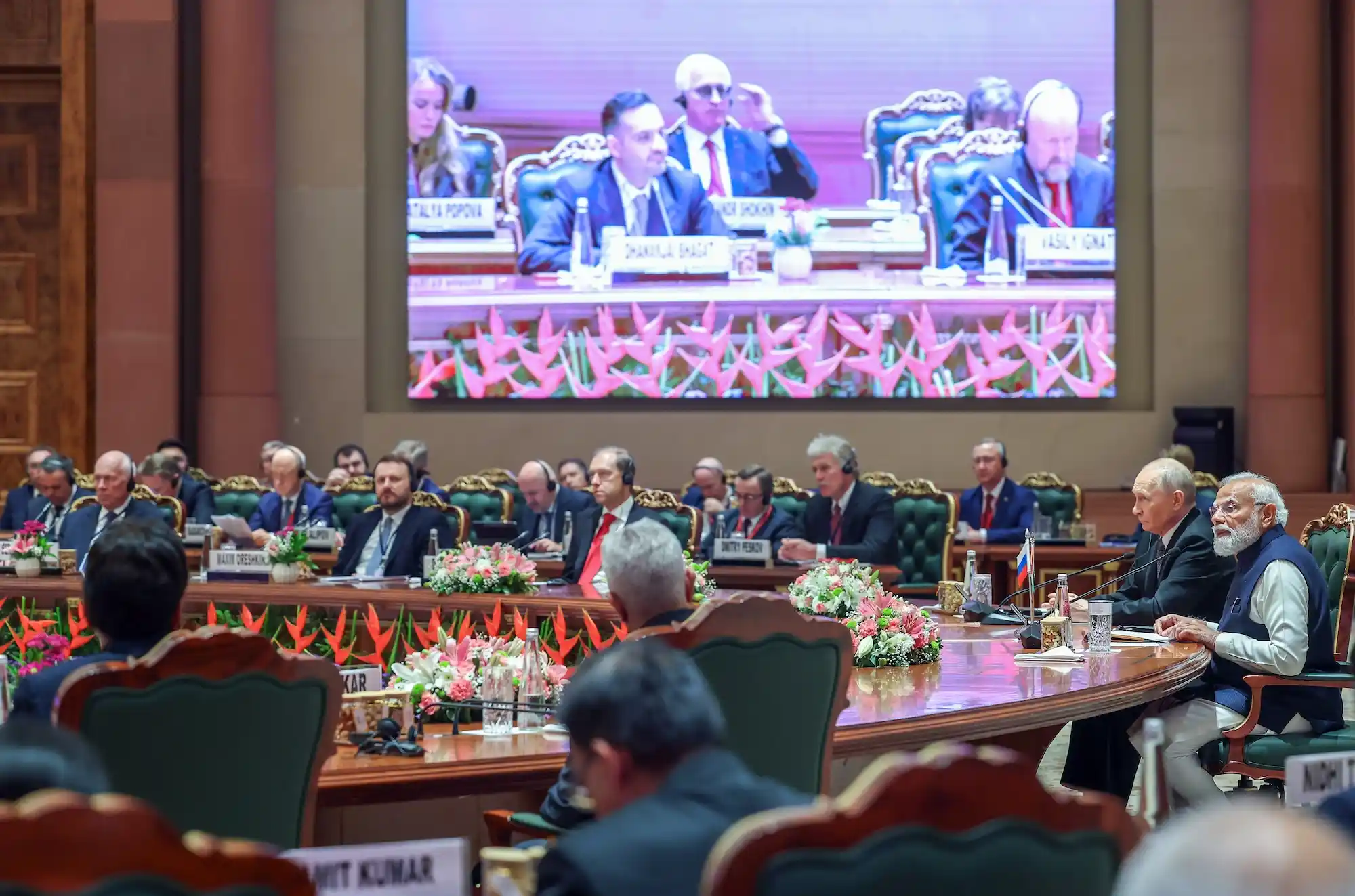
The 23rd Annual bilateral summit between India and Russia was marked by a two-day visit by President Vladimir Putin to India on 04-05 December 2025. The visit also marked 25 years of India-Russia strategic partnership since the signing of the “Declaration on the India-Russia Strategic Partnership” in October 2000, and ten years of bilateral encounters between Prime Minister Narendra Modi and President Putin, strengthening the relations further.
In recent past, India-Russia bilateral engagement has moved towards a ‘co-equal’ and ‘co-dependant’ partnership. With the visit, the partnership has gained further impetus in all spheres, including military and security, trade and investment, energy, nuclear, labour migration, science and technology, space, cultural, education, and humanitarian cooperation, including actively exploring new avenues for cooperation.
Some of the major outcomes during the Russian Premier’s visit were the objective to achieve a balanced trade and economic relations with the target of $100 billion by 2030. President Putin also assured an uninterrupted energy diplomacy between the two countries despite the growing US pressure for the imposition of tariffs on India if it fails to reduce its purchase of oil from Russia. The Labour Mobility Agreement aimed at exploring the prospects of Indian skilled workers to address the growing manpower shortages in Russia. President Putin also presided over the launch of RT India- a step towards promoting a non-Western narrative and strengthening media partnership between the two countries further in the digital age. Agreements were also signed in the field of nuclear energy, trade corridor, healthcare, medical education, fertilizers, science, customs, and commerce. The two countries also agreed to grant 30 30-day e-Tourist Visas on a gratis basis to Russian nationals on a reciprocal basis. As part of the essential preparatory work prior to President Putin’s arrival in India, the two countries signed a key military pact called the Reciprocal Exchange of Logistic Support (RELOS) on 02 December 2025 to provide logistics for warships and military aircraft of Russia to India and vice versa. This agreement is similar to the Logistics Exchange Memorandum of Agreement (LEMOA) signed between India and the US in 2016. Russia’s steadfast support to India on the issue of combating terrorism, active participation in the United Nations, and multilateral fora continue.
Speculations were rife regarding the timing of the visit as it was President Putin’s first visit after a gap of four years to India. While the visit was a diplomatic ritual as it was part of the annual bilateral summit arrangement, it has, however, come at an opportune time given the global geopolitical developments impacting both India and Russia respectively. Political analysts and media agencies widely regard the visit as an attempt to convey that, despite the growing challenges, the time-tested partnership between India and Russia has shielded itself from external global pressures, especially from the US.
While the visit presented an opportunity to build on important convergence of interests and navigate the current and future strategic and economic challenges, the outcome of the visit however was modest as the 23rd annual bilateral summit unlike the previous summits did not witness any pathbreaking agreements, especially in key spheres of cooperation including defence sector which had once been the major plank in India-Russia bilateral engagement.
Russia’s military intervention in Ukraine has been visibly successful as it has gained not only Crimea but also major territories in Eastern Ukraine. The Ukraine war has revitalised Russia’s global defence status, and this has been mainly due to the upgradation of Russian armed forces, procurement of high-end weapons technology, and the revival of its defence industrial complex (DIC), which has been a major foreign policy tool in executing the Moscow administration’s goals.
Russia, which has long relied on the defense economy, today has moved towards a petro-economy, which has played an integral role in Russia’s economic growth and been the main source of funding for many of its domestic policies, including large-scale budget allocation for defense procurement and for the functioning of the DIC. Hence, an impact on the Russian energy market is bound to have a domino effect on Russia’s overall growth performance in domestic and global politics.
India has been a potential ally given its import-oriented defence and energy market, and Russia is one of the leading energy exporting countries for India to satiate its growing demand in this sector. President Putin’s visit was to secure India’s confidence and assurance to continue to be a stable buyer of its energy resources as it is also one of the main sources of funding its military adventurism. Russia, having learnt from its past experience, would likely avoid shifting back to a defence economy as the main source of its economy. With the US tightening its grip on India, President Putin’s visit was to ensure that the New Delhi administration does not cave in to the unjust demands of the US, as it would ripple across Russian energy and defence markets.
Having said that, the India-Russia partnership is one of co-dependence. India, on the other hand, is extending a grand welcome, and with PM Modi himself receiving the President, breaking protocol is seen as a conscious attempt to send a strong political signal of India recalibrating its strategic autonomy in international politics. Alongside the traditional and reliable partner- Russia, alternative options for India to satiate its growing energy demands are limited, and the US, in this regard, has failed in providing a Russia-level caliber partnership. Despite the geographical diversification of defence markets by India, Russia continues to be benevolent in terms of providing upgraded weapons technology, joint military production, and military technical cooperation that have seen substantive outcomes. Additionally, in the fields of peaceful space exploration and nuclear technology, Russia has played an integral part in India’s domestic requirements. India also aspires to gain leverage against the US, especially with arrangements of expanding non-dollar trade mechanisms with Russia.
The economic sanctions on Russia, alongside mounting pressure on its bilateral partners such as India through tariff war, have put the strategic and privileged partnership between the two countries in an inescapable situation. More than ever, India’s multi-alignment foreign policy is undergoing a litmus test, and hence, a diplomatic mechanism is crucial for India in balancing all the major powers in its foreign policy aspirations, especially its bilateral engagement with Russia and the US, respectively.
Paving the way for a strong bilateral and strategic partnership with Russia, through this summit, India has signalled that the bilateral relations with its longstanding traditional partner matter as Russia continues to assist in achieving its national and global needs. However, the growing challenges and external factors cannot be ignored. While high-profile visits do send political signalling of power projection and relevance of the partnership, for India-Russia relations to emerge as a new power equation, mere signalling without substantive outcomes will continue to impact the bilateral engagement between India and Russia.