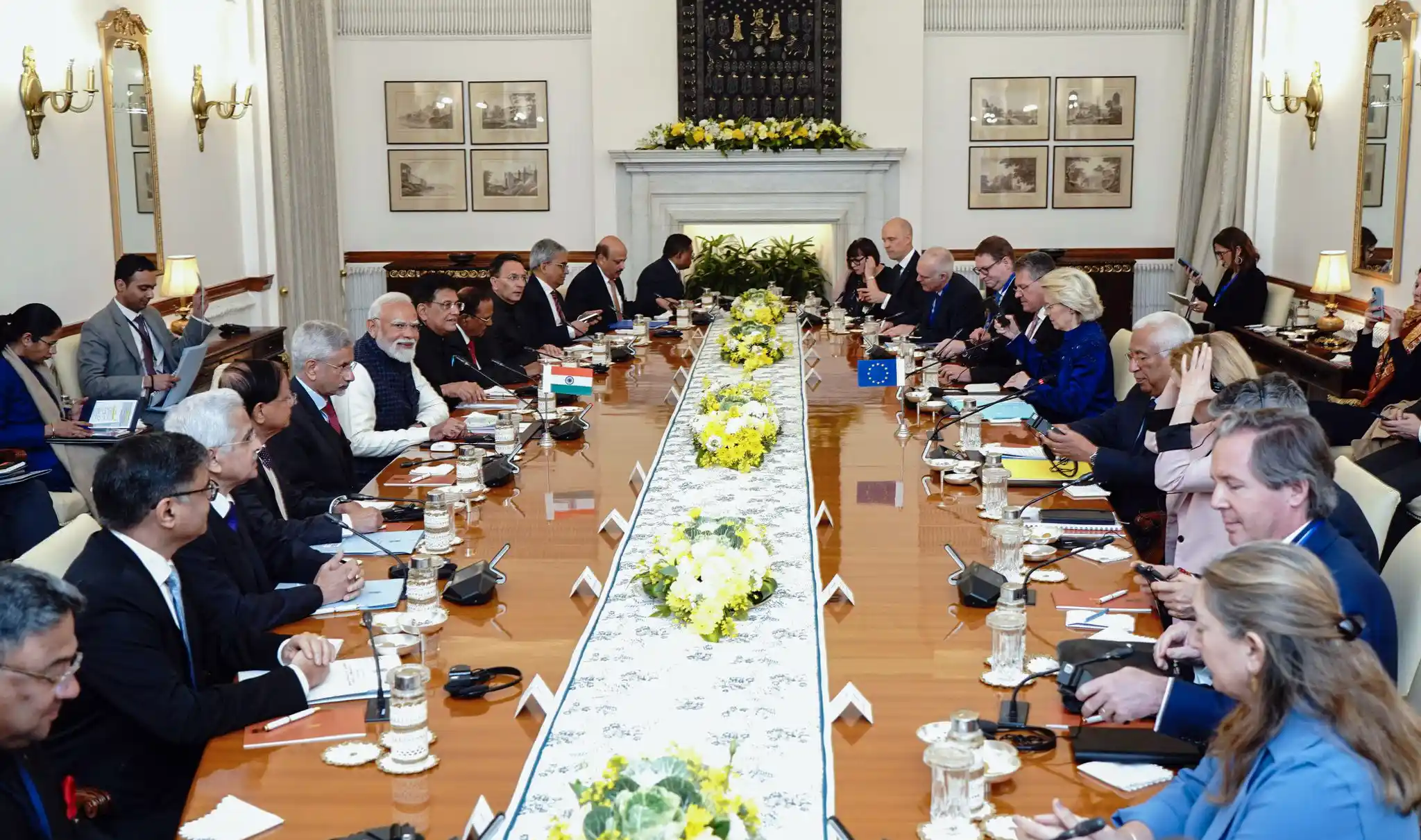
The 16th India-EU Summit, held in New Delhi on January 27, 2026, and co-chaired by Prime Minister Narendra Modi, European Commission President Ursula von der Leyen, and European Council President Antonio Costa, marked a decisive advancement in bilateral ties. The summit yielded 13 key outcomes, anchored by the finalization of a landmark Free Trade Agreement (FTA)—termed the “mother of all deals”—within the broader “Towards 2030: Joint India-EU Comprehensive Strategic Agenda.” This multifaceted framework addresses trade liberalization, security cooperation, technological innovation, sustainability, and human mobility, forging a $27 trillion market partnership amid global supply-chain disruptions and geostrategic realignments.
Structural Pillars of the Summit Deliverables
The summit’s agenda encompassed a holistic spectrum of domains, with the FTA serving as a cornerstone rather than the sole focus. Tariff reductions cover 90-97% of goods: India phases down duties on EU automobiles from 110% to 10%, machinery by up to 44%, and chemicals by 22%, complemented by EU reciprocity in services across 102 Indian subsectors such as finance and telecommunications. The Security and Defence Partnership (SDP) establishes interoperability protocols, providing India access to the EU’s €150 billion Strategic Autonomy for Europe (SAFE) fund for joint initiatives in cyber defense, unmanned aerial systems, and maritime surveillance.
Further deliverables include exploratory negotiations for an Investment Protection Agreement (IPA), India’s prospective integration into the Horizon Europe research program (€95 billion funding pool), and the inception of a Clean Energy Partnership via a Green Hydrogen Task Force. Digital collaboration designates India as data-secure, enabling joint artificial intelligence and emerging technology frameworks, while mobility arrangements facilitate visa processes, double social security exemptions, and an EU Legal Gateway Office in India. Additional commitments span trilateral projects in the Indo-Pacific and Africa, urban sustainability initiatives, and reforms to multilateral institutions.
A joint statement reaffirmed adherence to the Paris Agreement, WTO plurilateralism, and a rules-based international order.
Economic Reconfiguration and Trade Dynamics
The FTA projects a bilateral trade escalation from €120 billion to €200 billion by 2030, with India’s pharmaceuticals, textiles, and agrifoods gaining preferential entry to a 450-million-consumer market. Capital-goods inflows will modernize Indian manufacturing under “Atmanirbhar Bharat,” particularly in electric vehicles, semiconductors, and green technologies. For the EU, firms such as Volkswagen and BASF secure deepened market penetration, mitigating dependencies on Chinese supply chains for critical minerals and pharmaceuticals while recouping losses from prior GSP+ withdrawals.
The Horizon Europe overture and Green Hydrogen Task Force catalyze high-value FDI, fostering MSME innovation in biotechnology and advanced materials. These mechanisms collectively de-risk global value chains, with trilateral clean-energy deployments in Africa enhancing resilience against energy shocks.
| Domain | Principal Outcomes | Anticipated Bilateral Impacts |
| Trade & FTA | 90-97% tariff elimination | €80 billion trade expansion |
| Investment & Innovation | IPA talks; Horizon Europe access | MSME R&D synergies; FDI inflows |
| Sustainability | Green H2 Task Force; IMEC integration | Net-zero acceleration; Africa projects |
| Digital Governance | Data-secure status; AI frameworks | Secure cross-border data flows |
Geostrategic and Security Dimensions
The SDP extends EU strategic depth into the Indo-Pacific, addressing hybrid threats, Red Sea navigational disruptions, and counterterrorism through collaborative platforms. This alignment counters revisionist pressures without formal alliances, leveraging India’s Quad participation for maritime domain awareness. Mobility pacts resolve EU demographic shortfalls—particularly in Germany and France—with Indian skilled labor, enabling bidirectional skills transfer and remittances exceeding $100 billion annually.
Trilateral engagements in the Caribbean and Indo-Pacific amplify normative influence, while commitments to connectivity corridors like IMEC fortify infrastructure resilience. These elements position the partnership as a stabilizing counterbalance to U.S. tariff policies and Sino-centric economic coercion.
Sustainability, Mobility, and Global Governance
The Clean Energy Partnership operationalizes Paris Agreement imperatives through joint carbon markets and circular economy standards, mitigating Carbon Border Adjustment Mechanism (CBAM) frictions via calibrated reciprocity. Urban sustainability and women empowerment initiatives intersect with labor provisions, while institutional reform pledges target WTO revitalization and UN Security Council restructuring.
The summit’s comprehensiveness manifests convergent priorities: India achieves economic diversification and technological leapfrogging; the EU attains market access, supply-chain redundancy, and Indo-Pacific agency amid transatlantic uncertainties. The $27 trillion economic confluence harbors potential to shape global norms in digital trade and sustainability, preempting dominance by other powers.
Implementation hinges on a six-month legal review, domestic ratifications, and pilot deployments such as SDP projects and hydrogen rollouts. Latent tensions—agrarian protections, non-tariff barriers, intellectual property disparities—necessitate vigilant management. Failure to operationalize risks reversion to fragmented bilateral engagements, forfeiting strategic momentum. Success, conversely, cements an enduring axis of resilience, navigating 2030’s geopolitical volatilities through integrated economic and security architectures.