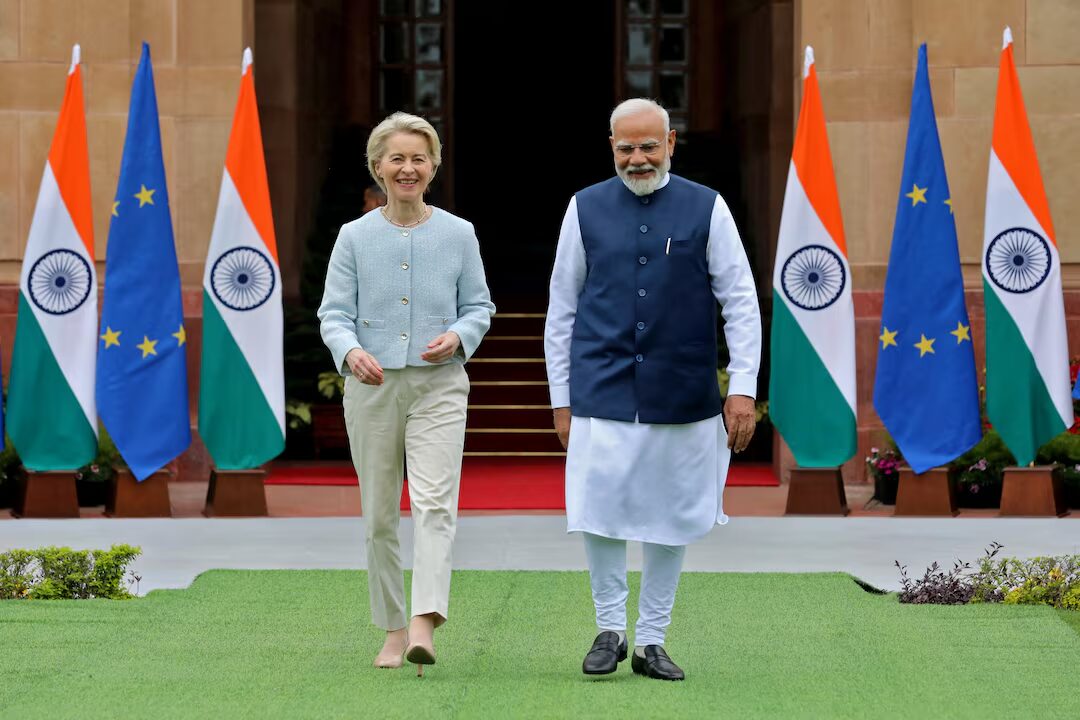
The European Union (EU) launched its 18th sanctions package in July 2025 that attempts to limit Russia’s war machinery against Ukraine. The latest set of sanctions not only targets Russia but also imposes secondary sanctions that carry ramifications for third countries like India. While aimed at constraining Moscow’s access to global energy markets, these measures involve significant knock-on effects for New Delhi’s access to energy as well as for its fiscal autonomy. India’s Ministry of External Affairs’ official response remained stern, “We have noted the latest sanctions announced by the European Union. India does not subscribe to any unilateral sanction measures”. Indian refiners, notably Nayara Energy, backed by Russian energy giant Rosneft, have raised concerns regarding potential insurance and payment disruptions. These expanded sanctions have brought to the fore a sensitive debate in Brussels and New Delhi: can the India-EU relations navigate divergent geopolitical priorities without eroding the current momentum in their strategic partnership?
Firstly, the factor of intricate economic interdependence characterises the existing India-EU relations. However, when such an economic reliance becomes conditional on a partner’s geopolitical alignment, a collaborative partnership risks getting transformed into a hierarchical relationship. Within the paradigm of India-EU strategic partnership, the EU maintains an advantageous position in financial and technological domains. In contrast, India’s importance as a democratic partner, a valuable economic actor, and its growing market base cannot be overlooked. These have created mutual dependencies for Brussels and New Delhi that complicate any attempts at unilateral economic coercion. Thus, when Brussels employs trade and financial mechanisms in the form of secondary sanctions to advance its geopolitical objectives that diverge from New Delhi’s strategic objectives, it reveals an inherent friction between interdependence and autonomy. In this light, the EU’s 18th sanctions package represents a prime example of a phenomenon where it attempts to put conditionalities on India’s access to European financial services in conformity with its own Russia policy, irrespective of India’s domestic energy security imperatives.
For India, being the world’s third-largest oil importer and consumer, energy procurement decisions at the policy level are fundamentally linked to macroeconomic stability and social welfare considerations at home. Moreover, the Russian hydrocarbon imports, constituting around 30 per cent of India’s domestic energy requirement, have contributed directly to substantial fiscal savings for New Delhi. This has eventually helped it manage subsidies, control inflation, and finance its broader developmental goals. But, when Brussels’ secondary sanctions regime attempts to favour alignment with its geopolitical priorities, New Delhi would be required to forgo those above domestic economic benefits. For India, it means absorbing higher energy costs, inflation, and fiscal pressures at home. Such an alignment would, moreover, contradict India’s domestic growth imperative, welfare, as well as the policy of strategic autonomy.
Secondly, what actually puts constraints on the EU’s capacity to leverage secondary sanctions against India is its own quest to diversify supply chains and reduce dependencies on its two largest economic partners- the U.S. and China. New Delhi remains an indispensable partner for the EU’s diversification agenda and economic security. This further limits Brussels’ ability to employ coercive measures without undermining its own strategic objectives. Furthermore, European manufacturing and technology sectors have been looking at India as a crucial alternative to Chinese production capabilities, especially in sectors such as electronics, pharmaceuticals, and renewable energy components. India has been identified as a key partner in order to reduce strategic vulnerabilities through the EU’s ‘Global Gateway’ initiative and various supply chain resilience programs. Therefore, any sanctions-related hindrances to India-EU economic relations would directly impact the EU’s broader security and economic diversification strategies in negative terms.
Lastly, Brussels’ secondary sanctions framework provides it with potential tactical advantages in the ongoing Free Trade Agreement (FTA) negotiations with New Delhi. It could even put forth sanctions relief as a negotiating tool. Such an approach would further allow the EU-side negotiators to frame trade concessions as a way to ease regulatory hurdles for Indian businesses in European markets. Such a type of leverage has its own limitations concerning the EU’s own diversification needs. Nevertheless, it introduces an additional variable in the ongoing FTA negotiations between India and the EU that carries potential to influence the pace and scope of these discussions.
To conclude, the trajectory of the India-EU relations will, therefore, depend on how both partners manage the inherent tensions between interdependence and strategic autonomy. For India, the secondary sanctions represent not only a compliance hurdle, but also a challenge to its fiscal stability, domestic welfare priorities, and strategic independence. For the EU, any application of coercive pressure on its partner would risk undermining its own goals of strategic diversification. It also risks damaging a partnership that it views as vital to its long-term economic security and stability. While the secondary sanctions could be looked through the prism of short-term bargaining leverage, they do carry uncertainty that could slow the economic integration that the bloc seeks to accelerate through the ongoing FTA negotiations. Thus, if managed pragmatically, the secondary sanctions could remain just a temporary irritant rather than becoming a structural faultline in the relationship.