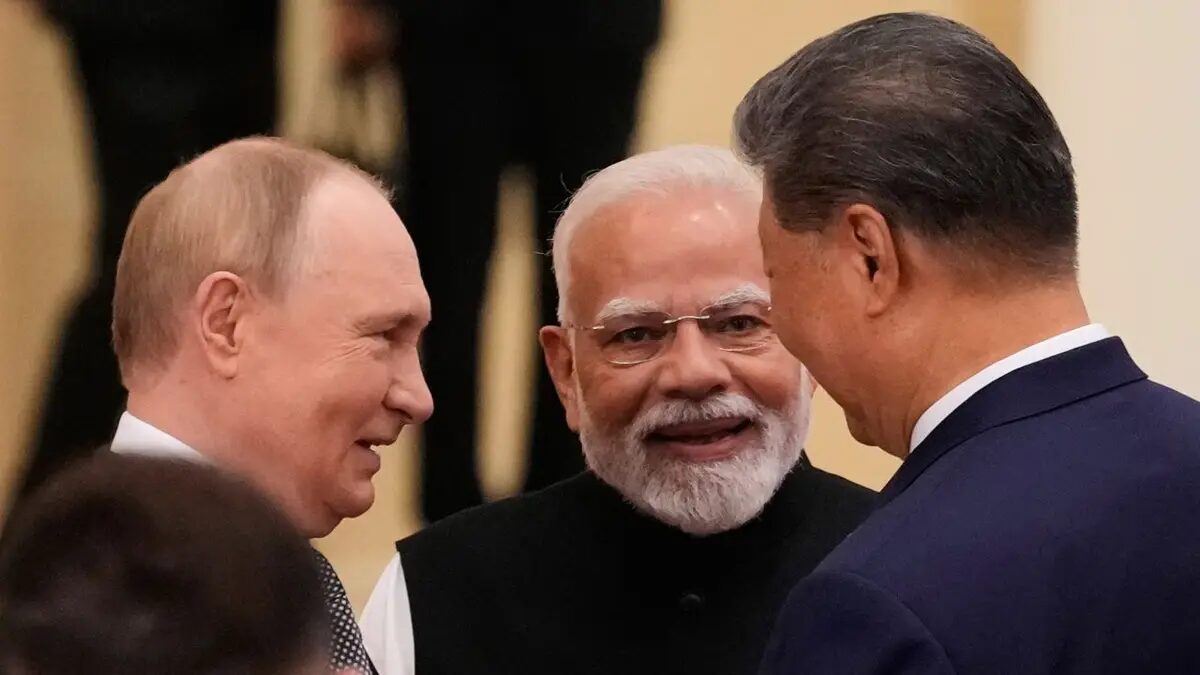
The 25th Shanghai Cooperation Organisation (SCO) summit, 2025, was successfully held from August 31 to September 1, 2025, in Tianjin, China, under the theme “Promoting the Shanghai Spirit: SCO in Action”. The summit saw the participation of prominent member state leaders, including Russian President Vladimir Putin and Indian Prime Minister Narendra Modi, as well as leaders representing the global South, such as United Nations Secretary-General Antonio Guterres. The successful conduct of the SCO summit has garnered positive appraisal as it has positioned itself as a non-Western organisation in promoting a polycentric world order and enhancing the role of the global South in the current geopolitical scenario.
The two-day event attended by global leaders from twenty countries has indicated that world politics is undergoing a major shift. While addressing the member states and leaders representing South and Southeast Asia, as well as West Asia, Chinese President Xi Jinping reflected that the SCO aimed to carry forward the vision for a new global security and economic order in a multipolar world system. President Xi subtly conveyed the growing displeasure of non-Western countries in the era of permacrisis, including the ongoing debate between ‘America First’ and global leadership under Trump 2.0. In the current scenario, the 25th SCO summit reflected a clear stand against hegemonism and power politics, efforts in resolving the Ukraine crisis, a declaration condemning the Pahalgam attack, Israeli-US attack on Iran, and the rejection of unilateral coercive measures with a veiled hint at the imposition of tariffs by the US.
One of the major takeaways from the 25th SCO summit was the camaraderie among Russia, India, and China, whose trilateral and multilateral engagement is now focused on staying ahead of the curve. The growing proximity between the three countries in recent times has garnered immense attention and scrutiny, especially by Western observers. The US has undertaken significant measures of restrictive actions, including the imposition of sanctions and tariffs, aimed at deterring the three countries from growing closer ties between them. On the contrary, there appears to be little impact, as it has only resulted in increasing interdependence among the three nuclear-powered Eurasian giants, who share a vision of diluting the unilateral behavior of the US.
While exploring the prospects of Russia, India, and China emerging as a new power equation, it is crucial to understand the engagement of these three countries at the bilateral level. Russia-China strategic partnership has witnessed an upward trend, especially post Russia’s call for ‘pivot to Asia’ strategy in 2014. There is a growing debate of ‘role reversal’ in the bilateral engagement between Russia and China, in which Russia is emerging as the ‘junior’ in the partnership. However, not viewing the relations through the prism of the West, despite the glaring difference in the individual growth performance of Russia and China after the Soviet collapse, the bilateral engagement has vouchsafed a ‘co-equal’ status that aims towards long-term, mutually beneficial cooperation. The two countries have overcome historical baggage and territorial disputes. In recent years, despite the imposition of sanctions and a trade war with the US, the proximity between Russia and China has manifested itself as an imminent challenge to the existing world system. In 2024, bilateral trade relations reached a record $244.8 billion, alongside several large-scale projects in transportation infrastructure development. Efforts to strengthen ties through progress in linking their respective payment systems, facilitating visas, student and academic exchanges, bilateral research projects, cross-cultural events, and trans-border cooperation also contributed to this growth.
In the context of the current thaw in India-China relations, the unilateral coercive measures by the US under Trump have prompted the two Asian giants to set aside diplomatic grievances and explore the potential of a strong partnership at all levels. Following a series of setbacks after the 2017 Doklam standoff and the 2020 Galwan Valley clash in Ladakh, the visit of PM Modi to China, after a seven-year hiatus, for the SCO summit and the interaction between the leaders of both countries has further gained momentum. While naysayers have disputed the stability and long-term bilateral relations between the two countries, India’s multi-alignment foreign policy and strategic autonomy provide scope for pursuing ties with all countries, including China, which has been a crucial component in its pursuit of a strong and stable South Asian neighbourhood policy.
The incessant interaction among Russia, India, and China at multilateral forums such as BRICS and SCO, including RIC, reflects the convergence of interests in establishing a multipolar world order, in which all three players aim to encapsulate the current volatile world order. In this context, the engagement between the three countries is also aimed at combating terrorism and transnational threats, establishing a new system towards a stable and secure Eurasia, democratizing international institutions, and fostering a collaborative effort with other developing nations for a fair economic, political, and social system.
The unpredictable developments in global politics, combined with 2025 being the year of permacrisis, have undoubtedly brought India, Russia, and China together, whose engagement is widely seen as shaping the new power equation, including posing a significant challenge to the unilateral actions of the US and the West. However, India will cautiously move forward, well aware of China’s objective of emerging as a global leader, which is no longer limited to being a dominant player in the South Asian region and the maritime domain. India-China relations are limited in scope, given historical mistrust, border disputes, China’s all-weather friendship with Pakistan, and China’s growing presence in the Indo-Pacific region. From China’s perspective, India’s active role in the Quad would be a hurdle to developing a potent bilateral relationship between the two.
New Delhi is also aware of Russia’s increasing reliance on China, particularly in the economic sphere of cooperation. Russia-China bilateral engagement has a global connotation, and as permanent members of the United Nations Security Council, the partnership between Moscow and Beijing is crucial in challenging the US-led international system. India’s relations with the US over the years cannot be ignored, as they have strengthened into a comprehensive bilateral relationship, especially as a counterbalance to China’s growing footprint in India’s maritime sphere. However, with Washington pursuing a foreign policy with a dictatorial approach, it has been more pernicious than remunerative to India’s strategic interests. The challenge and the task ahead therefore for India along with its engagement with Russia and China would be to react promptly to the evolving global politics while at the same time ensure active participation of the global South in their pursuit of establishing a well-founded multipolar world order to carry forward the vision for a new international security and economic order as propounded in the 25th SCO Summit 2025.