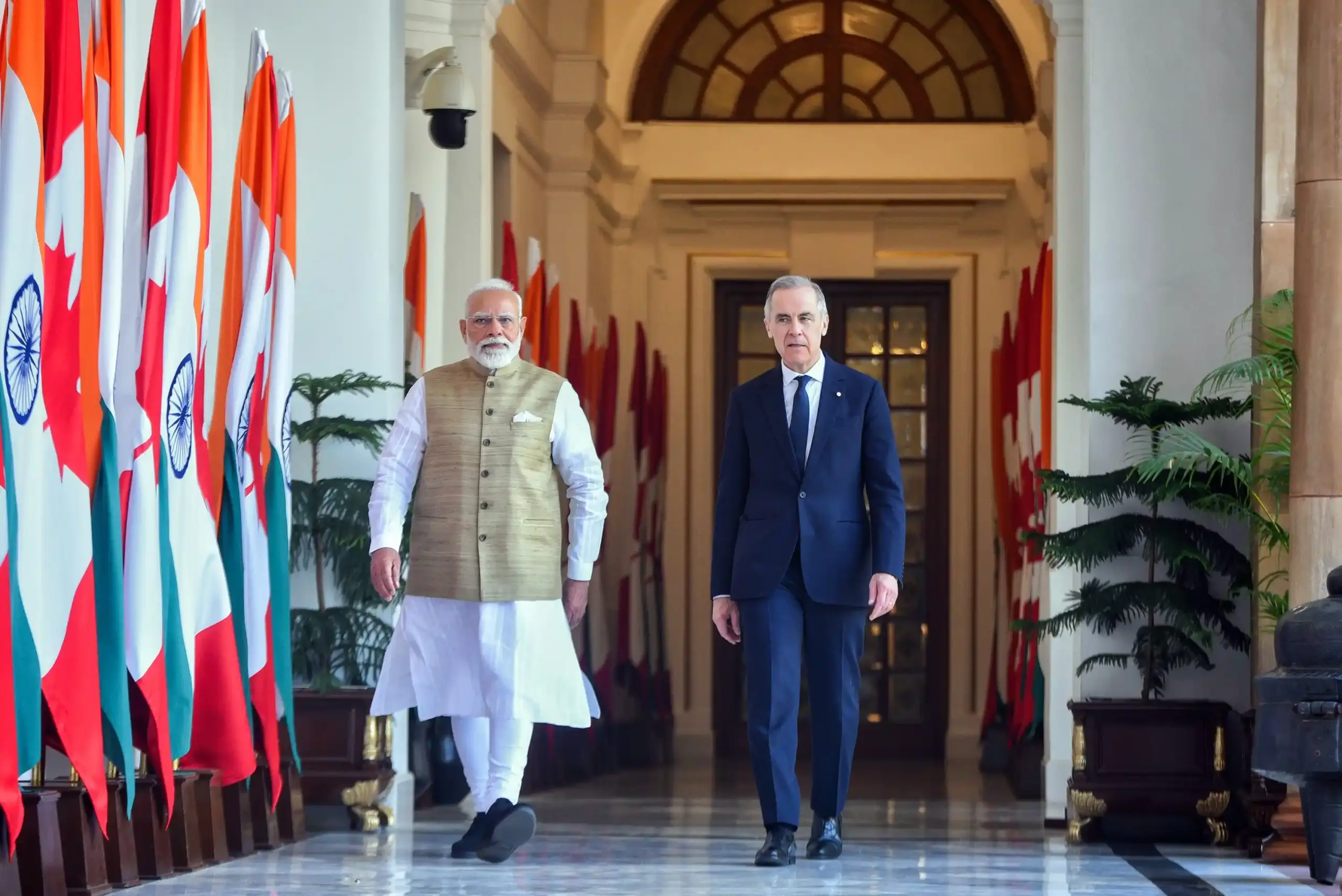
Prime Minister Mark Carney’s official visit to India from February 27 to March 2, 2026, was not a ceremonial courtesy call. It was a deliberate act of diplomatic re-engagement at a moment when both New Delhi and Ottawa appear to recognise that strategic distance, whatever its domestic political uses, carries real strategic and economic costs. The optics mattered, but the architecture mattered more. Carney arrived with senior ministers, provincial leaders, and CEOs because the relationship now needs ballast in trade, energy, technology, and institutional confidence. A reset that is meant to last must be built, not simply proclaimed.
The Joint Leaders’ Statement signalled that intent in familiar language: democratic values, respect for sovereignty and territorial integrity, and commitment to the rule of law. In a calmer era, such phrases could be dismissed as boilerplate. India and Canada differ in scale and geography, but both have a stake in predictable markets and credible international norms.
Energy as Anchor
Energy formed the spine of this recalibration, and for good reason. India’s demand is rising as it urbanises and industrialises, while Canada’s resource base is deep, diversified, and investment-ready. The relaunch of the India–Canada Ministerial Energy Dialogue at India Energy Week 2026 gave the partnership an institutional anchor, and the headline commercial outcome carried strategic meaning beyond its balance-sheet value.
A long-term uranium supply agreement between Cameco and India’s Department of Atomic Energy, valued at roughly ₹15,600 crore (CAD 2.6 billion), strengthens India’s civil nuclear programme and supports its clean-energy transition. It also signals Canada’s intent to be regarded as a stable supplier at a time when energy has once again become geopolitical. This was commerce, certainly, but it was also a marker of reliability.
The broader energy conversation, spanning gas and other hydrocarbon possibilities, reflects a straightforward reality: energy security now means diversification. For India, multiple dependable supply channels reduce vulnerability to price shocks and disruption. For Canada, deeper engagement with Asian energy markets is both an economic opportunity and a strategic hedge.
Minerals as Leverage
The Memorandum of Understanding on Critical Minerals Cooperation reflects a shared recognition that the energy transition depends as much on lithium, cobalt, nickel, and rare earths as it does on generation capacity. Mineral supply chains underpin batteries, electric mobility, grid-scale storage, and advanced manufacturing. Countries that cooperate on minerals will shape the pace, price, and security of clean technologies.
This is where strategic intent meets industrial policy. Mineral cooperation is not only about extraction. It is about processing capacity, traceability, environmental and labour standards, financing, and technology partnerships that reduce single-point dependence. If pursued seriously, India and Canada can help build a more trusted clean-tech ecosystem, one that strengthens resilience without sliding into reflexive protectionism.
Climate, Made Bankable
Climate cooperation during the visit carried a practical edge. The leaders prioritised collaboration in renewables, storage, hydrogen, bioenergy, sustainable aviation fuel, and grid modernisation, with plans for an India–Canada Renewable Energy and Storage Summit in 2026. Summits matter only when they produce pipelines: investable projects, shared standards, and procurement pathways that can survive political turnover. If the summit moves from announcements to bankable partnerships, it could become one of the visit’s most consequential follow-through mechanisms.
Carbon capture, utilisation, and storage also featured, reflecting a sober understanding of the political economy challenge both countries face. Climate responsibility must advance without hollowing out industrial competitiveness, especially in hard-to-abate sectors. The transition is not a sermon. It is a negotiated path between ambition and feasibility, shaped by technology, prices, and public consent.
Canada’s intention to pursue membership in the International Solar Alliance and to elevate its role in the Global Biofuels Alliance points to a maturing recognition that climate diplomacy is no longer peripheral. It sits increasingly at the core of market access, industrial advantage, and strategic influence.
Food Security Wins
Not all consequential cooperation arrives packaged as grand strategy. Agriculture and nutrition can deliver immediate, visible mutual gains. Canada’s strength in pulses and India’s position as the world’s largest producer and consumer of pulses create a natural complementarity. This is not only about trade volumes. It is about affordable protein, food security, and value-added processing.
The proposed Canada–India Pulse Protein Centre of Excellence at NIFTEM Kundli, with Saskatchewan as a partner, points toward a modern cooperation model: joint research, product innovation, and nutrition outcomes linked to commercial pathways.
Talent, Then Tech
Education and mobility remain the most visible connective tissue between the two societies, and the visit treated them as strategic assets rather than sentimental ties. Plans to expand joint and dual-degree programmes, facilitate offshore campuses, and revitalise higher education cooperation acknowledge both opportunity and obligation. Mobility must remain open, but it must also remain credible, including through transparency and predictable administrative processes.
The Memorandum of Understanding between India’s AICTE and Canada’s MITACS to expand the Globalink Research Internship programme, enabling around 300 Indian students annually to undertake research placements in Canada, sits alongside scholarships and fellowships in both directions. These exchanges do more than build skills. They create professional networks and the quiet familiarity that supports sensitive cooperation in technology, security, and crisis coordination.
Technology and space cooperation, too, moved from goodwill to governance. The relaunch of the Joint Science and Technology Cooperation Committee and the planned expansion of collaboration between the Canadian Space Agency and ISRO into areas such as atmospheric sciences, robotics, and quantum communications signal intent to work in domains where trust is the true currency. The leaders’ discussion of integrating artificial intelligence into space applications and distance medicine points to a grounded agenda: technology deployed for outcomes like grid management, energy storage optimisation, and wider health access. The Australia–Canada–India Technology and Innovation partnership adds a trilateral layer, reflecting a wider trend of trusted technology ecosystems among like-minded democracies.
Security as Bedrock
No reset between the two democracies can avoid the security conversation, and this visit did not try to. Enhanced cooperation on counterterrorism, organised crime, cybercrime, and narcotics trafficking, supported by structured liaison mechanisms, reflects a shared understanding that open societies require strong, lawful defences. It is also an area where misunderstandings can be costly, which is precisely why institutional links matter as much as political intent.
The institutionalisation of an India–Canada Defence Dialogue and Canada’s appointment of a Defence Attaché in India convey seriousness about military-to-military engagement. In the Indo-Pacific, both leaders reaffirmed their commitment to a free, open, and inclusive region. Canada’s interest in joining the Indian Ocean Rim Association as a Dialogue Partner similarly reflects converging strategic instincts. Security here is not a standalone pillar. It is the base layer that makes trade corridors, data flows, and scientific collaboration politically sustainable.
Trade as Test
Trade will ultimately judge whether this reset endures. The resumption of negotiations for a Comprehensive Economic Partnership Agreement is the most consequential long-term signal because it demands hard choices on market access, standards, mobility, dispute mechanisms, and regulatory transparency. The ambition to expand bilateral trade to roughly ₹4.2 lakh crore (CAD 70 billion) by 2030 is bold, but ambition has its uses. It disciplines policy, forces timelines, and signals seriousness to business.
Planned reciprocal ministerial-led trade missions, the reconstitution of the CEO Forum, and a Finance Ministers’ Economic Dialogue on payments modernisation and fintech innovation reflect an understanding of how commerce now works. It runs through industry buy-in, financial plumbing, digital interoperability, and regulatory confidence, not only through tariff lines. If dialogue translates into predictable rules and faster problem-solving, trade will provide durable momentum and wider political ballast.
From pause to purpose
Carney’s visit was neither nostalgic nor naively optimistic. It was pragmatic. It acknowledged, implicitly but unmistakably, that partnership among democracies is not self-executing. It must be maintained through institutions, reciprocity, and candour.
Diplomacy is best understood less as a handshake and more as a bridge. The ribbon-cutting makes headlines, but the bridge proves its worth only when it carries weight day after day, in all seasons. The March 2026 visit laid steel in several places: energy security, critical minerals, talent and mobility, trusted technology, and defence dialogue. Whether the structure holds will depend on sustained political will, administrative follow-through, and a shared refusal to let episodic controversy eclipse long-term interests.
In an era defined by uncertainty, recalibrated partnerships among democratic nations are not optional. They are strategic necessities. India and Canada have signalled an intention to move from pause to purpose. The next step is less glamorous than a summit: implement what was agreed, measure progress with transparency, and keep channels open even when politics gets loud. That is how a tested partnership becomes a resilient one.