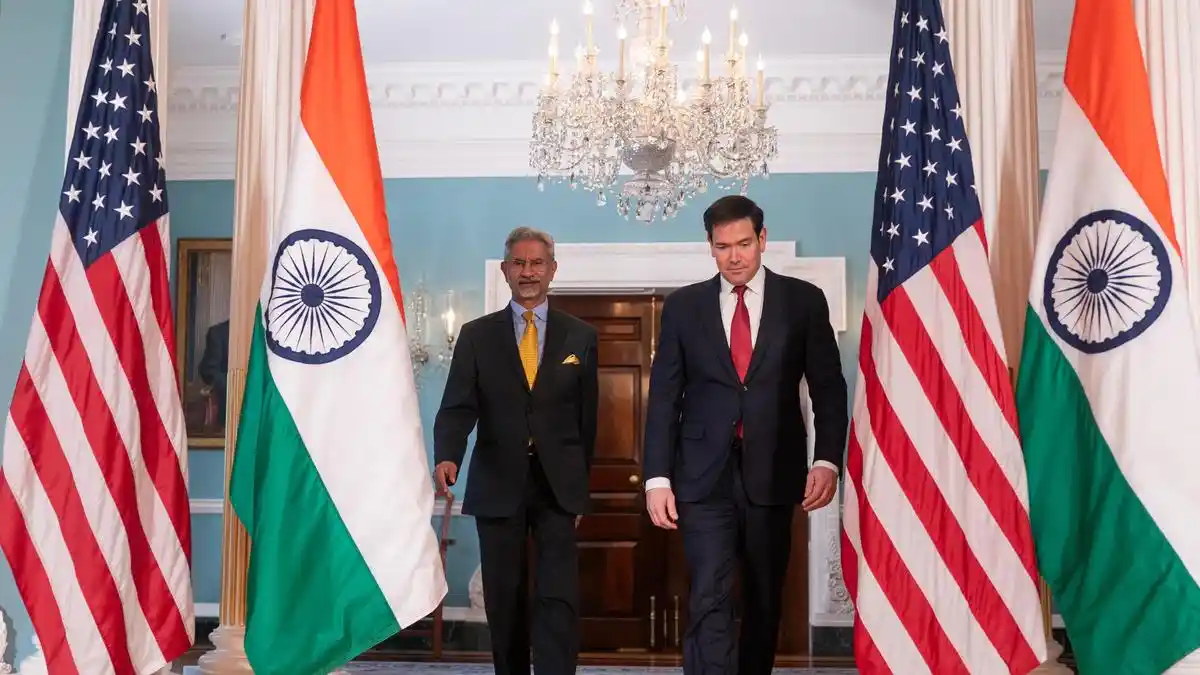
The recently released interim framework for the Indo-US trade deal has been met with a strongly divided reception, largely due to misreading the deal and overstating its intricacies. While Russian oil became a sore point in the deal, the larger part of the deal appears to be quietly balanced, demonstrating the management of power relations that had been the core objective in deals with superpowers.
The interim framework has three key highlights that capture the core of the deal. First, it aims to broaden the Indo-US strategic partnership by expanding BTA negotiations, particularly commitments under the US-India Catalyzing Opportunities for Military Partnership, Accelerated Commerce & Technology (COMPACT) initiative launched last year. Second, the deal seeks to balance Indo-US trade dynamics, in which India has maintained a large merchandise trade surplus with the US to date.
Third, it eases trade friction. India is committed to reducing or eliminating tariffs on all US industrial goods. Until now, India had maintained some of the highest tariffs on US goods, with tariffs as high as 37 per cent for agricultural goods and more than 100 per cent on certain autos. Similarly, the US had imposed tariffs on India of up to 50 per cent. This cycle of retaliatory tariffs between the US and India severely strained the ties, and with this deal, the ties are gradually beginning to ease, with the US also reducing tariffs to up to 18 per cent, a rate that, according to a note by JP Morgan, is roughly equivalent to an effective rate of 16 per cent.
This tariff reduction on both sides will ease pressure on various industries affected by the tariff, including India’s exports of $10.6 billion in textiles and apparel, $1.3 billion in leather and footwear (FY-2024-25), $9.5 billion in finished pharmaceutical formulations, and $5.7 billion in gems and diamonds. These three highlights demonstrate that India successfully managed its relations with the US by de-escalating tensions and avoiding further damage from the tariff war, taking into account the realities of power dynamics.
The Art of High Politics Trade
The trade negotiations and the politics surrounding them reveal a complex relationship between interests and bilateralism. The history speaks for itself, showing that trade negotiations are conducted and won through strategic foresight to fulfil the larger goal of maximising or adapting to evolving geopolitical realities and challenges, even if this requires concessions or calculated risks. In other words, for a deal to occur, three key elements must be addressed. First, relative gains, concessions to manage relative gains, and stability. In high-politics trade negotiations, a deal is unlikely to occur if one side achieves absolute gains while the other faces absolute losses. In the détente phase of the Cold War, the USSR faced a massive crop failure and a risk of famine; the US had surplus grain. In 1972, the US-Soviet grain deal was negotiated, under which the US agreed to sell $750 million worth of grain over three years to the Soviet Union on credit. In this deal, the USSR secured food security and avoided possible domestic unrest, while the US faced domestic backlash. Such a large sale to the USSR caused US domestic food prices to spike, leading to inflation for American consumers.
At first glance, this deal appeared to provide absolute gain to the Soviets; however, if we pay attention to the fine print, there was neither absolute gain nor loss, but rather negotiation aimed at protecting and maximising interests, where objectives mattered more than loss-gain calculations.
The 1972-73 grain deal gave the US diplomatic leverage over the Soviets, helping to soften the Soviet posture on the global stage, where US economic might served as a counterbalance to Soviet power. Geopolitically, it was a major win for the US and a major loss for the Soviets, but on the domestic front, US concessions led to some losses, while Soviet necessities ensured a tactical win at home. Even this high-politics Cold War trade negotiation had three elements. First, relative gain, where the USSR gained more from the US. Second, concessions to manage that relative gain, with the US’s deal, whether direct or indirect, softening the USSR at the diplomatic level and making the Soviets dependent on US economic power. Third, stability: the USSR sought internal stability, and the US sought to balance power at the peak of the Cold War by softening Soviet influence in key theatres. So, was the deal completely asymmetrical or symmetrical between the two superpowers? The answer is No. The agreement served only the broader strategic and tactical interests of both nations.
Similar power games were played during the US-China trade deal, against the backdrop of the 2020 US-China trade war. Under the US-China trade deal, China pledged to purchase $200B more in US goods and services, and in return, the US would slash tariffs, allowing China to avoid further escalation of the tariff war. For the US, it was a gain; for China, it was a loss, as it forced Beijing to accept such trade commitments and targets.
However, a closer look suggests that the concessions China made protected the Chinese manufacturing industry, which was being hurt by US tariffs, while at the same time preventing the US from achieving the original goal of the tariff war, which was to force China to make structural changes to China’s state-subsidy economic model. Securing its manufacturing sector and defeating the US’s purpose in the tariff war were long-term gains for China that balanced the US’s relative gains from the 2020 trade deal. In this case, neither China nor the US experienced an absolute loss or an absolute gain; both achieved recalibration and secured their respective tactical and strategic interests.
The Pressure Points
The critical commentary on the Indo-US trade deal focuses on two aspects. First, India made more market-access and concessionary commitments to the US, while the US offered only conditional concessions and adopted a purely transactional approach. Second, there is active surveillance of India’s oil trade to ensure that India does not directly or indirectly import Russian oil. The explanation for the first pressure point is that India didn’t completely surrender its market to the US; it strategically opened sectors to US investment, from technology to agriculture, to access the US market and attract US investment.
The US is India’s largest trading partner, and to sustain its 6.9 per cent GDP growth in 2026, India requires annual foreign capital inflows of $75-$100 billion. Therefore, committing to Preferential Market Access in the deal is in India’s broader strategic and economic interests, even if it entails some risks or concessions. It should be treated as the core gain of the deal, with the two countries balancing trade between the two countries.
Another issue regarding this aspect is the argument that the U.S. transactional mindset and conditional concessions render this deal lopsided. The counterargument is that, while India made concessions to grant the U.S. access to its market, it also insisted that the U.S. expand the Bilateral Trade Agreement with India to create greater room for economic convergence, thereby focusing solely on economic interests. Most importantly, India’s deal committed it only to purchasing $500 billion worth of U.S. energy products, technology, and aircraft, and it did not pledge to do so, unlike other countries such as Japan, which pledged $550 billion in purchases and investments. India’s deal also reserved its right to retaliate with tariffs against the U.S. if the U.S. increases tariffs unilaterally.
While the US pursued the deal with a transactional mindset, India, too, maintained a degree of transnationalism by avoiding entry into the US economic orbit and committing only to trade and market talks focused largely on investment incentives that fulfil and secure India’s strategic and tactical interests.
The Oil Conundrum
The second aspect is the US formally placing India under close scrutiny for purchasing Russian oil, directly or indirectly. This is widely regarded as the largest concession to the US under the US interim framework. The critical point is that India has undermined its autonomy in exchange for a deal.
However, India’s energy strategy has never relied on dependence; it has always pursued diversification. The obsession with Russian oil may have been tactical rather than fully strategic. Before 2022, Russia’s share of India’s oil basket was negligible (under 2%), but after the Russia-Ukraine war, India capitalised on this opportunity, and Russia’s share in India’s oil basket surged. In line with its diversification strategy, India is recalibrating its oil basket, but a complete halt to oil imports from Russia seems unlikely. As far as US monitoring goes, it has largely been ineffective in imposing caution on nations. Despite a maximum-pressure campaign and threats of sanctions against Iran for purchasing oil from China, the US’s monitoring tactics largely failed to halt Iran’s oil trade with China, where Iran’s oil exports reached a five-year high in 2024, averaging 1.5-1.7 million barrels per day. Therefore, these warnings and strongly worded conditions by the US in agreements have largely remained paper tigers in the long term. Even under such strong conditions, India’s official stance remains not to formally commit to a complete halt to Russian oil, as specified in the interim deal framework. At least recent statements by MEA do not indicate a move towards it. However, India must reconsider this oil clause before the final deal to avoid unnecessary friction and lock-ins in the future if the US decides to use it as leverage against India.
In sum, the Indo-US trade deal also demonstrated the classic high-politics trade negotiation, in which the US won by imposing oil sanctions but lost by failing to fully trap India within its economic orbit. The US sought to balance India’s relative gains in trade, such as low tariffs and market access, with conditional concessions (e.g., Russian Oil). On the other hand, India offset the US’s relative gains by not fully embracing the US economic sphere. The right reading of this deal is that neither side faces an absolute win or loss, but rather a recalibration and management of power relations and realities.