Prime Minister Narendra Modi, who in his first tenure as Prime Minister had laid the foundation stone of the rail line from Bairabi to Sairang (in Mizoram), will be immensely pleased to inaugurate the completed railway line on 11 September 2025. The opening of the 53.5 km rail line will not only fulfil the desire of the state, but will also be the continuation of the Indian Railways’ plan to connect all the state capitals of the Northeast.
Besides Guwahati, Itanagar (capital of Arunachal Pradesh) and Agartala (capital of Tripura) already have train connectivity. The process of establishing railway connectivity to Kohima (capital of Nagaland) is in full swing and is likely to be completed by 2029, while Imphal (capital of Manipur) is also expected to be connected around the same time. However, the process of connecting Shillong (capital of Meghalaya) may be delayed due to land acquisition issues.
Until a few years ago, no one could have imagined going directly from Agartala to Mumbai or from Itanagar to Delhi. But of late, there has been massive infrastructure development in the Northeast region. One of the unique features of the newly laid railway lines in the Northeast is that all railway tracks will have an electric system of operation, in addition to traditional diesel engines.
The railway line in Mizoram, 51.38 km in length and with a project cost of ₹8,071 crore, is an engineering marvel. There are 153 small and big bridges, including six high bridges with heights ranging from 70 to 114 metres. There are 45 tunnels, with the longest measuring 1.8 km. The entire railway track passes through dense forests, steep hills, and deep gorges. Apart from tunnels and bridges, almost 24 km of the track (46%) is in open areas, mostly through deep cuttings.
Unlike in most other states of India, the Indian Railways face tremendous challenges in extending railway connectivity in the Northeast. For almost four to five months, construction work is disrupted due to heavy monsoon rains. The alignment passes through hilly terrain, deep valleys, and gorges, requiring the construction of tunnels and viaducts or high bridges. Moreover, the project sites are prone to frequent landslides, making heavy maintenance work essential.
Additionally, suitable construction materials such as sand, stone, cement, iron rods, and chips are not easily available, especially in some hill states like Mizoram. Similarly, labourers have to be brought in from other states; however, few volunteer due to the remoteness and tough terrain.
Connectivity to Mizoram has brought another state of the Northeast onto the railway map of India. This will provide better and cheaper access to residents of Mizoram for travel to other states for education and healthcare. The movement of freight trains, along with the reduction in the cost of essential items, will also boost trade in the state. The railway line will greatly aid the movement of security forces such as the Assam Rifles and other paramilitary forces deployed along the Indo–Myanmar and Indo–Bangladesh borders.
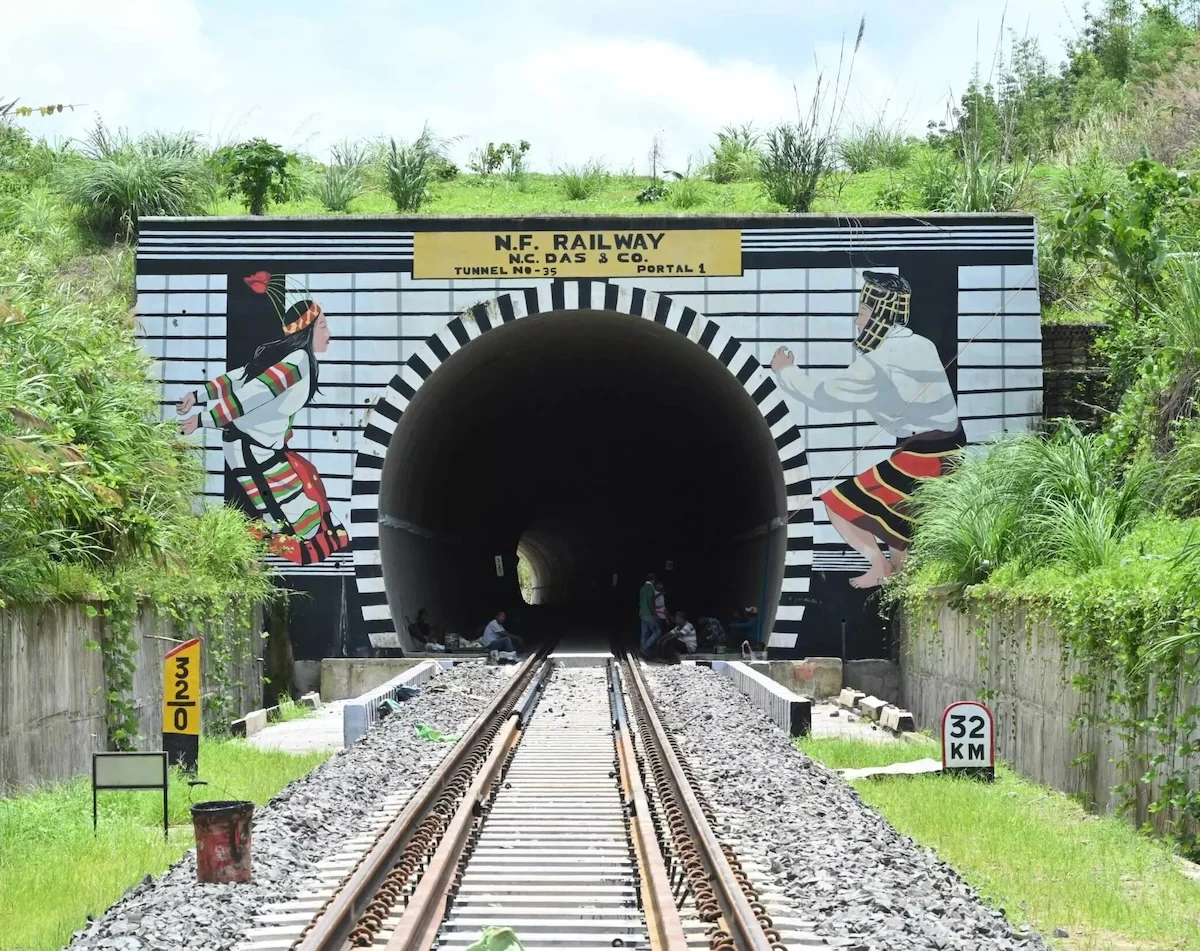
The Northeast is an excellent tourist destination. However, at present, tourism is mostly restricted to Assam, Arunachal Pradesh, and Meghalaya, which have better connectivity and infrastructure. Railway connectivity to Mizoram will attract tourists to the state. Cultural motifs have been depicted on tunnel faces to promote the culture of the state and transform the railway journey into an immersive cultural experience. These murals depict the dresses, festivals, customs, and traditions of local villages. The IRCTC (Indian Railways Catering and Tourism Corporation) has already signed a two-year MoU with the Mizoram Government to promote tourism in the state.
It is worth noting that the first railway line (metre gauge) in Assam was constructed in 1881. This 65 km line connected Dibrugarh town in Upper Assam with Margherita town. The primary motive of the British rulers in constructing the railway line was to facilitate the transportation of tea from plantation areas to the nearest river port on the Brahmaputra River for onward shipment to Chittagong (now in Bangladesh) and ultimately to markets in England. Similarly, the British extensively used freight trains for the carriage of coal and forest products.
Thus, the British had colonial interests in exploiting Assam’s rich natural resources, particularly tea, coal, petroleum, and forest products. However, much water has flowed down the Brahmaputra since then. The present thrust of the Government is the well-being and economic development of the people of the region. While attempting to meet the aspirations of the people, the Railways do suffer financial losses, but this does not deter them from striving to meet their objectives.
There is no doubt that all the states of the Northeast will soon find their place on the railway map of India.