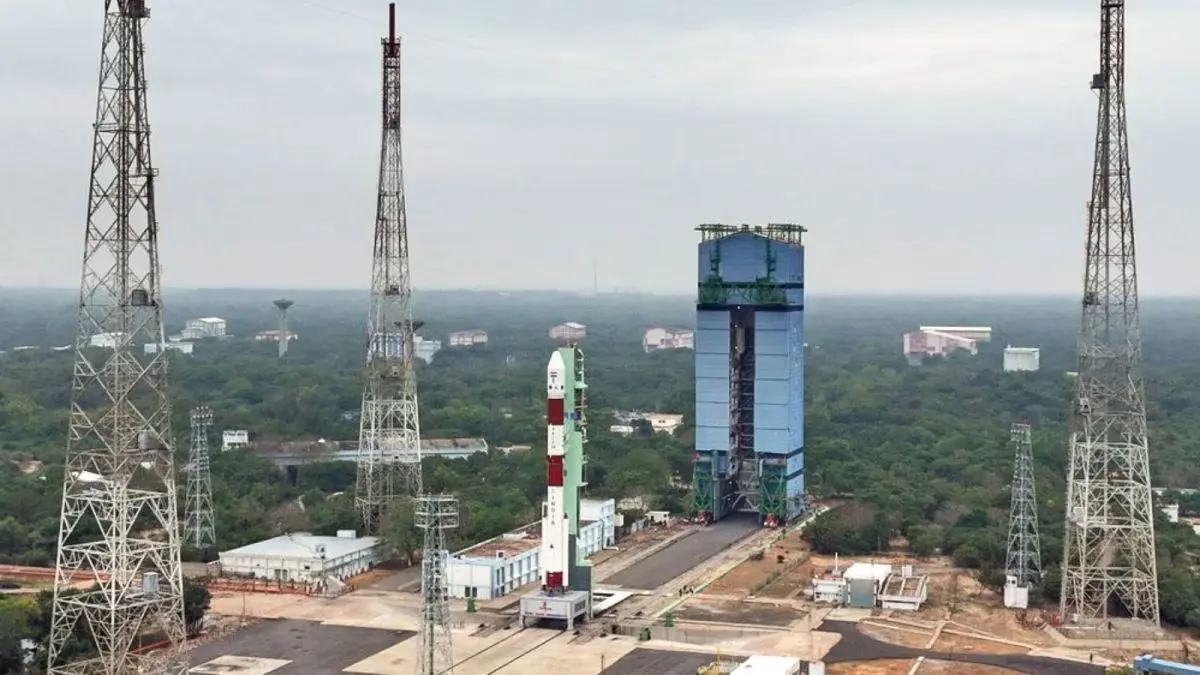
On January 12, 2026, the Indian Space Research Organisation (ISRO) scripted another chapter in its stellar ascent, successfully launching the PSLV-C62 mission from the Satish Dhawan Space Centre in Sriharikota. Liftoff occurred at around 10:17 AM IST, propelling the primary payload, EOS-N1 (codenamed Anvesha), and 15 co-passenger satellites into a sun-synchronous polar orbit. This marked ISRO’s first orbital mission of the year and the ninth commercial venture by NewSpace India Limited (NSIL), ISRO’s commercial arm. Amid reports of a minor third-stage performance anomaly—still under analysis—all payloads achieved their intended orbits, underscoring the Polar Satellite Launch Vehicle’s (PSLV) legendary reliability with a success rate exceeding 95%.
The PSLV-DL configuration, the 64th flight of this proven workhorse, demonstrated India’s mastery of cost-effective space access. At under $25 million per launch, PSLV undercuts global competitors like SpaceX’s Falcon 9 rideshares, positioning India as a preferred partner for small satellite deployments. The mission’s primary star, EOS-N1/Anvesha, a collaborative effort with the Defence Research and Development Organisation (DRDO), boasts advanced hyperspectral imaging across hundreds of spectral bands. This technology pierces beyond visible light, detecting subtle changes in terrain, vegetation, and infrastructure—ideal for border surveillance, troop movement tracking, agricultural monitoring, and disaster response. In an era of heightened Indo-Pacific tensions, Anvesha equips India with “no-escape” orbital vigilance, capable of identifying camouflaged assets or resource shifts that ground-based systems miss.
Complementing Anvesha were 14 co-passengers, blending domestic innovation with international collaboration. Notable among them: Spain’s Kestrel Initial Demonstrator (KID), a pathfinder for reusable re-entry tech slated for a controlled Pacific Ocean splashdown, testing heat shields and descent systems. Domestic payloads included experimental satellites from Indian startups and academic institutions, fostering the burgeoning private space sector under NSIL’s rideshare model. This commercial infusion generated revenue while de-risking ISRO’s focus on flagship programs like Gaganyaan, India’s human spaceflight endeavor targeting 2027.
The mission’s diversity reflects India’s strategic pivot. No longer just a launch service provider, ISRO now curates multinational payloads, weaving space diplomacy into its foreign policy toolkit. Partnerships with Europe, Southeast Asia, and beyond amplify India’s soft power, countering China’s assertive orbital expansions like the Tiangong station and BeiDou network. As NSIL scales operations, expect more such hybrid missions, blending defense primacy with economic multipliers—each launch injecting vitality into India’s $8 billion space economy, projected to hit $44 billion by 2033.
Resilience Amid Adversity
Even as celebrations ensued, ISRO’s transparency shone through. Telemetry data revealed a “performance anomaly” in the PS3 stage, echoing a prior 2025 PSLV mishap whose root cause remains elusive. Yet, the vehicle’s robust design ensured mission success, with satellites injected precisely into orbit. This incident, far from a setback, highlights ISRO’s iterative engineering ethos—learning from anomalies to refine future flights like the upcoming PSLV-N1 and GSLV missions lined up for 2026. In a field where perfection is elusive (NASA’s SLS has faced delays, Europe’s Ariane 6 stumbled initially), ISRO’s agility stands out, turning potential pitfalls into progress.
Critics might decry the anomaly as a red flag for India’s ambitious roadmap, including the Next-Generation Launch Vehicle (NGLV) and Bharatiya Antariksh Station by 2035. But history favors the resilient: Chandrayaan-2’s lunar soft-lander glitch birthed Chandrayaan-3’s triumph. PSLV-C62 reaffirms this pattern, proving that high cadence—ISRO eyes 10-15 launches annually—trumps occasional hiccups.
Zoom out, and PSLV-C62 embodies India’s multipolar space strategy. With President Trump’s reelection reshaping U.S. alliances and China’s military drills near Taiwan, orbital intelligence is the new great power arbitrage. Anvesha’s hyperspectral gaze fortifies India’s deterrence along the Line of Actual Control (LAC) with China, enabling real-time assessments of infrastructure like PLA airfields or hydropower dams. It also aids economic security, monitoring crop yields amid global food volatility or illegal mining in resource-rich frontiers.
Economically, the launch catalyzes self-reliance. Private firms like Skyroot and Agnikul, fueled by NSIL contracts, are prototyping reusable rockets, eroding foreign dependence. This ecosystem promises jobs, tech spin-offs (think satellite IoT for farmers), and export revenues—vital as India navigates U.S. tariffs and EU green mandates.
Charting 2026’s Cosmic Course
As 2026 unfolds, PSLV-C62 sets a blistering pace. Subsequent missions will escalate: SpaDeX docking demos for on-orbit assembly, NISAR radar mapping with NASA, and Aditya-L2’s solar vigilant successor. Yet, challenges loom—budget constraints, talent retention amid global poaching, and spectrum wars over satellite constellations.
ISRO’s response? Democratize space. Initiatives like Student Satellite Launch Opportunities and ARDC incubators empower the next generation, ensuring India’s orbit remains indigenous. Globally, this launch whispers a bolder message: India launches not just satellites, but sovereignty. In a contested cosmos, PSLV-C62 isn’t mere engineering—it’s existential insurance, a frugal fist in geostationary gloves. Nations eyeing partnerships (or rivalries) would do well to watch Sriharikota’s flames light the path ahead.