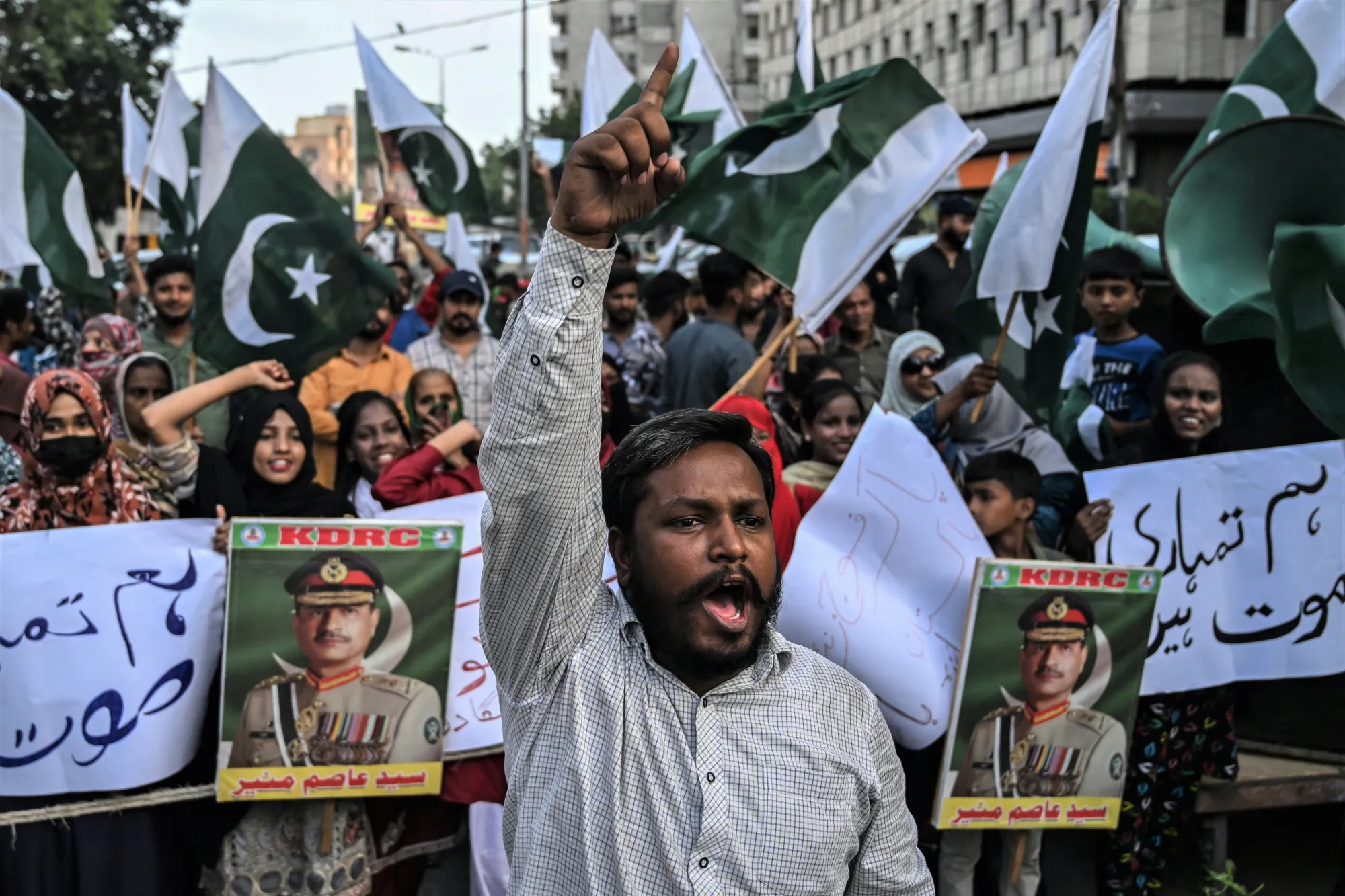
As the US cultivates the Pakistani hybrid regime and General Munir consolidates power inside the Pakistani polity, India needs to change tack quickly to highlight the ever-growing democratic deficit inside Pakistan. Earlier, in less than two months, Field Marshal Asim Munir has twice issued nuclear threats to India. In response, Indian Defence Minister Mr. Rajnath Singh said the BrahMos proved most effective during Operation Sindoor. Pakistan’s uncertain place in the regional politics of South Asia and West Asia is throwing up new dynamics. Much like the Pakistani state is a hybrid of a democracy and military dictatorship, its leader, Field Marshal Asim Munir, is also a hybrid entity in regional politics.
In April 2025, Pakistan was a largely forgotten state struggling economically and waiting for an IMF bailout. Both its benefactors, the US and China, were distracted with larger global politics, and its arch-rival India had emerged as one of the “middle powers”. On April 22, a terrorist attack killed 26 Indian tourists in Pahalgam, Jammu and Kashmir and brought Pakistan into the global limelight. The attack took place a few weeks after the Army Chief General Asim Munir delivered a vitriolic speech against India, calling Kashmir the jugular vein of Pakistan. India responded to the attack with Operation Sindoor – unprecedented and targeted military strikes on terror infrastructure inside Pakistan. During the four-day conflict that ensued, the rest of the world, including the US, Europe, and China, reverted to their conventional diplomatic positions and counselled Diplomacy and Dialogue. US President Donald Trump claimed he had mediated and stopped the war, although the Indian side dismissed this assertion. The bogey of nuclear conflict and the fluctuations of global geopolitics enabled the Pakistan Army to project itself as the protector of the faith to its domestic population once again.
Democracy’s further decline
However, before this four-day conflict with India changed his fortunes in 2025, the Pakistan army chief was reeling from a confrontation with the supporters of Imran Khan and his political party in 2024. As Ayesha Jalal writes in the Journal of Democracy:
“The real significance of the 2024 elections lies in the continuity of an electoral process that has historically been subject to political engineering by Pakistan’s security-oriented state. Further delays in the process, however defective, would have risked martial law and losing even the minor gains made on the “democratic” front. Democracy will remain a distant hope for Pakistan until its politicians know the difference between winning a battle and losing the war…The fact that PTI-backed “independents” performed so well on February 8 is a testament to the loyalty of PTI devotees and the ingenuity of the party’s social-media team, not to mention the addition of twenty million new young voters (who constitute 44 percent of the electorate and are believed to overwhelmingly support Khan’s party) to the rolls.”
Therefore, Field Marshal Asim Munir wants to crush this young impulse towards democratic politics in Pakistan. Although he has recently remarked that he does not want to replace the current president of Pakistan and that a sincere apology for May 9 protests is needed, he has displayed a vicious and vindictive attitude towards Imran Khan.
Field Marshal’s hybrid existence has been made possible in part due to the policy of the United States. The U.S. State Department has consistently stated that Imran Khan’s legal cases and arrest are an “internal matter” for Pakistan. Trump’s lunch with Pakistan’s Army chief on the eve of the Iran-Israel conflict has led to speculation that the Trump administration wants to co-opt Pakistan into its West Asia policy rather than South Asia policy. Meanwhile, former NSA Jake Sullivan has accused Trump of damaging India-US relations to bolster his family’s commercial deals with Pakistan. This has emboldened the General to escalate his rhetoric on nuclear sabre-rattling, religious dog-whistling, and domestic authoritarianism. Munir’s goal is to maintain Pakistan’s status as a useful military state for regional ambitions. His security pact with Saudi Arabia is more a reflection of a servile mindset rather than a strategic one.
Anti-India Policy as a feature, not a bug
However, he is also escalating his rhetoric against India to consolidate more power inside Pakistan. In the fiscal year 2025-26, Pakistan’s government announced a substantial increase in its defence budget. This hike, as reported by various international news outlets, is around 20%, bringing the total defence allocation to approximately 2.55 trillion Pakistani rupees (about $9 billion). The military spending hike comes amid a 7% cut in Pakistan’s overall government spending, diverting funds away from critical sectors like development, education, and social services. The military, under Munir’s leadership, has also taken a prominent role in economic policy, including through the Special Investment Facilitation Council (SIFC), which was created to make key decisions and secure international investment. In the wake of the conflict, the Pakistan military is undergoing a major modernization effort. Prime Minister Shehbaz Sharif announced the creation of a new military branch, the Army Rocket Force, specifically to supervise missile combat capabilities. This move is explicitly aimed at matching India’s military advancements.
There is also a difference in approach between Munir and some top-level generals. A key point of contention is his hard-line stance toward India, which led to the recent military conflict. Some senior officers, including the Chairman of the Joint Chiefs of Staff Committee, Gen. Sahir Shamshad Mirza, reportedly believe that this confrontational approach is detrimental to Pakistan’s security and economic interests and have advocated a more cautious approach or the conflict could erupt.
However, it is possible that hybridisation of the Pakistani state, as symbolized by the field marshal, is consolidating two features into permanent features. Anti-India sentiment is now squarely a domestic state policy for the Pakistani Army rather than an international issue, and Pakistan’s utility as a security state has to be repeatedly proven to its global benefactors. This means that the hybridization of the state could become impossible to disentangle so long as the current chief sees incentive in escalation and material benefit. This is an ominous portend for regional stability.
This is because, unlike previous anti-India Army chiefs who were strategic about this rhetoric, the current chief sees it as a tool to increase the material size of the Pakistani military and its commercial stakes at the heart of Pakistan’s domestic politics. This creates a vicious cycle of incentives, where every escalation could be rewarded by the international community, as happened in the aftermath of Pahalgam with Donald Trump and Asim Munir’s diplomatic overtures.
Indian Defence Build-Up
For India, this represents a new strategic environment,
“We have seen reports regarding a continuing pattern of reckless, war-mongering, and hateful comments from Pakistani leadership against India. It is a well-known modus operandi to whip up anti-India rhetoric time and again to hide their own failures,” Ministry of External Affairs (MEA) spokesperson Randhir Jaiswal said. He warned that “any misadventure will have painful consequences, as was demonstrated recently.”
The onus of restraint will fall on India, being the bigger power, but it still depends on the trigger. In the aftermath of the operation, the Indian government announced a major boost to the defence budget. A supplementary budget of approximately Rs. 50,000 crore was proposed, which would raise the total defence allocation to over Rs. 7 lakh crores. The Defence Acquisition Council (DAC), in its first meeting after the operation, cleared ten capital acquisition proposals worth over Rs. 1.05 lakh crore, all through indigenous sourcing. The IAF is acquiring three new spy planes and an upgrade program for 84 Su-30MKI fighter jets. The Cabinet Committee on Security (CCS) also cleared a significant deal worth Rs. 62,000 crores for 97 LCA Tejas Mark 1A fighter jets. The Army is set to receive three new regiments of the indigenous Quick Reaction Surface to Air Missile (QRSAM) systems.
After Operation Sindoor in May 2025, India’s drone production and acquisition have entered a new, accelerated phase, shifting from a focus on importing technology to prioritizing indigenous manufacturing and development. The government has provided strong financial backing. A significant allocation of $234 million (₹20 billion) has been made for the local drone industry over the next three years.
The Pakistan Army Chief’s goal is the constant militarization of the Pakistani hybrid state. India’s goals are emerging as a limited form of demilitarization of the hybrid state. However, the implications can be avoided if the international community supports the clear offshoots of democracy that are clearly visible now in the Pakistani polity. The Young population of Pakistan and its connection with the PTI may offer this hybrid state a potential pathway to democracy, along with its hybrid Army Chief/Field Marshal. This may not necessarily mean the rehabilitation of Imran Khan in Pakistani politics, but certainly his political party. The disentanglement of the various threads of the Hybrid Pakistani State is an essential requirement for Democratization and Demilitarization of the Pakistani Polity.