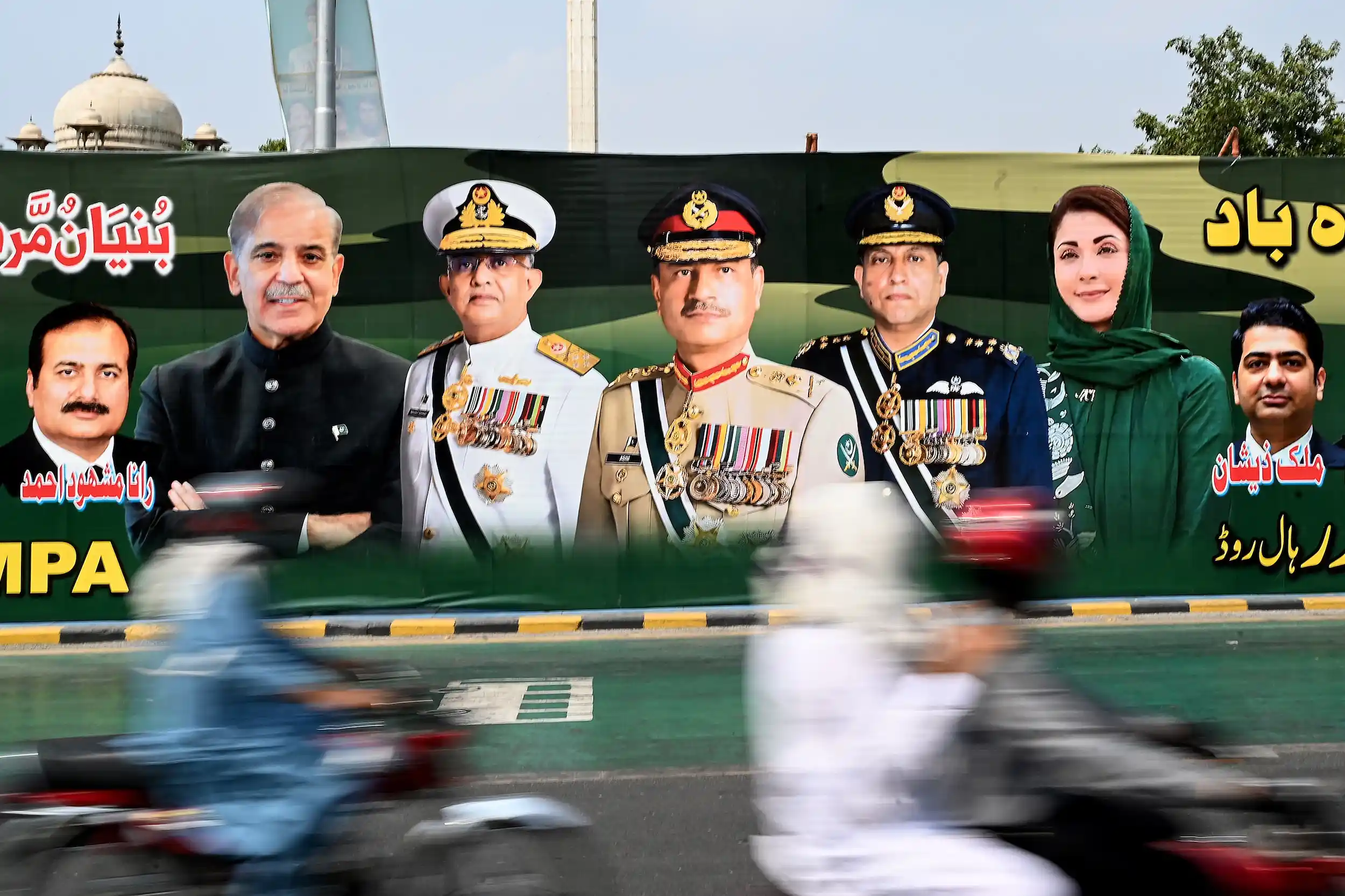
During its counterinsurgency operations (COIN) in the restive Afghanistan-Pakistan border in post 9/11 era, the Pakistan Army sustained immense casualties at the hands of the Al-Qaeda and Taliban, who went hammer and tongs, quaking the Pakistan Army in its boots. When the Americans rankled over the ‘disappointing’ performance of the army, some of Pak army officers complained privately that their opponent insurgents pay their cadres better than the Pakistan government compensates its soldiers. This complaint revealed latent dissatisfaction among the lower stratum of the Pakistani armed forces regarding payments. In Pakistan, this is significant, as the powerful armed forces traditionally command a larger share of the defence budget. Pakistan is the only state in the world where, it is said, the army has a state. After the initial ten years of tumultuous political high dramas, the army took hold of the administration in 1958, claiming to navigate the sinking ship through the howling gales. Resultantly, however, the army became deeply involved in politics and dominated all the state institutions. It not only became both de jure and de facto rulers of the state, but also a plunderer of the state’s resources. The armed forces personnel indulged in commercial and profit-making ventures, which constitute a major part of Pakistan’s political economy today, inherently different from the military budget. Notably, these commercial ventures are limited to the officer cadre rather than being evenly distributed among the rank and file.
Noted Pakistani political scientist Ayesha Siddiqa has referred to this military capital of Pak armed forces as Milbus. In her book Military Inc: Inside Pakistan’s Military Economy, Siddiqa exposes this unaudited military capital augmented for the personal benefit of Pakistan’s army officer cadres, whose significant component is entrepreneurial activities of the military personnel and their cronies under explicit or implicit patronage of the military. The army is Pakistan’s largest landlord, biggest industrialist, and powerful banker running an empire that penetrates every sector of the economy. Thus, the army needs control over the policy-making processes and distribution of resources and thus indulges in political control. The civilian governments are thrown out if they dare to upset this parallel economy generating tens of billions of dollars annually for the military top brass, which remain largely exempt from taxation, regulation, or civilian oversight. The civilian political leadership of Pakistan, on the other hand, has acquiesced to this arrangement. Instead of fighting back, the elected civilian leadership used the opportunity to satiate their hunger for wealth during their tenure. Thus, the Corruption Index Report of 2022 ranked Pakistan 140th out of 180 most corrupt countries in the world. The United Nations reported in 2021 that the subsidies worth $17.4 billion were rolled out to the elites, including corporate, feudal lords, and the military.
It has been the responsibility of all civilian governments in Pakistan to protect the interests of the ‘Milbus’ by not tinkering with it. The arrangement is now set in stone. Thus, the current military supremo, Asim Munir, was seen alongside Prime Minister Shahbaz Sharif at the World Economic Forum meeting in Davos last month, attending a series of informal engagements. The extraordinary attendance of a serving military chief at such economic-investment engagements highlights the grip of the Pakistani military over the country’s foreign as well as economic policy, which it does not leave in the hands of the civilian leadership. Munir shadowed the Pakistani prime minister to the Oval Office in Washington in September 2025 to meet US President Donald Trump was bagging a lucrative trade deal. A US metal company, US Strategic metals, signed a $500 million deal with Pakistan’s Frontier Works Organization, a premier military engineering organization in Pakistan, for collaboration plans that include setting up a poly-metallic refinery in Pakistan.
Pakistan has been a major supporter of the US’s West Asia policy. Washington cultivated Pakistan as the most cost-effective and essential means to protect US interests in the region, carrying the gun. For decades, the USA used the Pakistani military in its proxy wars in the region to bolster pro-West regimes against rising popular rebellion. US dollars and armaments have been pouring into the military coffers of Pakistan since then. The USA was so convinced about the unadulterated compliance of the Pakistani military and its indispensability in administration that it helped develop a ‘hybrid regime’, a deal of power sharing between the military rulers and the civilian leaders, as happened between Benazir Bhutto and General Pervez Musharraf in 2007, with the elected Bhutto government leaving the foreign and defence policy to the army. Bhutto’s assassination upset the arrangement, and it survived under her widower Asif Ali Zardari’s government. The problem, however, arose with Imran Khan, handpicked by the army itself in 2018. Khan lost confidence in the parliament (read army) and, as a result, his post in 2022 since he refused to acquiesce to this hybrid system, which was a façade for permanent military control. Besides Khan’s implacable stand on the USA and his ill-timed visit to Moscow in February 2022, when the Ukraine war started, narked Washington and expedited his departure, landing him in jail. The military oligarch of Pakistan does not want to lose the plundering power of the state resources and the control over the policy-making process. After the rise of Imran Khan’s Pakistan Tehreek-e-Insaf (PTI) as a popular resistance symbol to the ‘hybrid mechanism’, the rattled oligarchs turned increasingly distrustful of the civilian partnership. Thus, it amended the constitution enshrining the military’s supremacy over all state institutions. It convinced the business-minded US President, who suspended assistance to Pakistan in his first term, offering rare-earth reserves and a lucrative cryptocurrency partnership with the Trump family-controlled firm World Liberty Financial. Internally, it manages the public support with perennial ‘enemising’ of India, a pretext to justify its lion’s share in the budget, and sometimes helps restore its prestige. The gilded military top brass then brazenly attempts to deceive the public, claiming the deals as a remedy to the economic crisis, a pie in the sky, as the unfortunate neighbour remains stuck with low economic growth and suffers economic fragility. The Pakistani military oligarchs treat the country as the goose that lay golden eggs and feed it with a hybrid governing system and perennial Indophobia.