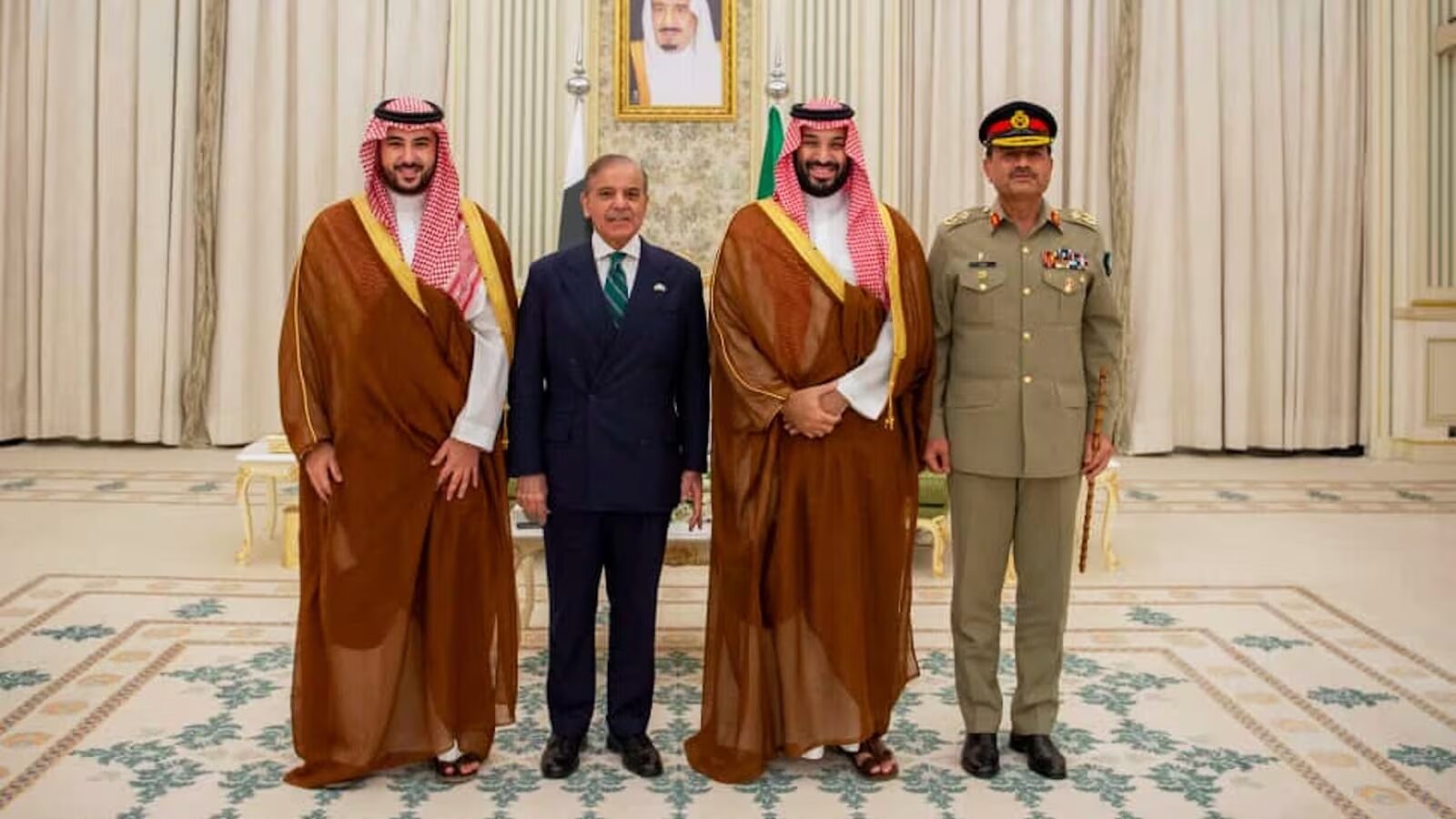
On 17 September 2025, the world’s only Islamic nuclear country, Pakistan, and the strong Arab response force, Saudi Arabia, signed the pathbreaking Strategic Mutual Defence Agreement in Riyadh. The accord reflected the shared commitment to enhanced security, develop aspects of defense cooperation, and strengthen joint deterrence against any external aggression. In fact, the defence pact states that “any aggression against either country shall be considered an aggression against both countries. While thanking the Crown Prince Mohammed bin Salman, Prime Minister Shehbaz Sharif was optimistic that the defence cooperation signalled robust bilateral relations, thus merging the ‘common’ interests and security concerns extending beyond the Middle East to the South Asian region.
The Pact
Given the current turmoil in the Middle East, Pakistan, which has no formal relations with Israel, has been highly critical of the latter’s military actions in Gaza, Iran, and Qatar. Pakistan’s anti-Israel stand is also reflected in the joint statement issued by Turkiye President Recep Tayyip Erdogan at a meeting with Pakistan’s PM Sharif in Tianjin at the sidelines of the 25th SCO summit, stating that Turkiye stands in the same position as Pakistan against Israel’s genocide and will work in tandem in this regard. Islamabad also condemned Israel’s bombing in Doha, calling it a brazen violation of Qatar’s sovereignty and international law. The signing of the deal is speculated to be an outcome of the Israeli attack on Qatar recently. Fearing a possible military action by Israel against Pakistan, this treaty has elevated the bilateral relations to new heights.
The defence pact has many countries, both from the Middle East and South Asia, hyperventilating. Saudi Arabia – the largest Middle Eastern economic power with an enormous military force alongside modern combat aircraft- Pakistan’s political and defence circles view this development as a game-changer. Mainly because, by de facto, the defence pact would act as an extension of Saudi Arabia’s military support in case of a war against India. As for Riyadh, a far-reaching strategic connection to the nuclear weapon program of Pakistan could possibly enable Saudi Arabia to acquire its own nuclear strike force in case of attack, especially by Iran. A swift possible transfer of nukes from Pakistan to Saudi Arabia within hours, according to political observers, which, if true, would mean that Saudi Arabia may become a de facto nuclear military power during the time of an attack on its territory.
Moving beyond Middle Eastern Regional Aspirations
With the signing of the defence agreement, it is speculated that Saudi Arabia’s regional aspirations are said to expand beyond the Middle East. Additionally, Riyadh’s dialogue partner status in the SCO and its growing proximity with India and China, alongside Pakistan, has further strengthened its geopolitical footprint in the South Asian region.
Political analysts speculate that the signing of the defence deal could result in a domino effect of an untoward military adventurism in the Middle East and South Asia, respectively. Alongside India, South Asian regional stakeholders, especially China, will also be mindful of the development. South Asia has always remained an integral part of its growth as Belt and Road Initiative (BRI), has extended its economic reach. The China-Pakistan Economic Corridor (CPEC), a flagship BRI project, connects China’s Xinjiang province to Pakistan’s Gwadar port infrastructure network, currently under construction.
China has long consciously avoided any full-scale military confrontation post the 1962 War against India. Beijing understands and has been a keen observer of the impact of any military adventurism, as seen with the US military presence in Afghanistan post Global War on Terror and the Russia-Ukraine War. Its commitment to strengthen its global footprint requires a stable and secure regional and international geopolitical environment. South Asian and the Middle Eastern region are a crucial part of its growth story. Hence, China monitoring Pakistan’s actions since the singing of the deal could put to test China’s clout in South Asian region including the ‘all weather’ partnership.
Should India be Concerned?
New Delhi and Riyadh have developed a strategic partnership that has seen an upward trend, with Prime Minister Narendra Modi’s visits to Saudi Arabia in 2016, 2019, and 2025, while Crown Prince Salman has visited India in 2019 and 2023. For India, ensuring peace, security, and stability in the Middle East is crucial, given the presence of a large Indian Diaspora and the region’s abundant energy reserves, which meet its growing energy demands.
While India and Saudi Arabia have displayed a certain maturity in their approach to each other, which enabled them to set aside minor irritants in their relations and emphasize and concentrate on those areas where their broad interests coincided in the long run, the same cannot be said of the recent signing of the defence agreement between Pakistan and Saudi Arabia.
Official spokesperson Shri Randhir Jaiswal quoted that “we will study the implications of this development for our national security as well as for regional and global stability. The Government remains committed to protecting India’s national interests and ensuring comprehensive national security in all domains.”
With Pakistan showing keen interest in initiating similar agreements with other Gulf States like Qatar and the United Arab Emirates, the thaw in the bilateral relations between India and China recently could possibly see how India puts a purposeful effort in gaining China’s confidence in mending Pakistan’s military aspirations, which could have possible repercussions in the South Asian region.
With Saudi Arabia holding a ‘soft spot’ for Pakistan, mainly as a victim rather than the perpetrator when dealt in the Indian context, Islamabad will be eager to grasp any opportunity, including economic and military assistance from the Riyadh administration, possibly against India. Hypothetically, should there be a third-party involvement in a military confrontation between India and Pakistan, which in this case is Saudi Arabia, despite a multi-alignment foreign policy, signing a similar defense agreement is far-fetched but accomplishable under certain circumstances, as seen in the past during the 1971 Bangladesh Liberation War.