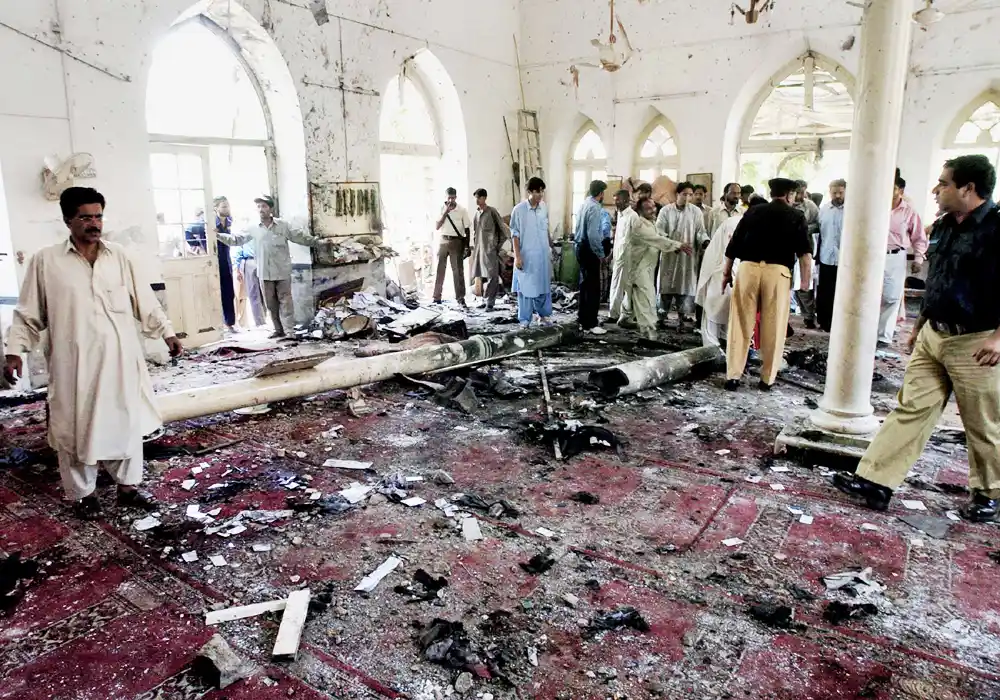
After almost five years, ISIS has carried out a high-intensity terror attack in the subcontinent, targeting Pakistan’s Shia mosque, killing more than 30 people and injuring around 170. The last such attacks were the 2023 Khar bombings, the deadly Peshawar Mosque bombing in Pakistan in 2022, which killed more than 60 people, and the Abby Gate bombings during the US withdrawal from Afghanistan in 2021, which killed over 170 people. After two years, ISIS-K carried out such a high-intensity suicide bombing, too, during the visit of the Uzbekistan President to Pakistan. This may appear an episodic case of terror, but passing it off as such would be unwise, and closer attention to the Khorasanis’ struggle for their foothold in the South Asian subcontinent raises a serious alarm for regional security.
The Khorasani Struggle
After the US withdrawal from Afghanistan, ISIS-K gained a limited opening to expand its influence in the subcontinent, beginning with the Kabul School bombings months before the withdrawal and continuing during it, including the Abby Gate bombings in August 2021. A closer analysis of ISIS-K activities in the subcontinent in 2021 reveals that the Khorasani stepped up attacks in Afghanistan and marked an alarming resurgence in South Asia’s backyard with 334 attacks, a significant increase from 83 in 2020, along with five suicide bombings in Afghanistan in 2021. However, by 2022-2023, ISIS-K was significantly weakened by the Taliban’s retaliation and counter-offensive operations, which led to the killing of key leadership of ISIS-K in Afghanistan. In early 2023, the Taliban killed Qari Fateh, ISIS-K’s military chief, and Abu Saad Muhammad Khurasani, a senior ideologue and interim leader.
As the Taliban intensified counterinsurgency operations, Khorasanis shifted to a clandestine mode of operation, creating strong, deep cells to sustain low-intensity attacks and remain below the radar. Even this strategy dried up, and the Taliban’s broad crackdown led to the infiltration of ISIS-K’s deep networks and continued raids in Khorasani strongholds such as Nangarhar and Kunar, as well as a few urban areas where the group was operating in a fragmented state. The current trend of attacks in Afghanistan remains low-intensity, limited to targeted killings of ideological and political figures.
The Pakistan Shift
From 2022 onwards, there was a shift from Kabul to Islamabad. The Khorasanis began carrying out low-intensity attacks in Pakistan and, within months, escalated their activities to a peak with the Peshwar Mosque bombing, which killed more than 60 and left more than 100 injured. Overall, the Khorasanis carried out a high frequency of internal attacks in Pakistan during 2022. By the end of 2022, the terror activities of ISIS-K began to decline, and the next major strike occurred almost a year later, when the Khorasanis carried out a suicide bombing in the Khyber Pakhtunwa region, Khar district, during a rally of the Islamic fundamentalist political party Jamait Ulema- E Islam(F), killing more than 60 people and injuring more than 200. In 2024, Khorasanis began expanding externally into the Central Asian region while keeping low-intensity, targeted killings active in Pakistan. The pattern of Khorasani suggests that they are largely focused on capitalising on a weakened security environment, finding the right distraction to strike, and sending signals of a strong or increasing presence.
The Khorasani Pattern
ISIS-K has, from time to time, sought to demonstrate its presence in Afghanistan and Pakistan by keeping its cadre alive through clandestine recruitment and targeted killings. To amplify its impact, it seeks opportune moments to deliver shock value and high casualties, thereby maximising terror, a hallmark of ISIS-style attacks. The Khorasanis have adopted a gap-driven strategy, prioritising lethality over frequency, to reassert their power and relevance in the region. During 2022 and 2023, ISIS-K (ISKP) attacks in Pakistan not only increased but also became significantly more lethal, capitalising on a weakened security environment due to the resurgence of Balochis and the breakdown of the ceasefire agreement with TTP in 2022. Similarly, in 2023, when TTP and BLA attacks increased, TTP carried out five attacks and bombing episodes in July 2023. In the same month, ISIS-K carried out the Khar bombings, capitalising on a pressured security environment and the distraction of Pakistan’s security establishment.
Similarly, in 2025, as the Baloch Liberation Army increased its operations in Pakistan, beginning with the Jafar Express Train hijacking in March, and the TTP stepped up its attacks, making 2025 its major operational success, the TTP reached a peak of over 300 monthly operations, a massive jump from the average of 100–200 monthly operations seen in 2024, according to a report. In the same year, the Darul Uloom Mosque bombing in Khyber Pakhtunkhwa district took place, assassinating Hamid Ul Haq Haqqani, a prominent Pakistani cleric and politician who supported the Taliban. The suicide bombing was suspected to have been carried out by Khorasanis to challenge the Taliban’s legitimacy and power by assassinating one of their prominent supporters in Pakistan. Even at this time, the Khorasani can be said to have successfully exploited a weakening security environment in Pakistan and to have reasserted its power and relevance.
The core objective of Khorasani in the contested regional space of the Af-Pak border is to ensure sustainable strength and capability to strike in Afghanistan and Pakistan, challenge the Taliban regime, and destabilise Islamabad to establish a strong foothold, further build organizational capability to overthrow the Taliban in the long term, and maintain transnational striking capability that extends beyond South Asia to the borders of Central and South East Asian regions.
The Islamabad Mosque Bombing
The recent Islamabad Mosque Bombing, carried out by ISIS-K, is another episode of exploiting security vacuums in Pakistan, where the Baloch Liberation Army (BLA) began Operation Herof 2.0 on 31st January, lasting till 8th February. This led to the targeting of 12 cities in Pakistan and is said to have killed more than 100 Pakistani security personnel. Just two days before the BLA officially concluded its operation, the Khorasani carried out a suicide bombing in a Shia mosque in Islamabad, killing more than 30 people and injuring around 170. However, this time ISIS-K strikes came with a small caveat to send a larger message. Last month, in January 2026, the US began air strikes, renewing its offensive against ISIS strongholds in Syria and Africa.
ISIS in Africa, which had rapidly resurged, especially in the Sahel region, suffered significant damage and losses in air strikes. This pushed ISIS into a desperate search for an opportunity to demonstrate its will to reassert its power, and perhaps they have found one window in Islamabad, after a suicide bombing in a Kabul Chinese restaurant targeting Afghan and Chinese citizens, almost a week after the US carried out air strikes in Syria. While the suicide bombing in the Chinese restaurant was an attempt to foil the Taliban’s international outreach and closeness with China, the incident also conveyed a larger message that, despite air strikes, ISIS still holds strength in some regions.
Pakistan’s Failed Gamble And Threat
According to some reports, Pakistan’s intelligence agency, ISI, entered into a clandestine agreement with ISIS in 2017, under which ISIS would not attack Pakistan and would limit its activities in Afghanistan; however, ISKP carried out a suicide bombing at a Baloch Awami Party (BAP) political rally in Mustang, Balochistan. While ISKP didn’t directly target Pakistani establishments until 2020, it has been argued that through secret engagements with ISKP, Pakistan sought to cultivate ISKP as a proxy against the Taliban and the Balochis. Allowing and tolerating ISKP’s activities in Afghanistan serves Pakistan’s dual strategic benefits: first, proxy warfare against the TTP and the BLA, and second, diplomatic brownie points through extradition and intelligence sharing on ISKP members, such as the March 2025 arrest and extradition of ISKP commander Mohammad Sharifullah to the US.
However, this clandestine dual-benefit cooperation with ISKP has caused severe blowback for Pakistan’s security establishment and has become a failing gamble. Even the recent alliance between Lashkar and ISKP, brokered by Pakistan’s security establishment to moderate and influence ISKP, didn’t seem to materialise well. Perhaps there are two key reasons behind ISKP’s reversal. First, survival and reassertion are more important than regional commitments. ISKP is currently fighting for survival and power, which are the outfit’s core objectives; therefore, it cannot discount its core activities in favour of tactical commitments. Second, the rigid ideological design of ISKP is in direct conflict with Lashkar. At least some sections of ISKP believe that Khorasani should aim for a larger goal of a regional Islamic caliphate in the South Asian region and a hardened approach. The recent killing of senior Lashkar commander Najibullah by ISKP last month and the Islamabad mosque blast are largely seen as internal betrayal and a failure of the nexus between Lashkar and ISKP.
The threat from ISKP is real, and if it resurges in Pakistan, it will threaten the broader region, including India, as ISKP is currently seeking an opportunity to reassert itself beyond its traditional sphere of operations. The threat is further complicated if Pakistan attempts to clandestinely re-negotiate with ISKP and turn them towards Kashmir by facilitating their operations against India. It may appear as an episodic terror strike, but India must exercise full vigilance and caution in assessing ISKP’s imprints, as Pakistan’s security instability may open doors for terror cross-border movements, leading to the emergence of new threats that may harden terror modules aimed against India.