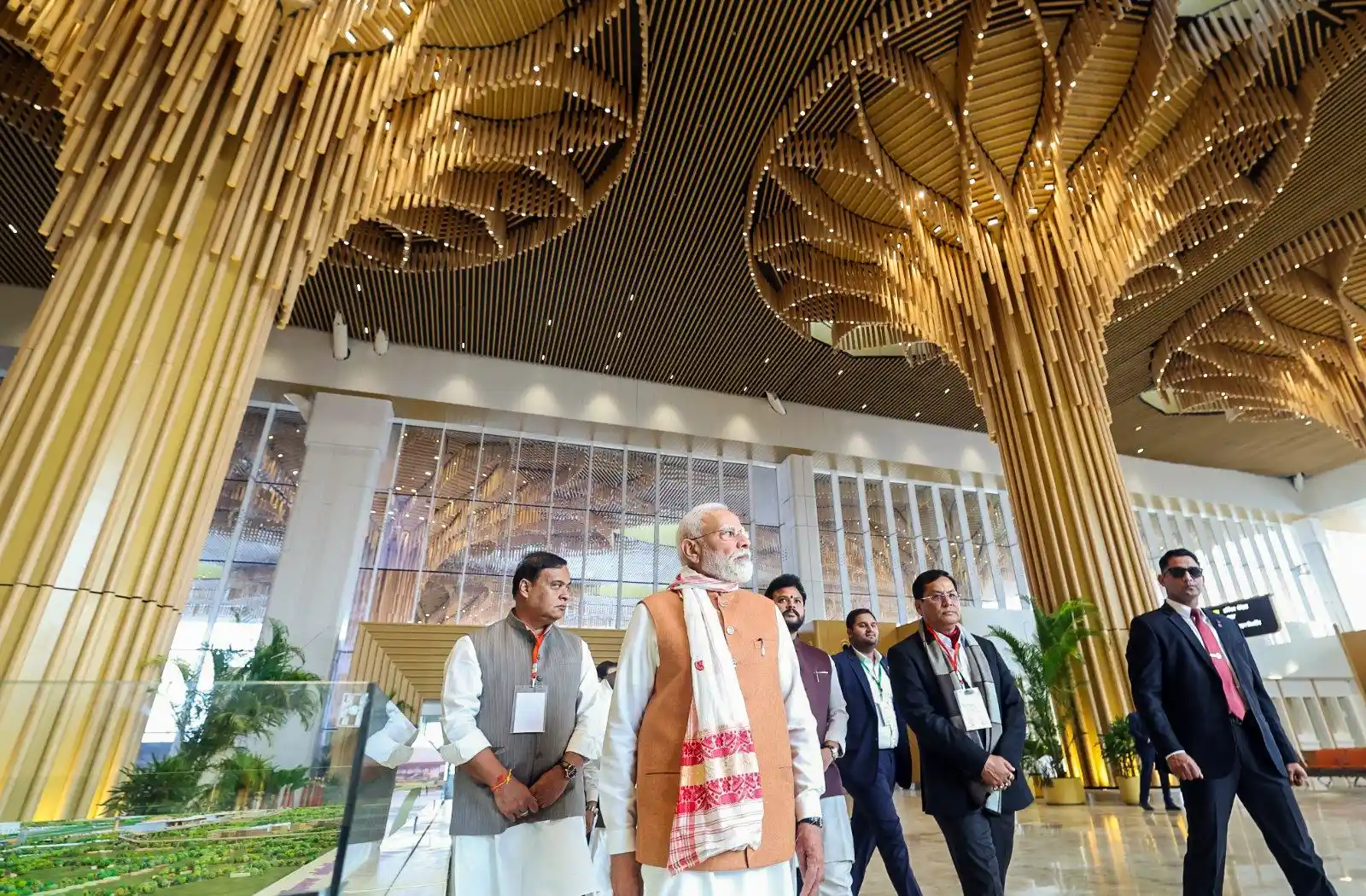
PM Narendra Modi’s Guwahati stopover was more than another ribbon-cutting exercise; it is a calibrated political message that infrastructure, nationalism and the Northeast’s long-frayed peripheries now sit at the heart of New India’s growth story. The visit knits together aviation, fertilisers, symbolism around the Assam Movement and the Kamakhya shrine into a single narrative of a region finally being brought into the mainstream on Delhi’s terms.
The centrepiece of Modi’s Guwahati itinerary is the inauguration of the new terminal building at Lokapriya Gopinath Bordoloi International Airport, billed as India’s first major “nature-themed” terminal and the largest in the Northeast. Spread over nearly 1.4 lakh square metres and designed to handle up to 1.3 crore passengers annually, the terminal is intended to make Guwahati a genuine regional hub rather than a provincial airstrip at the edge of India’s mental map.
The choice of location and scale is deliberate.
- It underscores the government’s claim that the Northeast is central to the Act East policy and to prospective value chains connecting South Asia to Southeast Asia.
- It provides a visual, photogenic anchor for the narrative that under Modi, airports and expressways are no longer the privilege of metros alone but a standard development grammar extended to “remote” regions.
Development as narrative, not footnote
Beyond the optics, the visit is pegged to a headline figure: projects worth around ₹15,600 crore to be inaugurated or launched in Assam. These include not just the Guwahati terminal but also significant investments in connectivity, industrial capacity and religious tourism infrastructure under the PM-DevINE scheme.
Three strands stand out.
- The Namrup Ammonia-Urea project: By performing bhoomi pujan for a major fertiliser plant of Assam Valley Fertilizer and Chemical Company Ltd at Namrup in Dibrugarh, Modi ties Assam’s agrarian economy to a broader pitch of self-reliance in inputs that have long been a political vulnerability.
- Connectivity and corridors: The government points to nearly 1,900 km of new railway tracks and about 6,000 km of additional national highways in the Northeast since 2014, alongside substantially higher railway budget allocations, as evidence that the region is no longer an afterthought.
- Pilgrimage and soft power: The Maa Kamakhya Divya Pariyojana, aimed at creating a world-class access corridor and amenities for pilgrims at the Kamakhya temple, fits into a wider template of combining religious tourism with concrete urban upgrades—roads, amenities, and hospitality infrastructure.
Memory, martyrdom and the Assam Movement
Perhaps the most politically loaded part of the Guwahati schedule is the tribute to the martyrs of the Assam Movement at Swahid Smarak Kshetra in Boragaon. In a state still negotiating the fallout of the NRC-CAA churn, this is not a routine floral tribute but an attempt to claim the legacy of a movement historically suspicious of Delhi’s intent.
By foregrounding homage to 855 Assam Movement martyrs, the prime minister is doing three things at once.
- He signals empathy with anxieties over identity and illegal immigration, even as his government’s legal instruments on citizenship remain controversial.
- He folds a long and often fraught regional struggle into the national story of sacrifice and integration, much as he did earlier with the Dhola-Sadiya (Bhupen Hazarika) bridge inaugurations and AIIMS projects in Assam.
- He turns memory into political capital ahead of future electoral cycles, especially in upper Assam where these wounds are closest to the surface.
The Northeast as a proving ground
Guwahati also serves as a showcase to defend the Modi government’s decade-long thesis that the Northeast has seen a decisive break from neglect, both in hard numbers and in the language of statecraft. Officials boast of a fourfold rise in development expenditure for the region since 2014, complemented by new IIT and IIM campuses and a string of health and sports facilities anchored in and around the city.
This is not without precedent.
- Earlier visits saw the inauguration of Dhola-Sadiya bridge, AIIMS Guwahati and an Indian Agricultural Research Institute campus, each projected as a marker of both security and integration.
- Today’s airport terminal and associated projects extend that logic: the region is not merely being connected but reimagined as a gateway rather than a buffer.
Ultimately, Modi’s Guwahati visit is as much about narrative consolidation as it is about new concrete pouring in Assam’s soil. The airport terminal, the fertiliser plant, the Kamakhya corridor and the homage to Assam Movement martyrs combine to tell voters that New Delhi has not only arrived in the Northeast but intends to stay with money, symbolism and attention.
For a region long defined in national discourse by insurgency, floods and neglect, that is a powerful proposition—but also one that invites scrutiny. The op-ed question now is whether these projects translate into durable local jobs, environmental safeguards and genuine political inclusion, or remain, like so many airports across India, gleaming islands in an unchanged landscape.