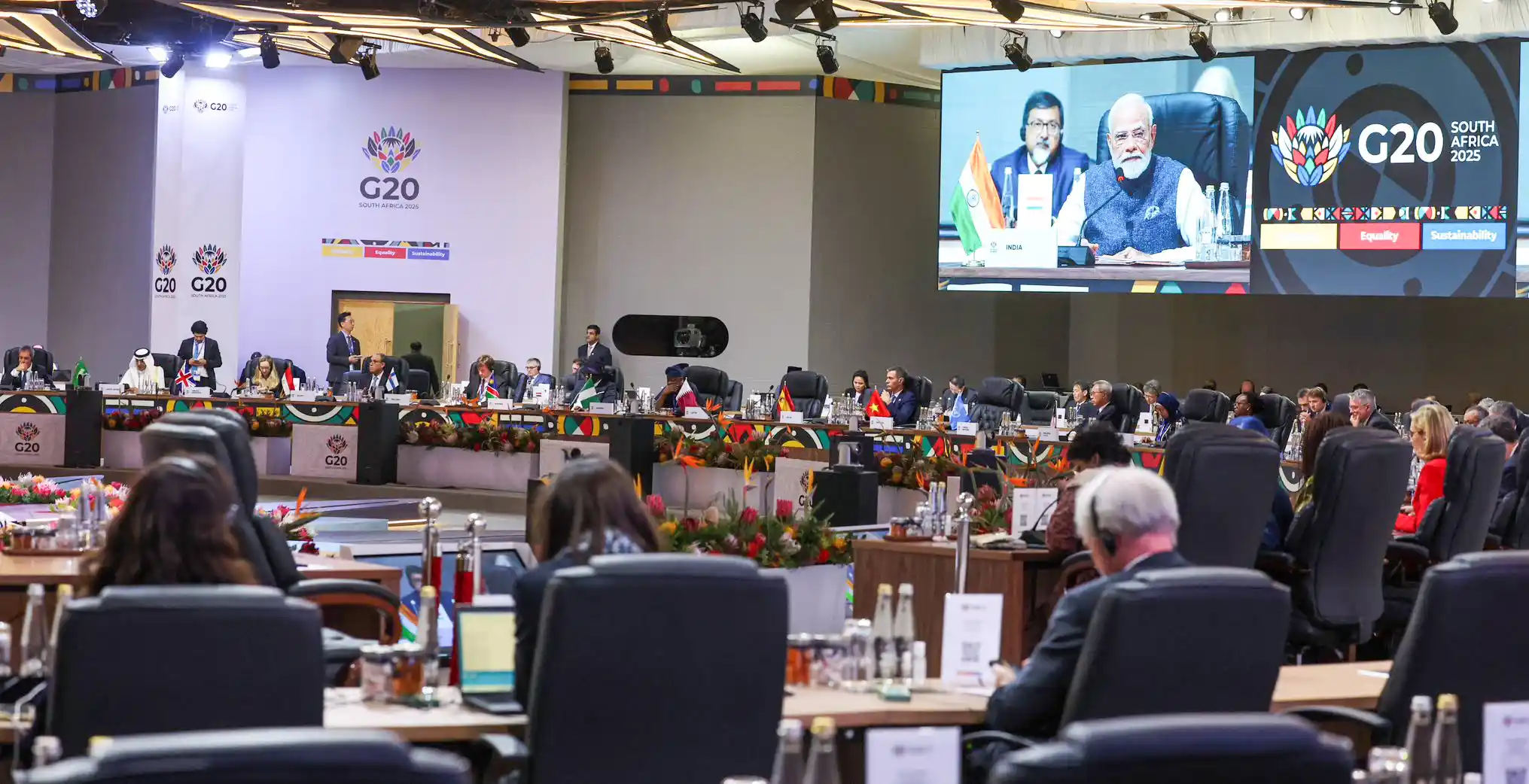
The recent G20 Summit in Johannesburg, hosted by South Africa from November 22 to 23, marked a pivotal moment in global diplomacy, especially as it was the first time the forum gathered on African soil. Amidst a landscape where some major world leaders, notably from the United States, Argentina, China, and Russia, chose to give it a miss, India’s Prime Minister Narendra Modi stood out by not only attending but actively shaping the discussions through his presence and interventions. When some of the world’s most powerful leaders chose to stay home, many expected Johannesburg to fizzle. Instead, the Global South discovered its voice carries just fine without a Western echo. This gathering, under the theme of “Solidarity, Equality, and Sustainability,” drew heavily on the African philosophy of Ubuntu, reminding leaders that true progress lies in our interconnectedness. Modi’s participation underscored India’s unwavering commitment to amplifying the voice of the Global South, a theme that has been building momentum across recent summits. The Johannesburg Declaration, adopted by consensus despite geopolitical frictions, continues the narrative from the Delhi and Rio de Janeiro summits, focusing on equitable development, climate action, and reforming outdated global institutions. In a world divided by conflicts and economic disparities, this summit signalled a shift towards more inclusive multilateralism, where emerging economies are no longer sidelined but are driving the agenda.
South Africa’s hosting brought a fresh urgency to issues long plaguing the developing world, such as debt sustainability and access to critical resources. The declaration’s emphasis on people-centred disaster response and sustainable industrialisation reflects a practical approach to the vulnerabilities faced by nations in the Global South. Modi’s six-point agenda, which included initiatives like the Africa Skills Multiplier to train a million youth and the Global Healthcare Response Team for crisis management, injected innovative ideas that resonated widely. These proposals were not just rhetorical; they built on India’s own experiences in digital public goods and green energy transitions, offering scalable solutions for collective challenges. As Modi noted in his address, the time has come to rethink development models that prioritise the few over the many, a sentiment that echoed through the halls of the summit venue. This event, though boycotted by some, proved the resilience of the G20 as a platform where the majority can forge ahead, setting the tone for future global cooperation.
Tracing the Unison
The Johannesburg Summit does not stand alone; it is the culmination of a remarkable arc shaped by consecutive presidencies from the Global South—Indonesia in 2022, India in 2023, and Brazil in 2024—now passing the baton to South Africa. Each of these gatherings has woven a tapestry of shared ideas, reflecting a growing unison among emerging economies to address systemic inequities.
During India’s presidency in Delhi, the focus was on “One Earth, One Family, One Future,” which introduced the African Union as a permanent G20 member and launched the Global Biofuels Alliance, highlighting unity in diversity. That summit navigated divisions over the Ukraine conflict to adopt a declaration that balanced geopolitical sensitivities with developmental priorities, much like Johannesburg’s approach to weak stances on ongoing wars while pushing hard on economic reforms.
Brazil’s Rio de Janeiro Summit in 2024 built on this foundation, deepening the lens on social inclusion, hunger eradication, and sustainable development. Under President Lula da Silva, the forum prioritised just energy transitions and blended finance for adaptation, aligning closely with India’s human-centric vision. Brazil’s emphasis on critical minerals as tools for industrial sovereignty rather than mere raw material extraction echoed India’s push for supply chain resilience, ensuring that resource-rich nations in the Global South retain control over their futures. This continuity was evident in the troika mechanism—India, Brazil, and South Africa— which coordinated agendas to keep development at the forefront, from debt relief to gender-inclusive growth.
South Africa’s event consolidated these efforts, with the declaration endorsing the G20 Critical Minerals Framework and reaffirming Paris Agreement goals, showing how these summits have progressively amplified calls for UN Security Council reform and increased representation for Africa, Asia, and Latin America.
Echoing Global South Aspirations
The Johannesburg Declaration, a 122-point document, stands as a testament to the summit’s success in prioritising the Global South’s agenda despite external pressures. Key highlights include commitments to debt sustainability for burdened nations, expansion of renewables, and the creation of initiatives like the Open Satellite Data Partnership for agriculture and disaster management. These elements address immediate needs, such as countering the drug-terror nexus through multilateral intelligence sharing and promoting women-led development by removing socio-economic barriers. Modi’s proposals, including a Global Traditional Knowledge Repository to preserve indigenous wisdom and the Critical Minerals Circularity Initiative for recycling and supply chain security, were integrated seamlessly, showcasing India’s role as a bridge-builder.
On climate and energy, the declaration reaffirmed the 1.5°C Paris target and global biodiversity goals, while endorsing voluntary frameworks for critical minerals to ensure equitable access. This is particularly vital for Africa, where resource wealth often benefits outsiders more than locals. The summit also launched Mission 300 to connect 300 million Africans to electricity by 2030, tying into broader goals of sustainable industrialisation and decent work. Health and skills development received attention too, with the Global Healthcare Response Team poised to tackle future pandemics and the Africa Skills Multiplier aiming to certify a million trainers for youth empowerment. These outcomes, born from the Ubuntu spirit, underscore a commitment to equity, where sustainability is not a luxury but a necessity for survival in the developing world.
Prime Minister Modi’s Sidelines Diplomacy
On the sidelines of the summit, Prime Minister Modi engaged in a series of bilateral meetings that strengthened India’s global partnerships. Modi met Australian Prime Minister Anthony Albanese, discussing enhanced cooperation in trade and technology, with a nod to the Quad framework’s role in Indo-Pacific stability. This was followed by a warm interaction with South African President Cyril Ramaphosa, where both leaders reviewed progress on the India-South Africa strategic partnership, emphasising joint ventures in renewable energy and digital infrastructure.
Modi’s meeting with Italian Prime Minister Giorgia Meloni was particularly productive, covering advancements in the Joint Strategic Action Plan 2025-29 and Italy’s support for India’s upcoming AI Impact Summit in 2026. Meloni praised India’s digital innovations, and the two agreed to deepen ties in defence and clean energy. Interactions with Japan’s Prime Minister Sanae Takaichi, in Modi’s first in-person meeting since her October phone call, focused on economic security and supply chain diversification, with commitments to accelerate the India-Japan Comprehensive Economic Partnership.
Further, Modi held talks with Canadian Prime Minister Mark Carney on and Arctic forward movement for Comprehensive Economic Partnership Agreement (CEPA), UK Prime Minister Keir Starmer on migration and climate finance, German Chancellor Olaf Scholz on green hydrogen projects, and UN Secretary-General Antonio Guterres on sustainable development goals. These engagements, alongside the IBSA trilateral with Brazil and South Africa, reaffirmed India’s pivotal role in South-South cooperation. The IBSA meeting, as noted in official briefings, stressed UNSC reform as a necessity, not an option, highlighting coordinated advocacy for Global South representation. Modi’s diplomacy thus extended the summit’s themes into tangible bilateral gains, fostering a network of alliances that bolster India’s strategic footprint.
G20 Synergies with BRICS
As two major institutional platforms for the Global South, BRICS and G20 have emerged as complementary engines driving the agenda of emerging economies.
The harmony between these forums manifests in their mutual reinforcement of core tenets. These platforms’ synergies hold transformative potential for global dynamics in the short term, likely featuring deepened financial interconnections that empower the Global South to navigate trade disruptions more adeptly, thereby diminishing the sway of unilateral policies and promoting balanced growth. Over the mid-term, their combined influence could spur sweeping updates to multilateral frameworks, including streamlined access to innovation funds and coordinated responses to demographic shifts, mitigating the dominance of legacy powers and enhancing collective bargaining in arenas like ocean governance. Yet, emerging fault lines, including selective engagements from established economies, will necessitate adaptive strategies to preserve this collaborative ethos.