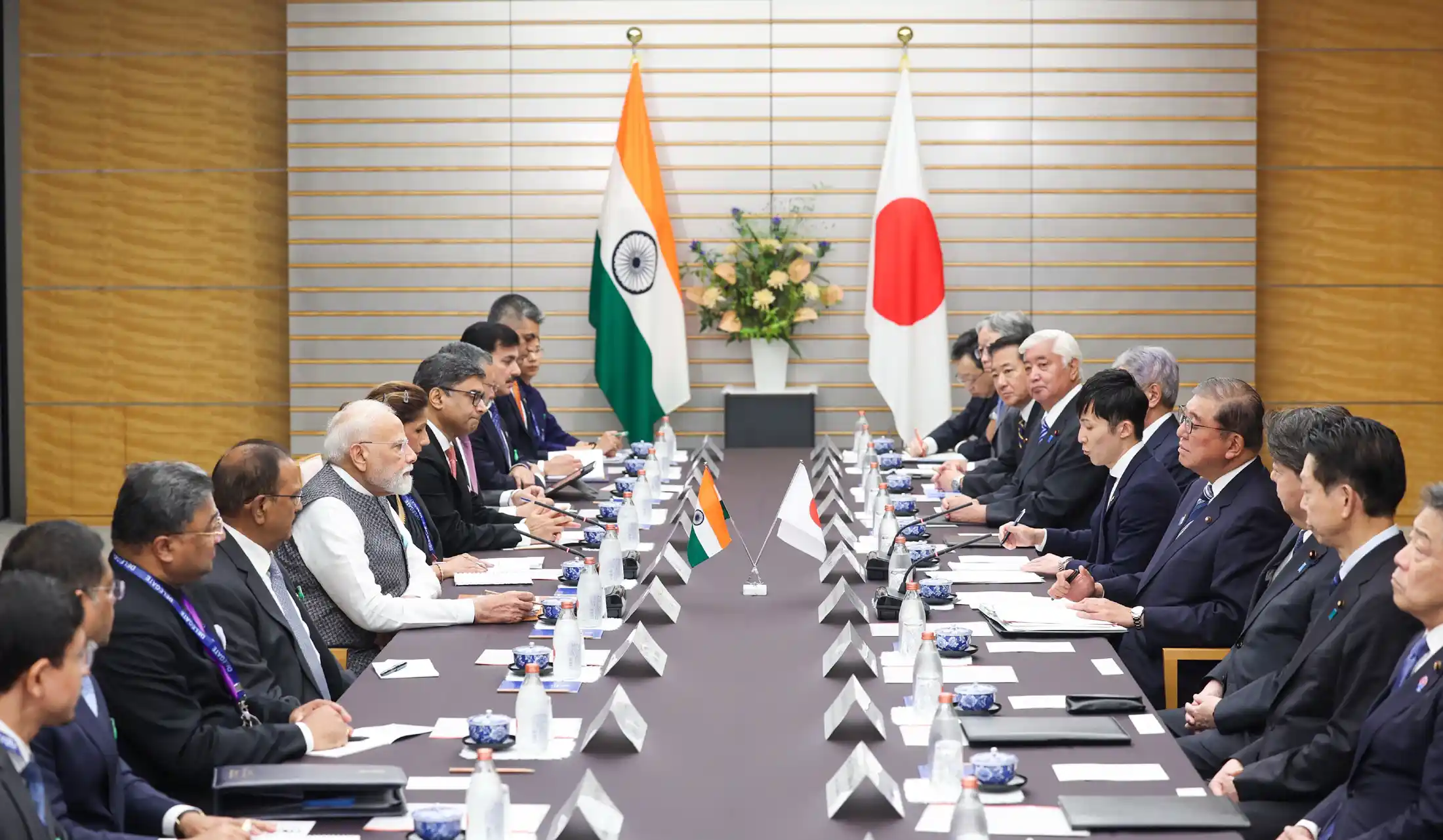
Japan’s deepening involvement in Northeast India’s connectivity projects exemplifies a mutually beneficial partnership that bolsters regional development and counters geopolitical challenges in the Indo-Pacific. This collaboration aligns seamlessly with India’s Act East Policy and Japan’s Free and Open Indo-Pacific (FOIP) vision, fostering economic growth while enhancing strategic resilience.
Connectivity Initiatives
Japan has committed substantial resources to infrastructure in Northeast India, investing over INR 23,529 crore across 20 projects as of early 2026, with connectivity as the cornerstone. Key efforts include the North East Road Network Connectivity Improvement Project, where the Japan International Cooperation Agency (JICA) provided JPY 34,537 million (INR 1,946 crore) for Phase 3(II), funding the Dhubri-Phulbari Bridge—the longest river bridge in India—linking Assam and Meghalaya across the Brahmaputra. Additional investments cover 750 km of roads, National Highway upgrades like NH-208 in Tripura (JPY 23,129 million or INR 1,492 crore), and the Gelephu-Dalu Corridor, integrating Bhutan, India, and Bangladesh to boost intra-regional links.
These projects aim to connect Northeast India to the Bay of Bengal and Indian Ocean, unlocking trade potential and socio-economic opportunities. Japan’s Official Development Assistance (ODA), totaling over $2 billion by 2021 and continuing to grow, addresses infrastructure deficits in this strategically vital region. This not only accelerates India’s regional integration but also positions Japan as a reliable partner in sustainable development.
Broader India-Japan Strategic Ties
The partnership has evolved into a Special Strategic and Global Partnership since 2014, elevated through milestones like the 2025 India-Japan Joint Vision for the Next Decade, spanning eight priority areas: economy, security, mobility, sustainability, technology, health, people-to-people ties, and sub-national engagement. Japan pledged JPY 10 trillion (USD 68 billion) in private investments by 2035, fueling projects like the Mumbai-Ahmedabad Bullet Train (Shinkansen technology at 360 kmph) and Delhi Metro Phase IV.
Defense cooperation has intensified with a 2025 Joint Declaration on Security Cooperation updating the 2008 pact, institutionalizing NSA-level dialogues, and expanding exercises like Dharma Guardian, Veer Guardian, JIMEX, and Malabar. Technology pacts include ISRO-JAXA’s Chandrayaan-5 lunar mission, AI initiatives for Large Language Models, and collaborations in semiconductors, robotics, and clean energy via the Joint Crediting Mechanism. The Acquisition and Cross-Servicing Agreement (ACSA) and 2+2 Ministerial Dialogues enhance interoperability without compromising India’s strategic autonomy.
Balanced Strategic Partnership
Northeast India serves as the nexus where India’s Act East Policy converges with Japan’s FOIP, countering assertive influences in the Indo-Pacific through enhanced maritime and land connectivity. The Quadrilateral Security Dialogue (Quad)—with India, Japan, the US, and Australia—provides intelligence sharing, technology access, and alternative infrastructure financing to China’s Belt and Road Initiative (BRI), both nations rejecting BRI participation.
Japan’s Northeast investments diversify its security posture beyond US reliance, while empowering India’s regional leadership. Shared concerns over supply chain vulnerabilities have spurred the Supply Chain Resilience Initiative (SCRI) and Mineral Security Partnership, prioritizing critical minerals, pharmaceuticals, and ICT. In 2026, this synergy promotes a rules-based order, freedom of navigation, and stability amid East Asian tensions.
This alliance exemplifies balanced reciprocity: India gains cutting-edge infrastructure and technology transfer, propelling Northeast development and Act East goals, while Japan secures a manufacturing hub via “China+1” and diversified partnerships. Challenges like trade imbalances (Japan’s exports USD 17.69 billion vs. India’s USD 5.15 billion in FY24) and project delays (e.g., Bullet Train to 2028) persist, but CEPA reviews and non-tariff barrier reductions are addressing them.
Divergent outlooks—India’s South Asia/Indian Ocean focus versus Japan’s East Asia priorities—require nuanced coordination, yet platforms like Quad and Act East Forum ensure alignment. Pro-India, this partnership amplifies New Delhi’s autonomy and regional heft; pro-Japan, it advances Tokyo’s FOIP without over-reliance on alliances.
Looking ahead, accelerating Northeast corridors like Gelephu-Dalu, co-producing defense tech, and expanding green hydrogen initiatives will deepen ties. With people-to-people exchanges targeting 500,000 mobilities, including 50,000 Indian workers, cultural bonds via Buddhism strengthen resilience. This pro-growth, pro-stability model positions India and Japan as Indo-Pacific anchors, driving shared prosperity.