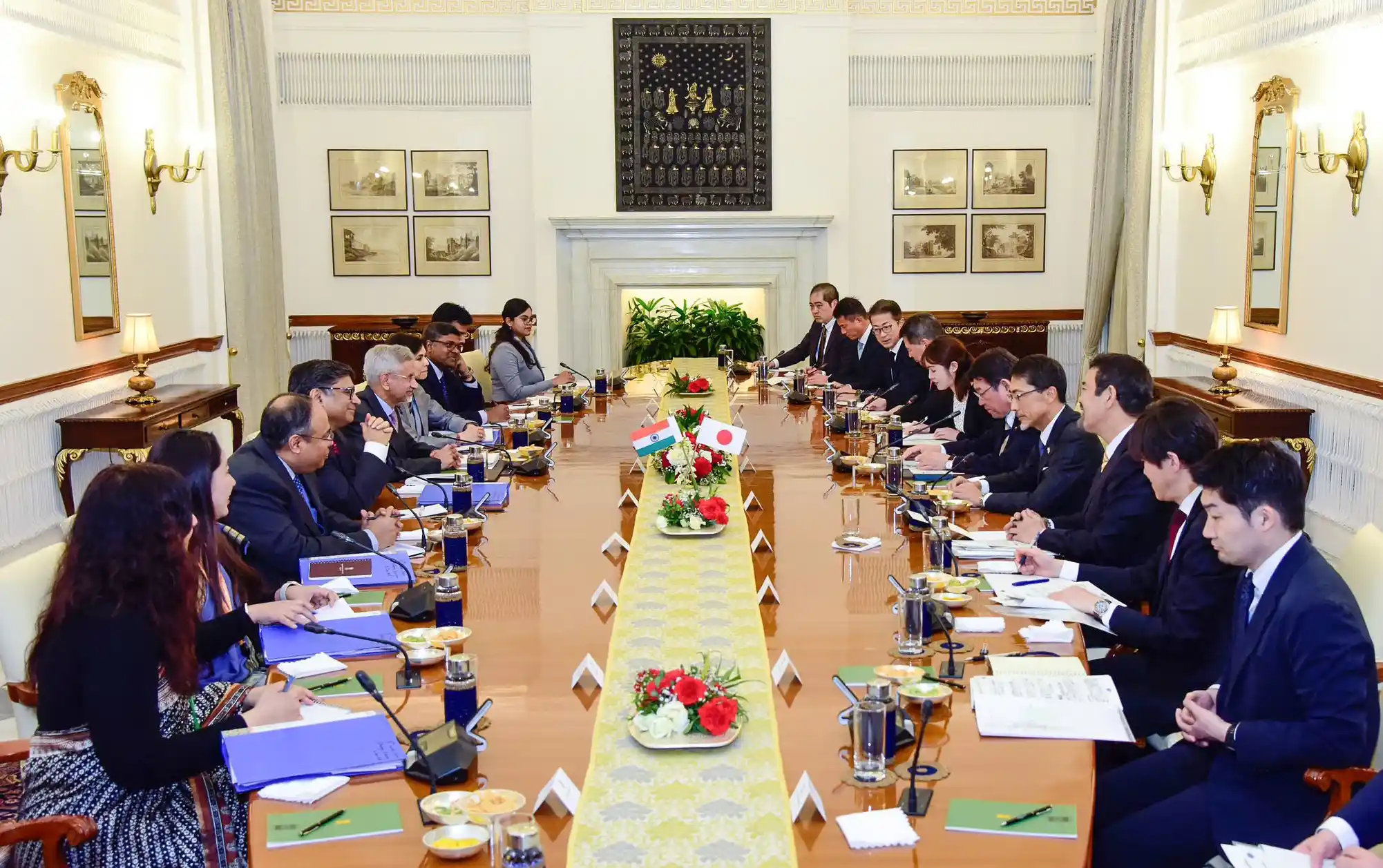
Japan’s Foreign Minister Toshimitsu Motegi’s visit to India from January 15 to 17, 2026, underscores the deepening strategic partnership between the two nations amid evolving Indo-Pacific dynamics. This three-day engagement, featuring high-level dialogues and symbolic gestures, signals India’s intent to fortify alliances against regional assertiveness, particularly from China. From New Delhi’s vantage, the visit exemplifies a pragmatic pivot toward resilient economic and security architectures.
Visit Highlights
Foreign Minister Motegi engaged in substantive bilateral interactions, commencing with the 18th India-Japan Foreign Ministerial Strategic Dialogue alongside External Affairs Minister S. Jaishankar on January 16. Discussions reviewed advancements since Prime Minister Narendra Modi’s August 2025 visit to Japan, which birthed the “Japan-India Joint Vision for the Next Decade,” encompassing security, economic resilience, innovation, and cultural ties. Key outcomes included the inauguration of an AI dialogue mechanism and a Joint Working Group on critical minerals, targeting rare earth elements and supply chain fortification.
Motegi also held a courtesy call on Prime Minister Modi, exchanging perspectives on economic security, artificial intelligence, investments, and people-to-people connectivity. Symbolic elements reinforced goodwill: Motegi paid homage at Raj Ghat and rode the Delhi Metro—a hallmark of Japan International Cooperation Agency (JICA) financing since Phase I—accompanied by Ambassador Keiichi Ono, evincing Japan’s stake in India’s urban infrastructure. These gestures align with Japan’s endorsement of India’s February 2026 AI Impact Summit.
Strategic Imperatives
The visit fortifies countermeasures to China’s maritime encroachments in the Indian Ocean and supply chain dominances. The Quad framework—comprising India, Japan, the United States, and Australia—emerges as pivotal, promoting a free and open Indo-Pacific (FOIP) predicated on rule-of-law principles. Motegi’s emphasis on economic security dovetails with India’s Atmanirbhar Bharat initiative, mitigating vulnerabilities in semiconductors, batteries, and critical minerals via Japanese technology transfers, such as the Unified Complex Radio Antenna (UNICORN) for defense interoperability.
Infrastructure synergies, exemplified by the Mumbai-Ahmedabad Shinkansen (E10-series slated for early 2030s), exemplify mutual complementarity: Japan’s precision engineering bolsters India’s high-speed rail ambitions, enhancing connectivity along vital trade corridors. Space collaboration via the Lunar Polar Exploration (LUPEX) mission, with ISRO providing the lander and JAXA the rover, positions India as a lunar exploration frontrunner. These endeavors counterbalance China’s Belt and Road Initiative, prioritizing sustainable, transparent development models.
Geopolitical Significance
In the broader geopolitical tableau, Motegi’s India sojourn—part of his inaugural 2026 overseas itinerary post-stops in Israel, Qatar, and the Philippines—affirms Japan’s proactive diplomacy under Prime Minister Sanae Takaichi. For India, it signals Tokyo’s reliability as a counterweight to Beijing’s assertiveness, including South China Sea militarization and Indian Ocean forays. The partnership transcends bilateralism, embedding within G20, G4, and UN platforms to advocate reformed global governance.
Amid U.S. President Donald Trump’s 2025 reelection and “America First” realignments, India-Japan ties assume heightened salience, insulating against transactional pressures. Japan’s Overseas Business Expansion survey ranking India foremost for four years underscores economic momentum, with Tokyo-backed ventures in Africa via the “Economic Region Initiative of Indian Ocean-Africa” amplifying India’s continental outreach. This convergence advances Viksit Bharat@2047, leveraging Japanese innovation to realize a developed economy.
Implications for Indo-Pacific Order
The visit heralds an “execution phase” in bilateral ties, transitioning from visionary pacts to tangible deliverables. India’s strategic autonomy benefits from diversified partnerships, reducing overreliance on any singular power while embedding FOIP norms to deter coercion. Enhanced people-to-people exchanges—via JET Programme, NIHONGO Partners, and cricket diplomacy—cultivate enduring affinities, essential for sustaining momentum toward the 2027 diplomatic golden jubilee.
Critically, the AI and minerals frameworks preempt technological bifurcations, fostering inclusive innovation ecosystems. As Indo-Pacific tensions persist, this alignment buttresses India’s maritime domain awareness and blue economy aspirations. Ultimately, Motegi’s engagements affirm India-Japan synergy as indispensable for a multipolar order rooted in democratic resilience and shared prosperity, positioning New Delhi as an indispensable Indo-Pacific fulcrum.