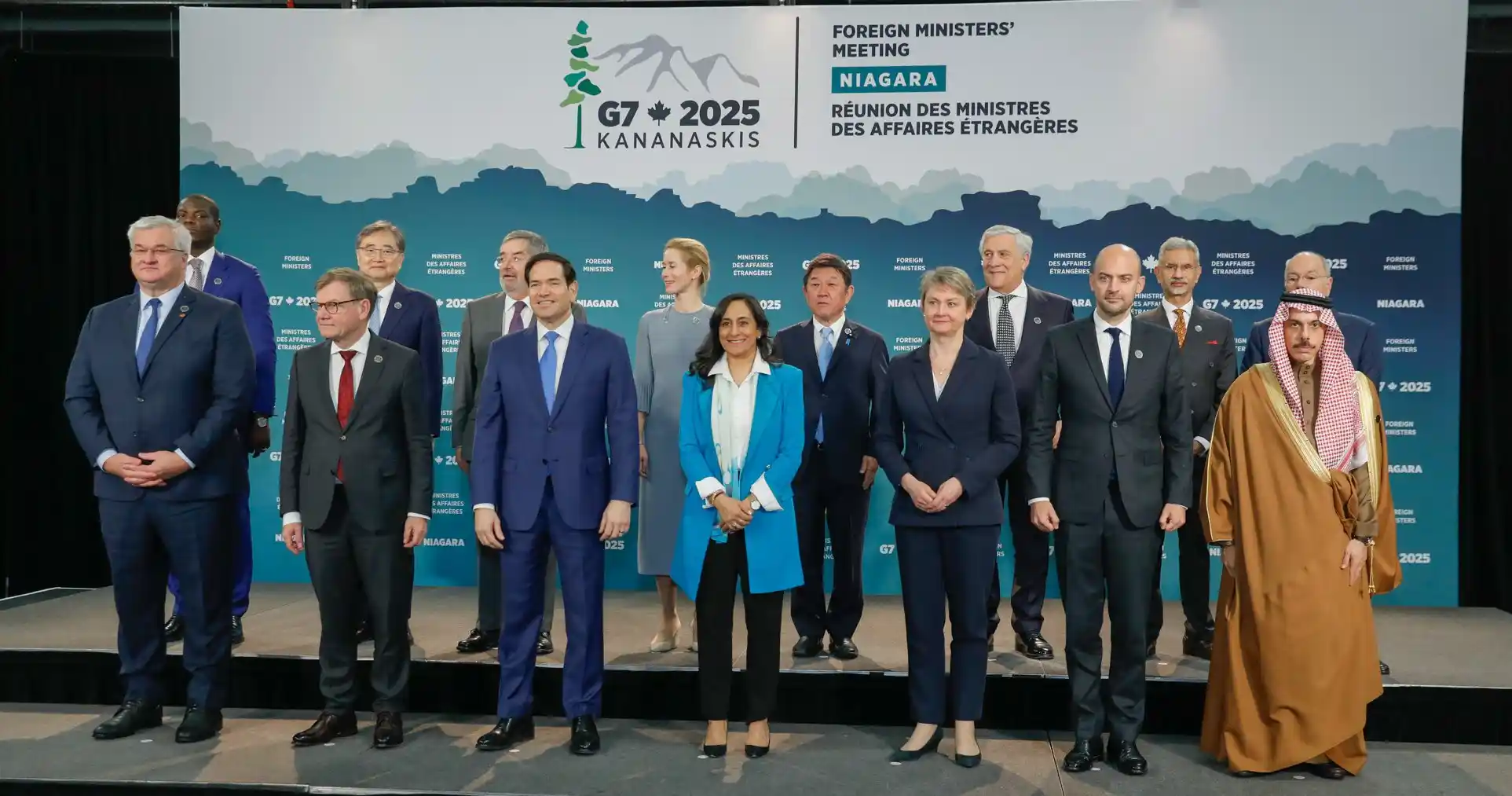
When External Affairs Minister Dr. S. Jaishankar arrived in Ontario for the G7 Foreign Ministers’ Meeting, it was not another ritual of global diplomacy. His presence carried the quiet weight of a world in transition, where India has begun to act as a bridge between power centres that no longer move in step. For India, it was a moment to reaffirm its role as a credible voice in a divided world. For Canada, it was an opportunity to host a dialogue that reflected the turbulence of our times and the uncertainty surrounding global institutions.
Held under Canada’s presidency, the G7 meeting unfolded amid visible geopolitical flux. The United States is re-examining its approach to protectionism, defence burden-sharing and even the future of multilateralism. Across Europe, political fatigue and internal divisions have eroded consensus on Ukraine. In the Middle East, the war in Gaza continues to test both moral clarity and diplomatic endurance. Against this unsettled backdrop, foreign ministers gathered in the Niagara region on 11–12 November to deliberate on issues that remain both urgent and unresolved.
Foreign Minister Anita Anand framed the meeting as a reaffirmation of dialogue and cooperation. Her emphasis on inclusion reflected an effort to hold together a coalition struggling to speak in one voice. The agenda covered peace in Ukraine, stability in the Middle East, supply chain resilience, critical minerals, maritime security and the Indo-Pacific. Beneath this broad canvas lay an anxiety about the fading unity that once defined Western leadership.
For India, the invitation came after months of careful repair in its ties with Canada. Relations had been strained following Ottawa’s unsubstantiated allegations against India, which led to the Indian High Commissioner being declared Persona Non Grata and a prolonged chill. The thaw began when Prime Minister Narendra Modi met Prime Minister Mark Carney on the sidelines of the G7 Summit in Kananaskis in June 2025.
Anita Anand’s visit to New Delhi and Mumbai in October gave new momentum to this process. Her discussions with Dr. Jaishankar at Hyderabad House focused on rebuilding trust and identifying areas of cooperation, and she also called on Prime Minister Modi. The two sides agreed to resume trade negotiations and explore partnerships in clean technology, higher education and critical minerals.
At Niagara, Dr. Jaishankar participated actively in discussions on trade, supply chain diversification, energy security and critical minerals, where India’s practical experience commands respect. He cautioned that diversification must not replace one dependency with another but should foster genuine autonomy for developing economies. His call for fairer frameworks in global trade found resonance among several participants who share India’s concern that developing nations must share in value creation, not remain on its margins.
On maritime security and the Indo-Pacific, Dr. Jaishankar reiterated India’s long-standing view that the region must remain free, open and inclusive, guided by respect for sovereignty and international law. His interventions reflected India’s approach: to engage without aligning, and to cooperate without compromising autonomy. Japan, the United States and Canada increasingly see India as central to any credible Indo-Pacific framework.
He also emphasised India’s “MAHASAGAR” vision for mutual advancement in security and growth across regions, its role as a first responder in the maritime domain, and efforts to deepen humanitarian assistance and disaster relief (HADR) partnerships through joint exercises and logistics agreements. He highlighted operational challenges such as protecting undersea infrastructure, combating piracy, smuggling, and illegal, unreported, and unregulated (IUU) fishing via international collaboration, while underscoring the need to uphold the UN Convention on the Law of the Sea (UNCLOS) and translate policy consultations into tangible ground-level actions for resilient ports and secure waterways.
The meeting also devoted considerable attention to the crises in Ukraine and Gaza. While the G7 remains committed to defending sovereignty and international law, differences are widening. Fatigue is visible among some members, and the path from confrontation to settlement remains uncertain. India’s position, blending empathy for civilian suffering with an insistence on dialogue, offers a moral and practical alternative. It may not mirror Western views, but it commands respect across the Global South, where many believe that sanctions alone cannot end a war.
On the Middle East, Dr. Jaishankar reiterated India’s call for restraint, humanitarian protection and the resumption of peace talks. India’s approach remains marked by principle and prudence. It seeks stability and coexistence, not moral grandstanding. That quiet balance explains why India’s views carry weight in such forums. It reflects realism anchored in empathy rather than ideology.
Economic discussions offered India a wider opening. Canada’s presidency placed emphasis on trade and critical minerals—key to the global energy transition. The contest for access to these resources is reshaping international partnerships. India, which has long advocated equitable collaboration in this field, presented a perspective rooted in sustainability and shared benefit rather than zero-sum competition.
On November 11, Dr. Jaishankar’s bilateral meetings on the sidelines reflected India’s growing diplomatic rhythm. His talks with Anita Anand reaffirmed a shared intent to stabilise relations through cooperation in trade, energy, counter-terrorism, respect for mutual concerns over sovereignty, territorial integrity, and stronger people-to-people exchanges. Engagements with South Africa’s Ronald Lamola focused on G20 coordination and digital infrastructure, while discussions with Mexico’s Juan Ramón de la Fuente advanced linkages in manufacturing and multilateral reform. Meetings with France, Brazil, the United Kingdom and Germany explored collaboration in defence, clean energy, biofuels, artificial intelligence and semiconductors. A meeting with Saskatchewan Premier Scott Moe opened new possibilities in agriculture and mining.
On November 12, during the G7 Foreign Ministers’ Meeting, Dr. Jaishankar met Australian Foreign Minister Penny Wong to discuss Quad maritime awareness and cooperation in critical minerals and green hydrogen; South Korean Foreign Minister Cho Tae-yul on technology, semiconductors, and maritime security; Saudi Foreign Minister Faisal bin Farhan on energy stability and regional de-escalation; and Ukrainian Foreign Minister Andrii Sybiha on humanitarian aid and reconstruction—affirming India’s balanced, pragmatic diplomacy.
Diplomatic momentum was visible with Canada’s Minister of International Trade, Maninder Sidhu, arriving in India on November 12, 2025, for a three-day visit to advance bilateral trade and investment ties through promotion of cooperation in artificial intelligence, clean technology, digital industries, energy, and agriculture.
India’s engagement with the G7 has a longer arc. The first formal invitation came in 2003, when Prime Minister Atal Bihari Vajpayee attended the outreach session of the G8 Summit in Évian. Since then, India has been a regular participant. In the past five years, Prime Minister Narendra Modi has represented India at successive G7 summits held in the United Kingdom in 2021, Germany in 2022, Japan in 2023, Italy in 2024 and Canada in 2025. Ministerial participation has deepened, allowing India to articulate the perspectives of the developing world directly to advanced economies on issues ranging from energy and health to technology and economic security.
Over the years, India’s approach to the G7 has evolved. It no longer views the gathering as an exclusive Western club but as a forum where its independent voice can help bridge divides between the Global North and South. This evolution reflects maturity in Indian diplomacy. Having emerged as a credible advocate for the developing world, India now uses these platforms to promote dialogue over division and cooperation over dependency.
The broader lesson from Niagara is that global diplomacy itself is changing. The G7, once the unquestioned nerve centre of international governance, now functions with greater humility, aware that power is dispersing. Platforms such as BRICS and the G20 enjoy broader legitimacy and participation. Yet the G7 remains relevant for its ability to convene, to listen and to adapt. By inviting India, Brazil, South Africa, Saudi Arabia and South Korea, it recognises that legitimacy today rests on inclusion. The world can no longer be directed from the Atlantic alone.
In the end, Dr. Jaishankar’s journey to Niagara was about more than the G7. It symbolised India’s steady evolution from a reactive participant to a proactive shaper of global dialogue. The old structures of power are bending, though not yet broken. As they reshape, India’s calm and reasoned voice will help define the contours of the next world order. In a divided world, that steadiness may well be India’s greatest strength.