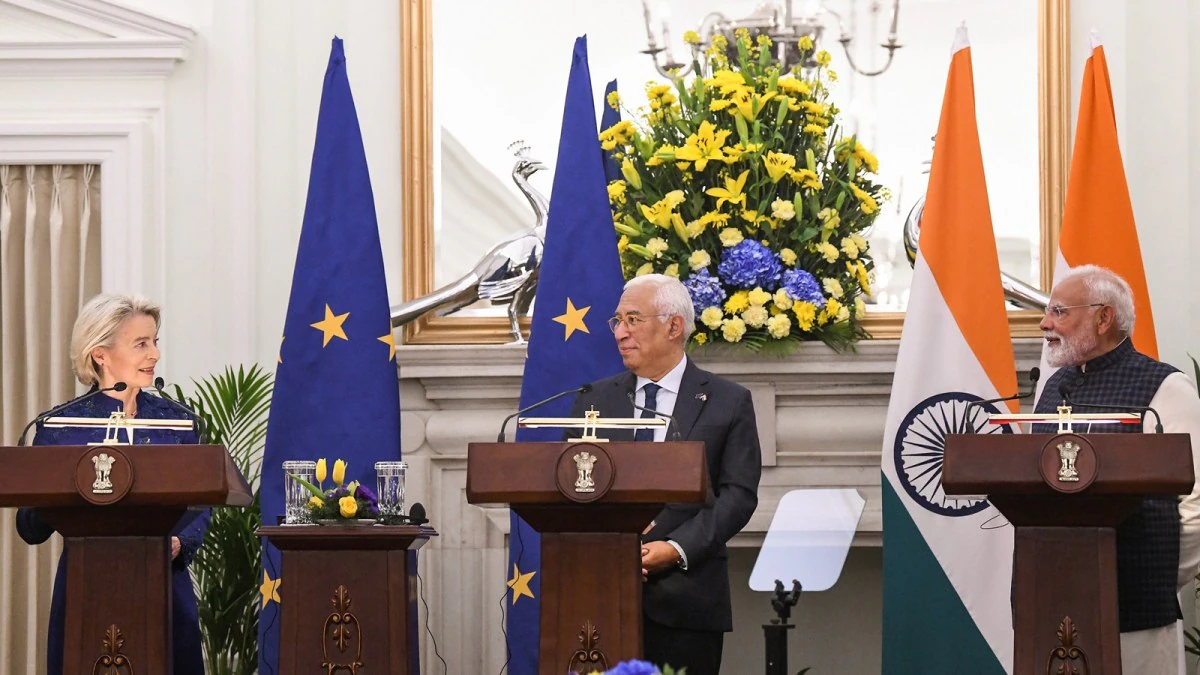
India’s strategic partnerships with Germany and the wider EU have moved from transactional engagement to long‑term strategic alignment, anchored in economics, technology, and a shared interest in a stable Indo-Pacific. Recent high‑level visits and upgraded frameworks with Germany, France, Italy, Finland, and the EU leadership have consolidated Europe as India’s second strategic theatre after the Indo-Pacific’s core Quad network.
For much of the post‑Cold War era, India’s ties with Europe were dominated by trade, aid, and diaspora‑linked politics, especially with Germany. Today, the centre of gravity has shifted to strategy: technology supply chains, defence co‑production, clean‑energy transition, and joint Indo-Pacific projection. The EU has formally classified India as a strategic partner since 2004, but only in the last five years has Brussels begun treating New Delhi as a systemic stabiliser and key voice of the “Global South”, reflected in the EU College of Commissioners’ unprecedented visit to India in February 2025.
Simultaneously, leading member states have “bilateralised” their India bets. France has elevated ties to a “Special Global Strategic Partnership”; Germany marks 25 years of Strategic Partnership; Italy has unveiled a detailed 2025‑2029 Joint Strategic Action Plan; and Finland has deepened its strategic partnership through high-level ministerial and presidential engagements in early 2026. This creates an overlapping lattice: EU‑level frameworks on trade, digital and connectivity, complemented by state‑level defence, industrial and technology cooperation that directly feed into India’s growth and security objectives.
Key European partners at a glance
| Partner | Current framing | Recent high‑level marker | Strategic focus |
| EU | Strategic Partnership, Roadmap to 2025 | Visit of European Council and Commission Presidents and 16th India‑EU Summit, Jan 2026 | Trade, tech, green transition, connectivity, digital norms |
| Germany | Strategic Partnership (25 years, 2025) | Chancellor Merz visit, Jan 2026; Inter‑Governmental Consultations track | Manufacturing, skilling, green and industrial transition, Indo‑Pacific |
| France | “Special Global Strategic Partnership” | President Macron’s Feb 2026 visit; elevation of partnership | Defence, space, Indo‑Pacific maritime security, high tech |
| Italy | Strategic Partnership with Joint Action Plan 2025‑2029 | Adoption of Joint Strategic Action Plan Nov 2024 | Industrial cooperation, energy, digital, Mediterranean–Indo‑Pacific linkages |
| Finland | Enhanced Strategic Partnership | Foreign Minister and President visits, Feb 2026; focus on tech and Arctic-Indo-Pacific links | Digital innovation, clean tech, education, northern connectivity |
Germany: geoeconomics meets green transition
Germany’s relationship with India has long rested on economic complementarity, but the recent pivot is toward a strategic industrial and green‑transition partnership. Chancellor Friedrich Merz’s January 2026 visit to India – his first trip to Asia – was deliberately framed as a signal that Berlin sees New Delhi as a primary Indo‑Pacific partner, not a peripheral emerging market.
The visit coincided with the 25th anniversary of the India–Germany Strategic Partnership (2025) and 75 years of diplomatic relations in 2026, allowing both sides to claim historical depth while setting a new industrial agenda. The two leaders addressed an India–Germany CEOs Forum, backed by a delegation of 23 German CEOs, with explicit emphasis on investment, technology collaboration and skilling, and with follow‑up to come through the Inter‑Governmental Consultations format later in 2026.
For India, German capital and technology are instruments for de‑risking its China‑exposed supply chains and accelerating its domestic manufacturing and green‑energy ambitions. Agreements and initiatives on higher education, skilling, renewable‑energy training, sports cooperation and youth exchanges are politically low‑cost but strategically high‑yield, as they build human capital and societal familiarity that underpin long‑term industrial partnerships. For Germany, India offers both market and diversification away from Chinese over‑dependence, while also providing a politically palatable Indo‑Pacific presence that aligns with Berlin’s evolving strategy for the region.
France: the Indo‑Pacific anchor
If Germany is India’s geoeconomic engine in Europe, France is its key Indo‑Pacific security anchor. Paris and New Delhi have explicitly framed their relationship as a “Special Global Strategic Partnership”, a qualitative jump that acknowledges their converging roles as middle powers seeking autonomy within a contested international order. President Emmanuel Macron’s visit to India from 17–19 February 2026 underscored this convergence through expanded defence, technology and maritime cooperation.
Analysts note that the partnership strengthens both countries’ operational reach, particularly in the Indian Ocean and wider Indo‑Pacific. It also creates a template for “networked security”: not a formal alliance, but dense cooperation in capability development, joint exercises and defence industrial ties that raise the costs of coercion by any major power. France benefits by connecting its European strategic ambitions with Indo‑Pacific realities via India’s geographic centrality and growing military capabilities, while India gains a partner whose cooperation is seen as less conditional and more compatible with its doctrine of strategic autonomy.
In this sense, the India–France axis is not narrowly bilateral. It feeds directly into India’s wider Indo‑Pacific network – from the Quad to trilaterals and minilaterals with other middle powers – and offers Europe a tangible stake in Indo‑Pacific stability without forcing it into U.S.–China bipolar logics.
Finland: Nordic tech bridge to northern resilience
Finland’s inclusion in India’s expanding European portfolio exemplifies New Delhi’s strategy of engaging mid-sized, high-tech European states for niche strategic gains. The India-Finland Strategic Partnership, elevated in recent years, gained fresh momentum with back-to-back high-level visits in February 2026: first by Foreign Minister Elina Valtonen, followed by President Alexander Stubb’s state visit to New Delhi. Discussions during President Stubb’s visit centred on aligning Nordic innovation with India’s self-reliance goals, covering digital transformation, climate resilience and geopolitical connectivity between the Arctic and Indo-Pacific.
Key agreements signed included a bilateral framework for joint R&D in green hydrogen production and storage, cybersecurity protocols for critical infrastructure, and expanded university exchanges with focus on quantum technologies and 6G telecommunications standards. Leaders also explored sustainable Arctic resource management, emphasising polar shipping routes as future trade corridors amid climate shifts, while underscoring Finland’s NATO-aligned contributions to global stability. Helsinki’s expertise in sustainable tech and its post-2023 NATO membership position it as a vital bridge between India’s Arctic interests – including resource security and northern logistics – and broader geopolitical flux. The visits reflect mutual needs: India seeks Finland’s cutting-edge innovation to fuel its digital public infrastructure ambitions, while Finland views India as a diversification partner amid Russia-adjacent vulnerabilities. This partnership subtly extends India’s strategic horizon northward, complementing EU-wide tech norms with practical, bilateral deliverables.
Italy and the EU: agenda‑setting through plans and summits
Italy’s decision to formalise a 2025‑2029 Joint Strategic Action Plan with India is politically revealing. It signals that the partnership is no longer opportunistic, but governed by a time‑bound, sector‑specific roadmap that both sides have agreed to pursue, covering areas such as industrial cooperation, green transition, and digital technologies. For Rome, this positions Italy as an early mover among mid‑tier European economies seeking deeper stakes in India’s growth story; for New Delhi, it diversifies European economic partners beyond the usual big two of Germany and France.
At the EU level, the February 2025 decision to send the entire College of Commissioners, led by Commission President Ursula von der Leyen, on their first extra‑European collective visit to India was a signalling event. It underlined Brussels’s view of India as a key voice of the Global South and a stabilising force amid systemic flux. The follow‑on January 2026 state visit of the Presidents of the European Council and Commission, coupled with the 16th India–EU Summit, kept up this momentum, with leaders reviewing the “India–EU Strategic Partnership: A Roadmap to 2025” and emphasising trade, investment and critical sectors through an India–EU Business Forum.
The EU’s approach remains normative and process‑heavy, centred on rules‑based trade, data and digital regulation, climate policies and connectivity, which can at times clash with India’s preference for regulatory flexibility. Yet both sides now see mutual benefit in coordinated approaches to supply‑chain resilience, critical raw materials, emerging tech governance and digital public infrastructure, especially as they respond to parallel pressures from U.S. tech power and Chinese state‑capitalist models.
Strategic implications for India
Taken together, India’s intensifying partnerships with Germany, France, Italy, Finland, and the EU mark a qualitative re‑ordering of its European diplomacy. Instead of treating Europe as an adjunct to the trans‑Atlantic system, New Delhi increasingly views it as a multi‑node strategic ecosystem in which different partners serve differentiated functions – industrial, technological, maritime, regulatory, and Nordic innovation. Recent visits and upgraded frameworks show Europe reciprocating by recognising India not just as a market, but as a co‑shaper of regional orders in both the Indo‑Pacific and the Global South.
For India’s foreign‑policy calculus, this diversification reduces over‑dependence on any single major power, complements its deepening but carefully autonomous ties with the U.S., and broadens its options in managing the China challenge without formal alliances. It also gives New Delhi a greater voice in setting the norms of future economic and digital orders, where EU regulatory heft, German industrial weight, French security reach, Italian niche capacities, and Finnish tech prowess can be leveraged in concert. The strategic partnership with “Europe” is thus no longer a slogan; it is becoming a lived, operational reality, built visit by visit, roadmap by roadmap, and increasingly aligned with India’s long‑term quest for secure, autonomous rise.