During the Kargil Conflict (1999), the Indian Army had to import specific variants of ammunition from a few countries to sustain the momentum of India’s successful campaign. Israel provided 160 mortar shells, while South Africa supported India with artillery ammunition. Going further back, during the thick of the 1962 Indo-China War, the United States came to India’s aid with supplies of crucial military hardware, which some experts opine compelled China to withdraw from the war front.
However, much has changed since then, especially during the last decade. A well-defined ammunition philosophy of the Government, supported by speedy execution, has made the country nearly self-reliant in ammunition production. Not only that, but India is also emerging as an export hub for different types of ammunition.
While acquiring or producing the latest weapon platforms is important, it is the uninterrupted supply of ammunition that is the decisive factor in the outcome of any war. There was a time when India had to import the bulk of its ammunition. Disruption of global supply chains amid geopolitical tensions, rising security concerns in the country’s neighbourhood, and a strong urge for self-reliance have been major contributing factors to the rapid growth of the ammunition industry in India.
The National Defence Policy 2024 aims to make India a global defence manufacturing hub, with record production and exports recorded in the Financial Year 2024–25. The country achieved its highest-ever defence production of ₹1.54 lakh crore and aims to reach ₹3 lakh crore by 2029, thereby establishing itself as a global defence manufacturing hub.
This has been possible due to the Government’s proactive philosophy of “Make in India”, “Make for the World” and Atmanirbhar Bharat. India has been able to indigenise approximately 90 per cent of its ammunition requirements in a very short span of time, which is a remarkable achievement.
It is pertinent to note that the Indian Army uses close to 200 variants of ammunition for different and diverse weapon systems, ranging from rifles to artillery guns and missiles. Near self-sufficiency has been achieved due to the combined efforts of ordnance factories, research and development institutions, and the significant growth of private-sector manufacturing bases.
The entire production and supply chain of ammunition has been restructured. To cater for unforeseen contingencies and to ensure continuity, vendor diversification has significantly strengthened supply resilience. As per available information, 159 of the 175 ammunition variants have been indigenised, considerably enhancing war-fighting potential and endurance while also saving valuable foreign exchange.
The Kargil Conflict of 1999, as well as Operation Sindoor, highlighted that in a short and intense war, a country that cannot provide ammunition to its troops or faces shortages of critical equipment may suffer strategic paralysis. For example, during the Kargil Conflict, while Bofors artillery guns played a decisive role, the blacklisting of ammunition suppliers for the weapon system severely exposed India’s vulnerabilities. Merely possessing effective weapons is not sufficient; an uninterrupted supply of ammunition is equally essential, failure of which may undermine battlefield success. Countries with robust supply lines have been able to sustain operational momentum.
In a world where global dynamics are increasingly fluid, suppliers—due to geopolitical considerations or political pressure—may stop the supply of contracted arms and ammunition. Thus, indigenous production of nearly 90 per cent of ammunition marks a turning point in India’s defence preparedness. The remaining 10 per cent of ammunition variants are also being developed indigenously through sustained coordination among research agencies and public- and private-sector enterprises.
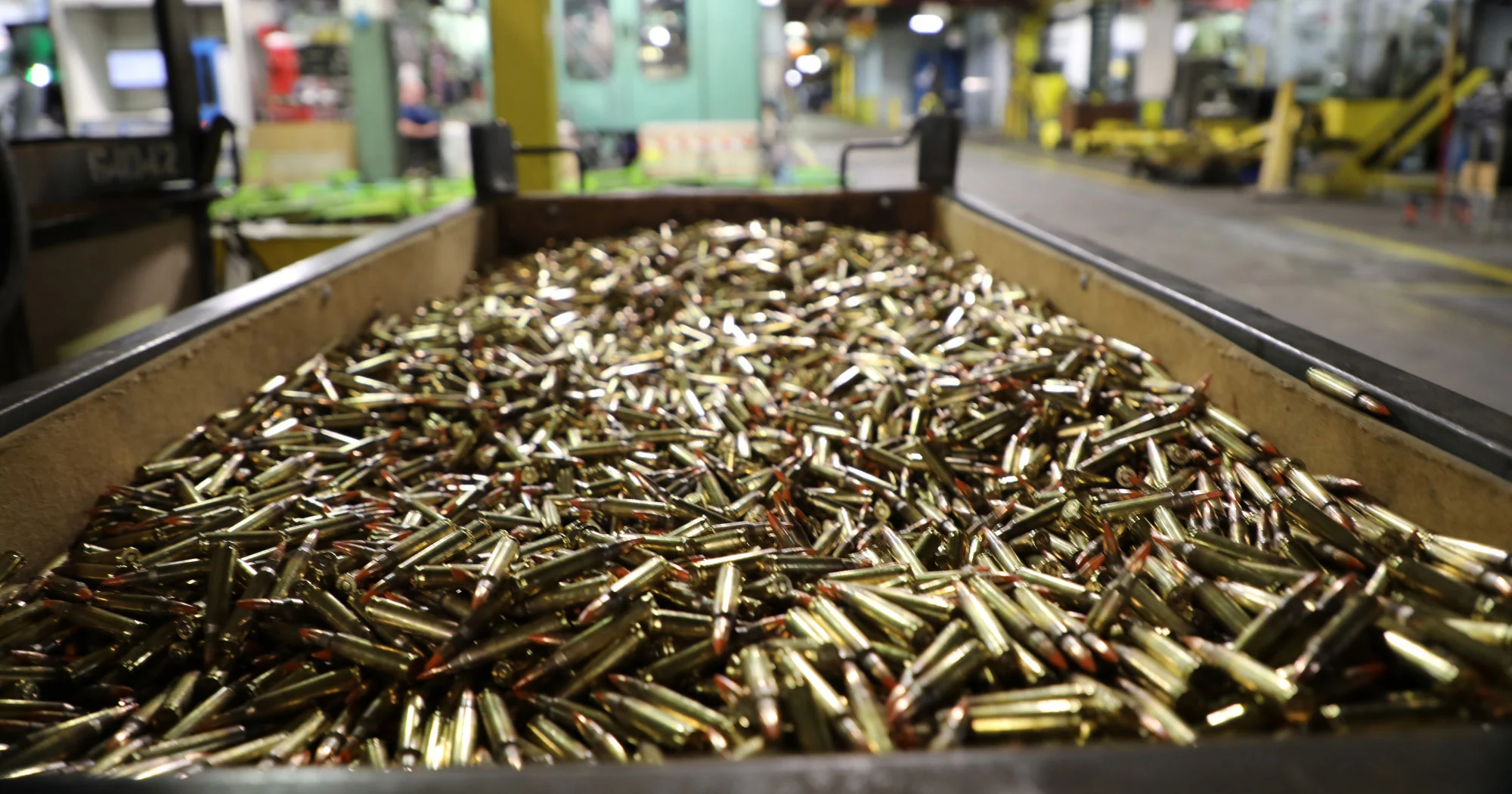
What is particularly satisfying is that India is now emerging as an export hub, supplying ammunition to many countries. India’s arms market was valued at USD 110 billion in 2023. The country exports a wide range of ammunition, arms, subsystems and accessories to more than 80 countries. The export inventory includes 5.56 mm assault rifle ammunition, 155 mm artillery ammunition, and 40 mm shoulder-fired rocket ammunition, among others.
Some of the key players in India’s ammunition industry include HAL (Hindustan Aeronautics Limited), OFB (Ordnance Factory Board) and BDL (Bharat Dynamics Limited). OFB has made rapid strides in recent years by developing cutting-edge products such as the Dhanush Artillery Gun (an upgraded version of the Bofors system) and 7.62×39 mm AK-203 assault rifles. Countries importing Indian ammunition include the United States, France, Armenia, Egypt, as well as several Southeast Asian and African nations.
India’s defence exports have grown 34 times—from just ₹684 crore in 2013–14 to ₹23,622 crore in 2024–25—representing a growth of over 12.04 per cent. The private sector’s contribution stands at ₹15,233 crore, while public sector undertakings account for ₹8,389 crore. India aims to achieve defence exports worth ₹50,000 crore by 2029.
Indigenous ammunition production has helped the country preserve precious foreign exchange while ensuring an unlimited and unrestricted supply of ammunition to its troops. One of the key strengths of indigenous ammunition production has been the growing role of the private sector, ensuring healthy competition among vendors and providing multiple sourcing options to the armed forces.
While the outlook is largely positive, India’s self-reliance efforts still face certain constraints, including technological gaps, insufficient R&D investment, complex procedural requirements, incomplete technology transfer (ToT), and dependence on imports for several critical components. However, with the number of measures being undertaken by the Government, these challenges are likely to be overcome in due course.
To conclude, fuelled by Atmanirbhar Bharat, India’s ammunition sector has witnessed a complete turnaround—from import dependence to becoming an exporter. The country is well-positioned to emerge as a global defence manufacturing hub in the foreseeable future.