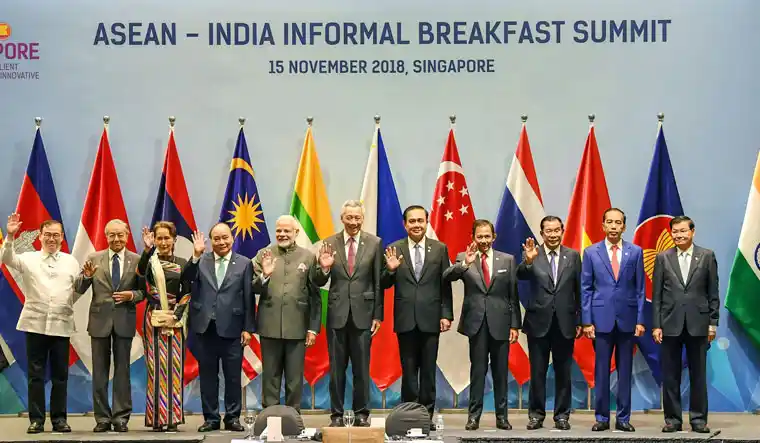
India’s Act East Policy (AEP), introduced in 2014 by Prime Minister Narendra Modi, marks a significant evolution from the earlier Look East approach. It emphasizes active engagement with ASEAN nations and East Asian partners across economic, strategic, and cultural domains. In the current context, marked by regional instabilities and China’s growing influence, the policy’s focus on maritime cooperation and Quad partnerships has gained renewed urgency. This analysis examines its development, synergies with the Quad, challenges in Myanmar and Bangladesh, and its broader strategic value.
Foundations and Quad Synergies
The AEP rests on four key pillars: culture, commerce, connectivity, and capacity building. It builds on phases of economic integration since the 1990s, with the post-2014 period incorporating security elements. Initiatives like the India-Japan Act East Forum have supported infrastructure in India’s Northeast, linking it to ASEAN networks.
The Quadrilateral Security Dialogue (Quad), involving India, the United States, Japan, and Australia, complements the AEP without undermining ASEAN’s central role. Through mechanisms such as the Indo-Pacific Maritime Domain Awareness initiative, the Quad provides satellite data to monitor maritime threats, including those in the South China Sea. This supports India’s Security and Growth for All in the Region (SAGAR) framework.
Joint exercises like Malabar enhance coordination for humanitarian assistance and disaster relief. Economic efforts, including the Critical Minerals Initiative, promote supply chain resilience, positioning India’s Northeast as part of regional networks. Capacity-building programs in digital infrastructure and STEM education extend the AEP’s reach, fostering long-term partnerships.
Recent Progress and Maritime Emphasis
Developments in 2025 highlighted the policy’s strategic shift. Prime Minister Modi’s declaration at the ASEAN Summit made 2026 the Year of Maritime Cooperation, strengthening ties through naval engagements and technology transfers. The recent visit to Malaysia elevated bilateral relations, advancing trade settlements and digital linkages.
Projects such as the Sittwe Port and the India-Myanmar-Thailand Trilateral Highway continue to advance connectivity, despite delays. These efforts align with broader Indo-Pacific goals, integrating economic and security objectives.
Challenges in Myanmar and Bangladesh
Myanmar’s ongoing civil conflict since the 2021 coup presents major obstacles. Ethnic armed groups control key border areas, disrupting projects like the Trilateral Highway and the Kaladan Multi-Modal Transit Transport Project. China’s investments, such as the Kyaukpyu Port, further complicate India’s position.
In Bangladesh, the 2024 political transition has strained relations. Restrictions on access and trade measures have affected initiatives like the BBIN framework. Instability in both countries heightens vulnerabilities for India’s Northeast, underscoring the need for alternative maritime routes.
Current Strategic Relevance
These challenges amplify the AEP’s importance in 2026. Land connectivity disruptions emphasize maritime pathways, including through the Andaman and Nicobar Islands. The policy addresses trade imbalances with ASEAN and counters China’s regional dominance through diversified partnerships.
Integration with the Quad enhances India’s role as a security provider. It supports economic resilience via supply chain diversification and digital exports, aligning with goals like Viksit Bharat by 2047.
To overcome hurdles, India could establish dedicated vehicles for infrastructure delivery and leverage BIMSTEC for regional cooperation. Strengthening sub-national engagement and digital initiatives would sustain momentum.
The AEP serves as a vital instrument for India’s Indo-Pacific engagement. The Quad provides essential support, while addressing Myanmar and Bangladesh issues requires adaptive strategies. Effective implementation will solidify India’s position as a key partner in the region, promoting stability and prosperity.