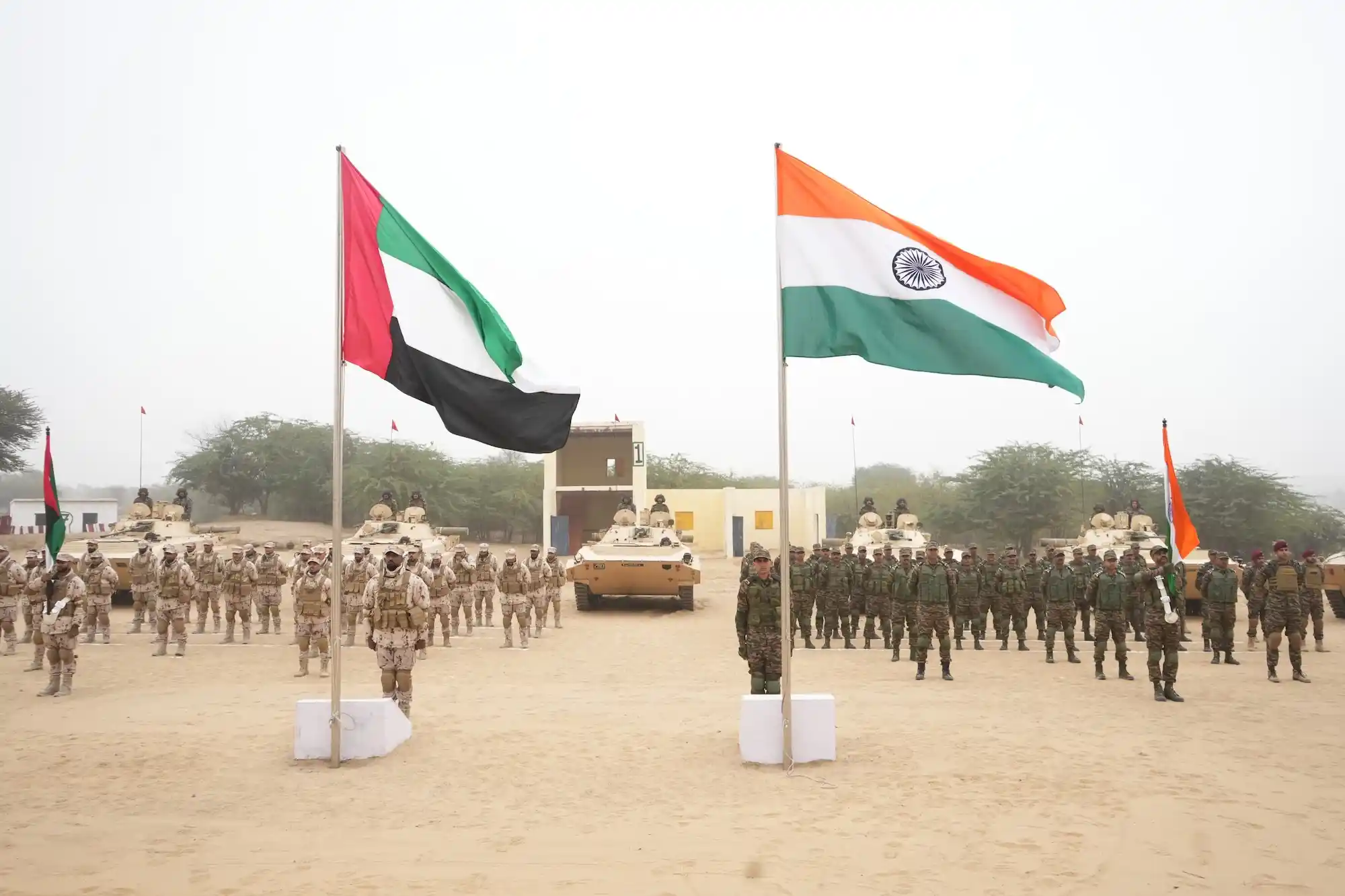
India and the United Arab Emirates (UAE) are translating their relationship into a more explicit defence and security framework. This indicates that their partnership is no longer transactional, but will also discuss the hard-security calculations. This happened following the conclusion of the Strategic Defence Partnership Agreement between the two nations in January 2026. This agreement was part of the wider package of agreements, including defence, space, energy, technology, and investment. The defence partnership sits within a broader institutional deepening of the “Comprehensive Strategic Partnership.” The proposed Strategic Defence Partnership framework aims to expand cooperation across defence industrial collaboration, innovation and advanced technologies, training and education, doctrine development, special operations, interoperability, cyberspace, and counter-terrorism. It also suggests a shift from sporadic military exchanges by aligning doctrines, building interoperability, and developing capacity in emerging domains like cybersecurity that typically indicate a maturing partnership. The timing of this partnership shows the move against the increased geopolitical upheaval in the West Asian region with added significance to changing regional alignments and frictions. For the UAE, the last decade has reinforced the strategic value of diversified partnerships that provide military capability, intelligence cooperation, and technology access. For India, instability in the West Asian region translates into energy price fluctuations, diaspora issues and maritime insecurity—problems that cannot be managed only through diplomacy.
Counter-terrorism and financial enforcement are also being included into this partnership narrative. Plus, there is reiterated condemnation of terrorism, including cross-border terrorism, and by both sides along with affirmation to deepen cooperation under the FATF framework to restrict terror financing and strengthen anti-money laundering efforts. This highlights the partnership as a comprehensive security arrangement encompassing both kinetic and non-kinetic dimensions, including intelligence, finance, and regulation.
A striking feature of this agreement is how tightly security cooperation is interwoven with connectivity and corridor politics. It explicitly places India and the UAE as the key partners of the India–Middle East–Europe Economic Corridor (IMEC) concept and notes that both have warm relations with Israel. This further implies that India–UAE coordination has wider regional implications. The strategic idea is that if connectivity projects become more central to geopolitical competition, states seek security arrangements that protect infrastructure, shipping, data routes, and supply chains. Defence partnerships are thus fast becoming the “insurance layer” of geoeconomic strategy.
From India’s perspective, the partnership also fits a broader pattern by moving from being a primarily economic stakeholder in the Gulf region to a more direct contributor to regional security outcomes—particularly in maritime and non-traditional security arenas. The focus is on trade corridors, MSME connectivity, cyber and interoperability, and cross-domain threats such as drones, cyberattacks, shipping risks, and terrorism financing. For the UAE, a strategic defence partnership with India also carries diversification value. India offers a distinct mix with a large and increasingly capable defence-industrial base. The UAE visualises this for co-developing capabilities and building resilient supply relationships.
The deeper geopolitical significance lies in how this partnership recalibrates regional signalling. When India and the UAE emphasise sovereignty, strategic autonomy, counter-terror financing, interoperability, and advanced technology cooperation, they are effectively constructing a partnership designed to function amid multipolar competition and recurring regional crises rather than only during stable periods. This is not an alliance in the classical sense, but it is a strategic alignment. It projects the pragmatic operational content—one that could increasingly shape how India positions itself in West Asia as a less distant partner focused on a security relevant partnership with bilaterally established defence cooperation.
The India–UAE strategic defence partnership can be best described as a consolidation move wherein it formalises a maturing security relationship that has been growing beneath the surface of expansive transactional ties. This convergence spanning across defence industry, interoperability, cyber, counter-terrorism, and adjacent domains like space and advanced technology—signals that both the nations are developing resilient ties in a contested regional order in which protecting trade, energy flows, and critical infrastructure requires stronger defence coordination, not merely diplomatic goodwill.
The views expressed are the author’s own.