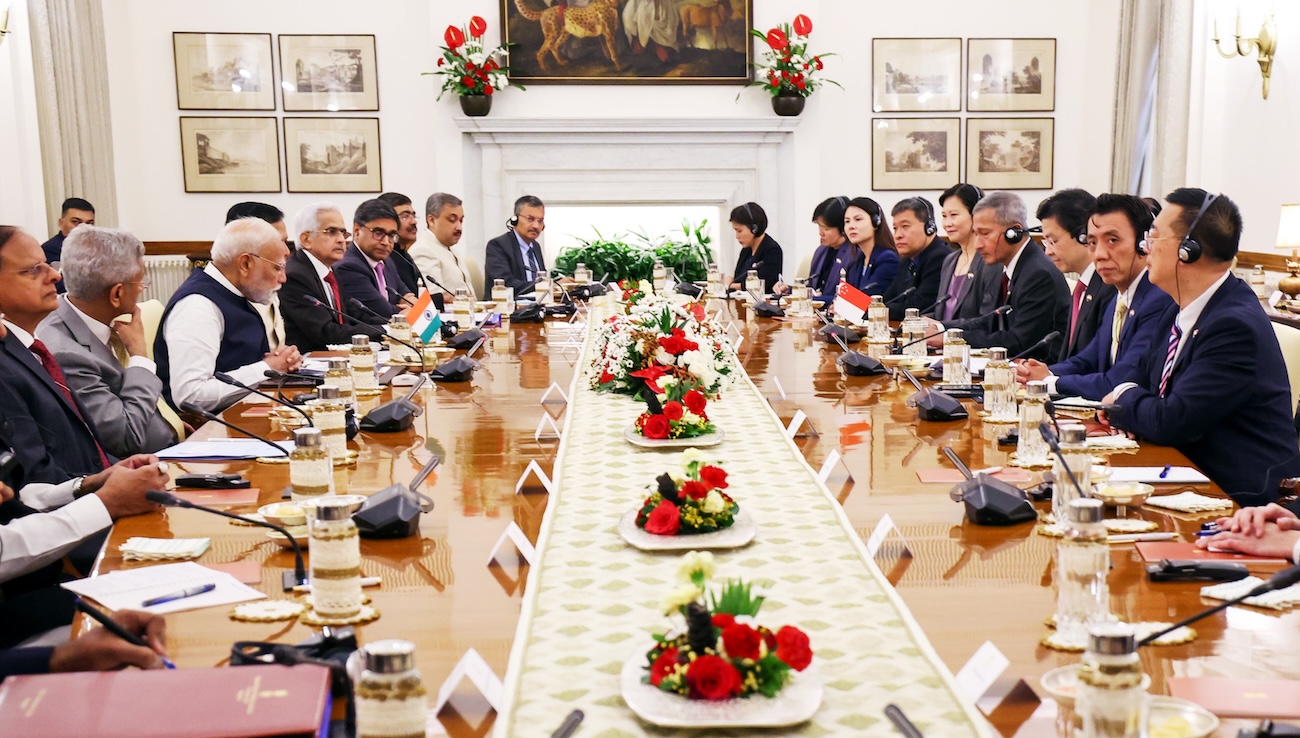
India and Singapore’s Comprehensive Strategic Partnership (CSP) 2025 has marked a pivotal moment in Asia’s evolving geopolitical and economic landscape during the visit of Singapore’s Prime Minister Lawrence Wong to New Delhi from September 2 to 4, 2025. The visit coincided with the 60th anniversary of diplomatic engagement. The visit underscored the strategic importance of both nations’ trade, technology, sustainability, defense, and people-to-people connections for a resilient and forward-looking Indo-Pacific.
The Significance of the Visit
The visit was Prime Minister Wong’s first visit to India, including high-level engagement meetings, thus emphasising the strategic significance of the partnership. The engagement reaffirms Singapore’s pivotal role in India’s ‘Act East’ policy and as India’s largest trading partner, with cumulative trade surpassing $175 billion. Multiple MoUs and agreements were exchanged between the countries. Through the exchange, a detailed roadmap was formed to facilitate broader collaboration across the CSP’s eight pillars: defense, security, connectivity, skills enhancement, economic cooperation, healthcare, and people-to-people connections.
Economic Cooperation: A Foundation of Trade and Investment
Through CSP, both countries aim to strengthen their economic ties through an extensive review and modernisation of existing trade agreements. Agreed to fast-track the third review of the Comprehensive Economic Cooperation Agreement (CECA), alongside working on revamping the ASEAN-India Trade in Goods Agreement (AITIGA), with the objective of concluding within 2025. The intent is to establish a foundation for easy market access, simplify dispute mechanisms, and expand business-to-business relationships. Through the NSE-IFSC-SGX GIFT Connect initiative, it plans to deepen financial interconnections. Such steps acknowledge shifting global trade patterns, protectionist pressures, and the need for more agile, supply chain-resilient agreements.
Semiconductor Collaboration: Building a Strategic Technology Ecosystem
India’s ambition of building a robust and resilient semiconductor ecosystem aligns with Singapore’s expertise in capital investment and global innovation networks. Also, focusing on technological priorities, one of CSP’s flagship components is semiconductor collaboration. Both countries plan to pursue joint research and development (R&D) programs, workforce training, and green manufacturing protocols. The aim is to make India a hub for semiconductor design and fabrication. The emphasis on sustainable manufacturing reflects both countries’ commitment to the environment and future industry policy.
Sustainability and Connectivity: Green Shipping and Beyond
Making sustainability a central focus of projects, such as the Green and Digital Shipping Corridor, which connects Indian ports with Singapore. It is expected to reduce port turnaround times by up to 30% and significantly cut carbon emissions; the corridor sets a regional benchmark for sustainable maritime trade. It aims to vessels adhering to strict low-emission standards, while enabling priority docking, streamlined digital customs processes, and AI-powered logistics improvements. Connectivity is further enhanced by air service agreements, the promotion of sustainable aviation fuel use, and the development of joint space industry initiatives. Together, through these initiatives, the aim is to build robust physical and digital infrastructure, which is essential for strengthening regional supply chains and economic integration in the Indo-Pacific region.
Skill Development and Healthcare: Empowering Human Capital
Recognising the workforce challenge and drawing lessons from recent global health crises, both countries decided to work on joint skill development programs and healthcare. The National Centre of Excellence in Chennai, supported by Singapore, will prioritise sectors vital to India’s industrial ambitions and healthcare system capacities, including advanced manufacturing, aviation maintenance and nursing, digital health technologies, disease surveillance, and pharmaceutical trade relations.
Defense and Security: A Growing Strategic Partnership
Commitment to solidify defense collaboration with the commitment to joint drills, maritime domain awareness, and intelligent exchange focused on counterterrorism. With the aim of deepening trust and joint work on regional security, India plans to join the Malacca Straits Patrol. It also aims to develop next-generation defense technologies, including quantum computing, AI-enabled solutions, and unmanned operational platforms.
People-to-People Exchanges: Sustaining Societal Bonds
Cultural and academic exchange, as well as parliamentary dialogues, are to be focused on, along with government-level cooperation. Entrepreneurship programs are designed to bridge societal gaps and nurture innovation.
Institutionalizing Cooperation and Future Outlook
The India-Singapore Ministerial Roundtable has been formalized for regular reviews and flexible governance. This mechanism ensures that the roadmap remains a living document, adaptable to increasing shifts in the global and regional circumstances.
The India-Singapore CSP 2025 showcases an essential shift in the relationship, which is driven by an action-oriented partnership with a roadmap for a forward-looking collaboration rather than a reactive one. It also responds pragmatically to work on dual imperatives of economic resilience and geopolitical flexibility. By integrating new cooperation technologies, culture, sustainability, and talent with security, it offers a model of contemporary diplomacy in an uncertain global environment.
Complementary nature in the cooperation where Singapore’s technology and financial clout align with India’s scale and vast market, which benefits both countries in innovation and practical economic growth. The collaboration between semiconductor and green manufacturing is a strategic partnership for achieving global supply chain and climate goals, thereby merging commercial and strategic priorities alongside a firm institutional mechanism and people-to-people connections to gain trust and build longevity, rather than relying on statecraft. This roadmap sets the standard for emerging alliances in Asia. This move in the India-Singapore Comprehensive Strategic Partnership will influence regional integration in the coming years, ushering in mutual benefits and a partnership for the 21st century, defined by a shared vision, mutual trust, and common purpose.