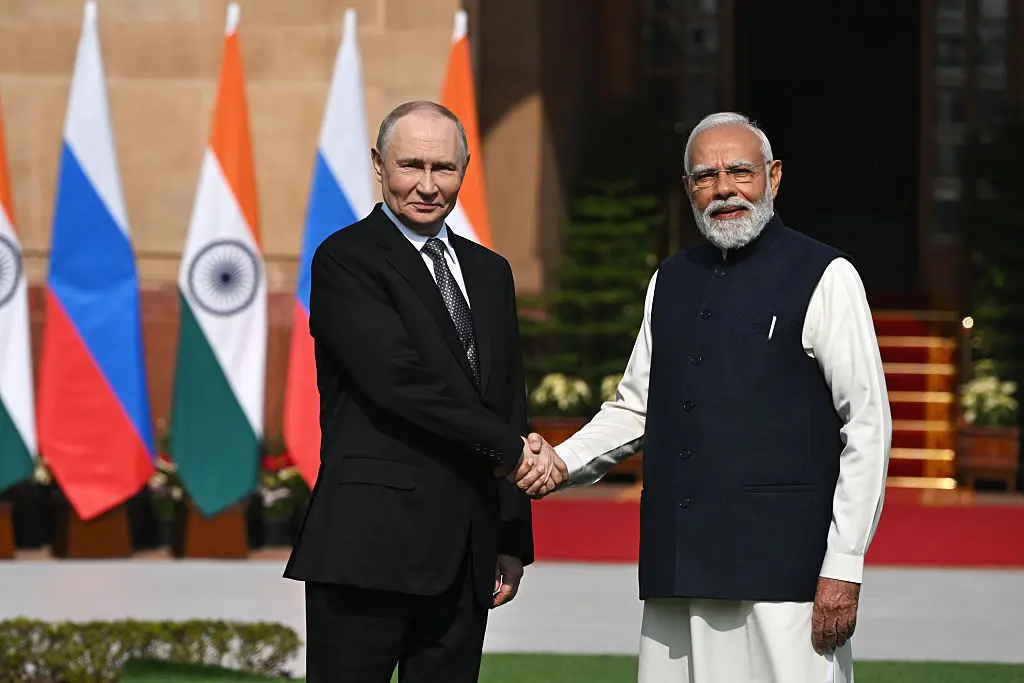
During his 3-5 December 2025 visit to New Delhi, Vladimir Putin reaffirmed that energy cooperation with India remains a top priority. Standing beside Indian officials, he said Russia is ready to continue “uninterrupted shipments” of fuel to India, also emphasised that Russian oil companies continue to consider their Indian partners “very reliable,” underscoring Moscow’s commitment to keeping the energy corridor open despite growing Western pressure. The message was timely: India’s imports of russian crude had just jumped to a five-month high, signalling that Indian refiners see Russia as indispensable even as U.S. secondary sanctions came into effect on 21 November.
Sanctions, high-risk shipping, and the cost of keeping crude flowing
Since 2022, India’s import of Russian crude has increased steadily. Nayara Energy has been a major contributor to this growth. Between 2023 and 2025, Nayara sourced 55% of its entire crude intake from Russia, which is a significant proportion of the total. In some months of 2024, russian grades supplied nearly 60% of its Vadinar refinery, a 20-million-tonne-per-year complex calibrated specifically for heavy-sour grades such as Urals and ESPO. Nayara seems to be maintaining its current approach despite of the U.S. sanctions. It appears that, according to shipping schedule records reviewed by The Economic Times, the company had already tentatively booked nine to eleven russian-origin cargoes for December 2025. It is thought that these were routed through non-designated intermediaries and transported via vessels that are still outside Washington’s sanctions lists.
It is understood that this commitment to maintaining the flow of Russian barrels is accompanied by significant challenges. Western insurers have withdrawn coverage from vessels linked to the so-called “dark fleet”. This has resulted in shipping costs to India rising 20% compared with mid-2025 levels. It is estimated by maritime brokers that 40% of tankers previously used for Russia–India routes are now deemed high-risk or uninsurable, which may be having an impact on refiners, who are having to rely on unfamiliar carriers and complex logistical routes.
Moreover, payment systems have evolved. In light of the recent regulatory changes in the U.S., buyers are exploring alternative options, including dirham- and yuan-denominated settlements, to ensure continued operational efficiency and financial stability. It is important to note that while these channels are functional, there are some considerations to bear in mind. These include potential compliance and currency-stability risks.
But it is also worth noting that the sanctions architecture targets specific entities rather than banning Russian crude altogether, meaning refiners will recalibrate rather than retreat. There may be growing evidence of ship-to-ship transfers, blended cargoes, and re-documentation through transit hubs such as Fujairah, Malaysia, and the Turkish Mediterranean, which may be allowing Russian barrels to reach India without direct links to sanctioned exporters. This pattern could be compared to earlier episodes in which sanctioned crude found opaque but uninterrupted routes to market.
Why indian refiners still prefer russian barrels
The November import surge was not an anomaly but perhaps a sign of Indian refiners’ strategic thinking. It is understood that russian crude continues to offer discounts of $4-7 per barrel relative to comparable Middle Eastern grades, a margin that directly influences refinery profitability. In light of the current global economic climate, which is being influenced by a number of external factors, Russia’s consistent supply of oil is a stabilising factor.
Despite the United States’ pressure, India continues to regard Russian oil which constituted approximately 35% of its crude basket in late 2025 as being essential to maintaining energy security and managing inflation. For New Delhi, the debate is practical. A reliable and affordable supply can strengthen the domestic economy and provide some protection against global economic shocks.
The barrel will find its way
It seems that, following Putin’s visit, there is a growing feeling that Moscow is keen to maintain the corridor. For India, the next phase involves navigating U.S. sanctions without sacrificing energy stability. In this calculus, Nayara Energy has become a bellwether. The decisions made in relation to shipping practices, payment systems and supplier selection are likely to have a significant impact on the adaptation of Indian refiners in 2026.
It is believed by energy analysts that russian oil will continue to arrive in India, albeit through a growing number of opaque pathways. “In the medium term, refiners are already adjusting. We’re seeing a shift toward non-designated russian entities, more use of opaque trading channels, and increased sourcing from the Middle East, West Africa, and the Americas,” Sumit Ritolia, Lead research analyst, refining & modeling at Kpler told to the Financial Express. The barrel will find its way, only the paperwork will get more complicated.
For New Delhi, this evolving ecosystem underscores a larger principle: it is vital that energy policy reflects India’s interests, as opposed to the preferences of external powers. It seems likely that, for as long as russian oil remains economically advantageous, India will want to keep that corridor open, regardless of the political crosswinds.