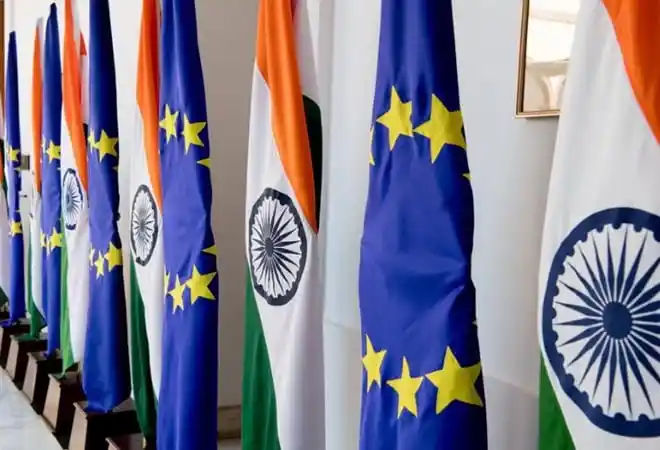
De-Risking, Hedging, Changing Alignments, and Strategic Autonomy – We have repeatedly heard these terms included in statements from Indian and European policymakers. Before Russia invaded Ukraine, Europe had figured out a fairly stable independent foreign policy position based on a trifecta – Security and Commerce with the United States, Trade with China, and Energy transactions with Russia. Before Donald Trump was elected President for the second time, India framed its foreign policy in terms of multi-alignment based on a Global partnership with the US, a special and privileged partnership with Russia, and a cooperative-competitive partnership with China. As we reassess their positions in 2025, a remarkably different picture starts to emerge.
Europe is now looking to de-risk from the United States after the economic and security pressures exerted on Europe by the Trump administration. Europe’s relations with China are undergoing changes within the ambit of economic security involving trade leverage, export controls, and manufacturing issues. Europe’s relations with Russia are locked in an increasingly escalatory dynamic. India’s ties with the US are at their worst in the last 20 years, as India’s Russian oil purchase has come under unreasonable Western pressure, and because there is a nativist backlash amongst Trump’s MAGA domestic political base. India’s relations with China are recovering with an eye on economic security and regional stability. India’s relations with Russia are under external pressure due to military and energy trade and a struggling Russian economy.
Where are they coming from, and where are they going
A quick look at its history will demonstrate that Europe is relatively fresh in the domain of acting as a geopolitically independent actor. Having thrived as a US ally for decades, Europe is still finding its feet when it comes to pursuing and crafting a truly independent foreign policy. India, on the other hand, is considered a master in maintaining an independent foreign policy since the successful days of the Cold War. In that sense, Europe is moving towards strategic autonomy after a long period of privilege. India is moving towards strategic autonomy after decades of continuous struggle. Yet both India and Europe are struggling in this period of renewed Great Power interference. Having enjoyed sustained periods of strategic stability, their strategic environments are undergoing rapid changes. Therefore, both are looking to maintain their independence and interests. The question is – Will they succeed?
To answer that question, we need to engage in strategic foresight. India’s view of strategic autonomy corresponds more neatly with traditional Nehruvian Non-Alignment rather than multi-alignment, even if it is more passive than under Nehru. A closer look at EAM Jaishankar’s statement at UNGA shows India is moving away from multi-alignment towards a more traditional and conventional form of strategic autonomy.
“Bharat approaches the contemporary world, guided by three key concepts:
One, Atmanirbharta or self-reliance. That means developing our own capabilities, building our own strengths, and nurturing our own talent. Two, Atmaraksha or securing oneself. We remain determined to protect our people and secure their interests, at home and abroad. And three, Atmavishwas or self-confidence. As the most populous nation, as a civilizational state, as a rapidly growing major economy, we are confident about who we are and what we will be. Bharat will always maintain its freedom of choice. And will always be a voice of the Global South.”
On the other hand, EU President Ursula Von der Leyen’s State of the Union address in 2025 indicates a sharper activist version of strategic autonomy
“Europe is in a fight. A fight for a continent that is whole and at peace. For a free and independent Europe. A fight for our values and our democracies. A fight for our liberty and our ability to determine our destiny for ourselves. Make no mistake – this is a fight for our future. So, yes, Europe must fight. For its place in a world in which many major powers are either ambivalent or openly hostile to Europe. A world of imperial ambitions and imperial wars. A world in which dependencies are ruthlessly weaponized. And it is for all of these reasons that a new Europe must emerge. This must be Europe’s Independence Moment.”
Two different ends
It is clear that India and Europe look at independent foreign policy from two different vantage points. For Europe, maintaining the status quo is of paramount importance as it has thrived and prospered in the international order of the last 75 years. India, on the other hand, is coming to terms with the fact that great powers and the prevailing order will always be a challenge, even if India conforms to the prevailing norms and rules. After great reluctance and external pressure, India and Europe are trying to craft a new strategic space for themselves. For Europe, US remains indispensable despite the fact that Trump has treated them like a junior partner. India, having tilted towards the United States over the last 20 years, is still bruising from the Trump onslaught.
For Europe, China is a dilemma. Europe and China are bound at the hip with a strong economic relationship that has spanned decades. China’s dual-use trade with Russia has muddied the waters, even though China insists that it has provided no direct military support to Russia. Europe’s economic security playbook has not quite worked as expected, with China and Chinese advancement in 4th generation and green technologies making Europe apprehensive about the future. Yet there is enough common ground between the two for the relations to remain stable. This is because the sheer size of the trade relationship comes with in-built resilience. The US is now trying to exert even more pressure on the EU’s China policy, as shown by the recent Nexperia case, where a Dutch court ruled under US pressure that a Chinese company in the Netherlands should expel the Chinese executives of the company.
For India, on the other hand, China is a hybrid of challenge and opportunity. India has only just regained stability with China after a long-drawn-out military standoff following a military clash in Galwan in 2020. The process of the reset involved five long years of arduous and incremental civil-military diplomacy. The central imperative of the reset was economic. Morgan Stanley predicts that the India-China economic relationship is likely to grow as the India-China trade corridor is already the fifth fastest growing trade corridor in the world. The Morgan Stanley report summarizes the economic relationship as follows.
India can leverage China’s strengths in manufacturing and technology, while China can utilize India’s vast market for exports and investment. However, there’s a caveat: geopolitics. While economic imperatives point to deeper trade and investment ties, political developments could slow progress. For India, this means that it must rely on Chinese imports to meet its increasing demand for capital goods as well as critical inputs that are necessary for its industrialization and Chinese companies can capture this growth opportunity by investing in and serving the domestic Indian market. Chinese mobile phone companies have already been doing this, and whether this can broaden to other sectors will depend on the opening up of India’s markets. India needs to integrate itself into the global value chain. And to do that, India needs Foreign Direct Investment from China, much like how China’s rise was fueled by Foreign Direct Investment from the U.S., Europe, Japan, and Korea.”
Finally, Europe’s relations with Russia are on the brink, and this is where European independence will meet its biggest test. The rapid escalation of the Ukraine war will further create divisions in the international system. For Europe, a Ukrainian victory and a Russian defeat are the only acceptable outcomes. Europe has successfully navigated Trump’s interventions, but whether Trump’s latest about-turn, followed by another about-turn, will lead to a Russian defeat is not certain. In fact, the Russian ground offensive maintains a degree of momentum. A Ukrainian defeat will push Europe towards a more confrontational stance, and a Ukrainian victory is bound to make Europe more accommodating towards the rest of the world.
India’s relations with Russia have been unfairly linked with its relations with the US and Europe by the Western powers due to an American imposition of additional 25% penal tariffs on India. India, however, will continue to hedge in the Ukraine war. While there will be marginal diversification in the military and energy domains away from Russia, this will be against India’s own strategic preference. The long-term effect of India’s Russia relations will be on India’s relations with the West, as India’s quest for independence is existential. Whether the US and Europe can adjust better to a non-aligned India will be the decisive factor in the long term. From India’s perspective, India will have to intensify efforts and deliver results to the Indian people to sustain its independence. Any mistake or failure will definitely be punished both in domestic electoral politics and international politics.
In conclusion, the EU and India can achieve better strategic convergence if they understand their different views on Strategic Autonomy. These views are not opposite, but they are not aligned. This will help both sides avoid setbacks and strategic inertia.