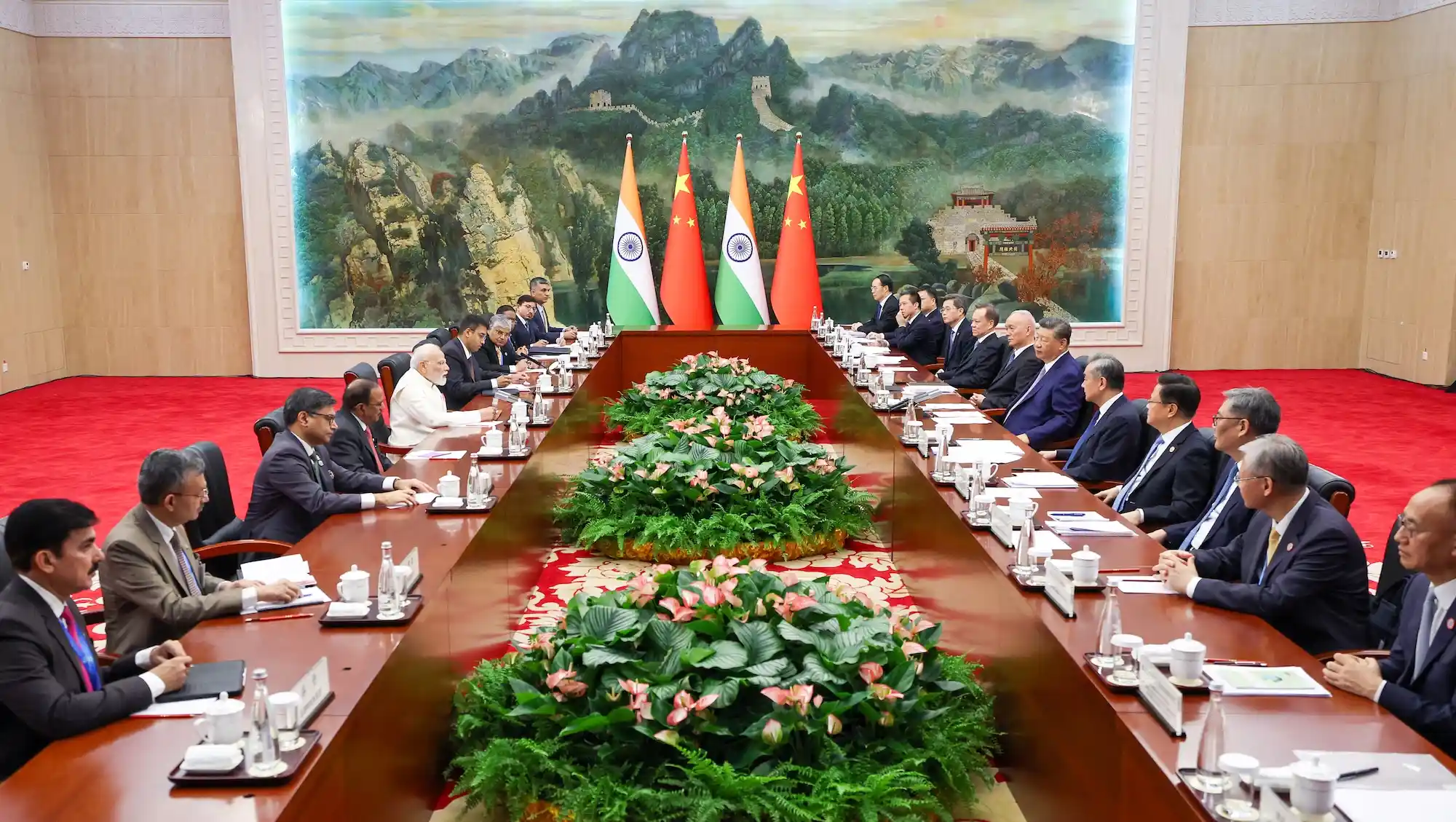
India-China bilateral relations have undergone substantial recalibration throughout late 2025, demonstrating both nations’ commitment to managing strategic competition through institutional mechanisms while preserving core national interests. The period from September through December 2025 witnessed sustained high-level engagement, including the October 25 Corps Commander meeting at Chushul-Moldo—the 23rd such military-level consultation since border tensions escalated in 2020—and subsequent diplomatic interactions that collectively evidence systematic conflict management approaching maturity. The December 2025 Tawang incident, rather than signaling fundamental reset failure, demonstrates the operational utility of established institutional architectures in preventing escalation and enabling negotiated resolution of tactical disagreements.
Institutional Architecture and Military Engagement
The trajectory of India-China relations has shifted from acute military confrontation toward structured dialogue mechanisms spanning multiple institutional levels. The October 2025 Corps Commander meeting represented the first general-level military engagement following the August 2025 Tianjin summit, establishing consistent cadence for military-to-military consultation. Both sides acknowledged “peace and tranquility” maintenance across border areas while reaffirming commitment to “use existing mechanisms to resolve any ground issues,” reflecting mutual recognition that institutional frameworks effectively constrain escalation risks.
This institutional continuity proved consequential when Chinese military personnel conducted operations in Tawang’s Yangtse area on December 9, 2025. Defence Minister Rajnath Singh characterized the incursion as “pre-planned,” involving approximately 200-300 troops and exploiting scheduled Indian rotations. Rather than representing institutional mechanism failure, the incident occurred within established dispute resolution frameworks. Flag meetings convened by December 11—merely two days after the incident—demonstrated that both nations possessed functional protocols for managing tactical disagreements and preventing escalation. This “tactical probing,” wherein China tests Indian military capabilities and territorial commitment without violating core disengagement frameworks established in October 2024, reflects strategic behavior calibrated within defined parameters.
The Working Mechanism for Consultation and Coordination (WMCC), operational since 2012 and supplemented by regular Corps Commander meetings and Special Representatives’ dialogue, constitutes multilayered institutional architecture for dispute management. However, the persistence of approximately 50,000-60,000 troops from each nation along the Line of Actual Control underscores that disengagement remains partial rather than comprehensive. Unresolved standoff locations persist beyond Depsang and Demchok, where force deployments remain unchanged since 2020, reflecting differing strategic objectives: India prioritizes demilitarization and pre-2020 deployment restoration, while China demonstrates preferences for managed coexistence alongside infrastructure development.
Economic Interdependence and Structural Asymmetries
Bilateral trade dynamics reveal substantial economic interdependence alongside significant structural imbalances. China surpassed the United States to become India’s largest trading partner in August 2025, with bilateral trade reaching approximately $127 billion—demonstrating substantial commercial engagement despite diplomatic tensions. However, India’s $99 billion trade deficit represents considerable asymmetry favoring Chinese exporters.
Chinese dominance persists across critical sectors: electronics comprise 57.2 percent of imports, machinery and hardware 44 percent, and chemicals 28.3 percent. Strategic dependencies remain acute in renewable energy inputs (95.7 percent solar modules), active pharmaceutical ingredients (91.4 percent), and industrial textiles. Conversely, Chinese direct investment into India remains modest relative to trade volumes, with 2023 flows reaching approximately $42 million in equity concentrated in electronics manufacturing and e-commerce.
This asymmetry prompted consideration of investment facilitation mechanisms as potential cooperative initiatives. Analytical assessments suggested that facilitating Chinese participation in strategic sectors—including electric vehicle manufacturing and semiconductor assembly—could demonstrate India’s commitment to deeper economic engagement while addressing India’s structural vulnerabilities. Such arrangements would represent mutual interest accommodation: India gains technology transfer and capital infusion while China secures market access and strategic supply chain positioning.
Multilateral Engagement and People-to-People Exchange
Beyond bilateral channels, India-China engagement proceeds through multilateral institutional venues. The September 2025 Shanghai Cooperation Organisation (SCO) Summit produced the Tianjin Declaration and approved the SCO Development Strategy (2026-2035), establishing frameworks for counterterrorism cooperation, cybersecurity coordination, and energy collaboration. These multilateral mechanisms enable cooperative engagement in mutually beneficial sectors while compartmentalizing disagreements regarding border demarcation and territorial assertions.
Both nations reaffirmed commitment to restoring people-to-people engagement disrupted during the 2020-2024 tension period. The third meeting of the India-China High-level Mechanism on People-to-People Exchanges will occur in India during 2026, representing institutional restoration of cultural and educational exchanges. Celebration of the 75th anniversary of diplomatic relations establishment provides commemorative occasion for reinforcing shared historical linkages.
India’s 2026 BRICS Summit hosting presents additional multilateral engagement opportunity. Both nations demonstrated commitment to this venue, permitting simultaneous cooperation and competition—advancing competing visions for global governance while maintaining diplomatic decorum and institutional engagement.
Strategic Autonomy and Managed Competition
India’s approach throughout late 2025 reflects “strategic autonomy with hedging”—simultaneously pursuing economic engagement with China while maintaining strategic partnerships with the United States, Japan, and Australia. Defense partnerships, military modernization programs, and Indo-Pacific strategic cooperation proceeded parallel to economic re-engagement with Beijing, reflecting recognition that neither complete alignment nor containment represents feasible strategy. Rather, India pursues asymmetric interdependence management, deepening mutually beneficial ties while maintaining military capabilities and strategic partnerships preserving autonomy.
India-China relations in late 2025 exemplify mature statecraft within multipolar international order. The October Corps Commander meeting, December Tawang incident resolution, and sustained multilateral engagement collectively demonstrate transition from acute conflict toward systematized management of enduring disagreements. The reset represents relationship rationalization rather than transformation—both nations recognize that development imperatives and economic interdependence justify sustained diplomatic engagement while neither abandons core strategic objectives. This creates “cooperative competition” wherein institutions manage interaction bounds while strategic competition persists. Functioning confidence-building mechanisms, graduated disengagement, and sustained dialogue constitute significant achievements in managing inherently competitive relationships, though fundamental disputes continue circumscribing deeper cooperation.