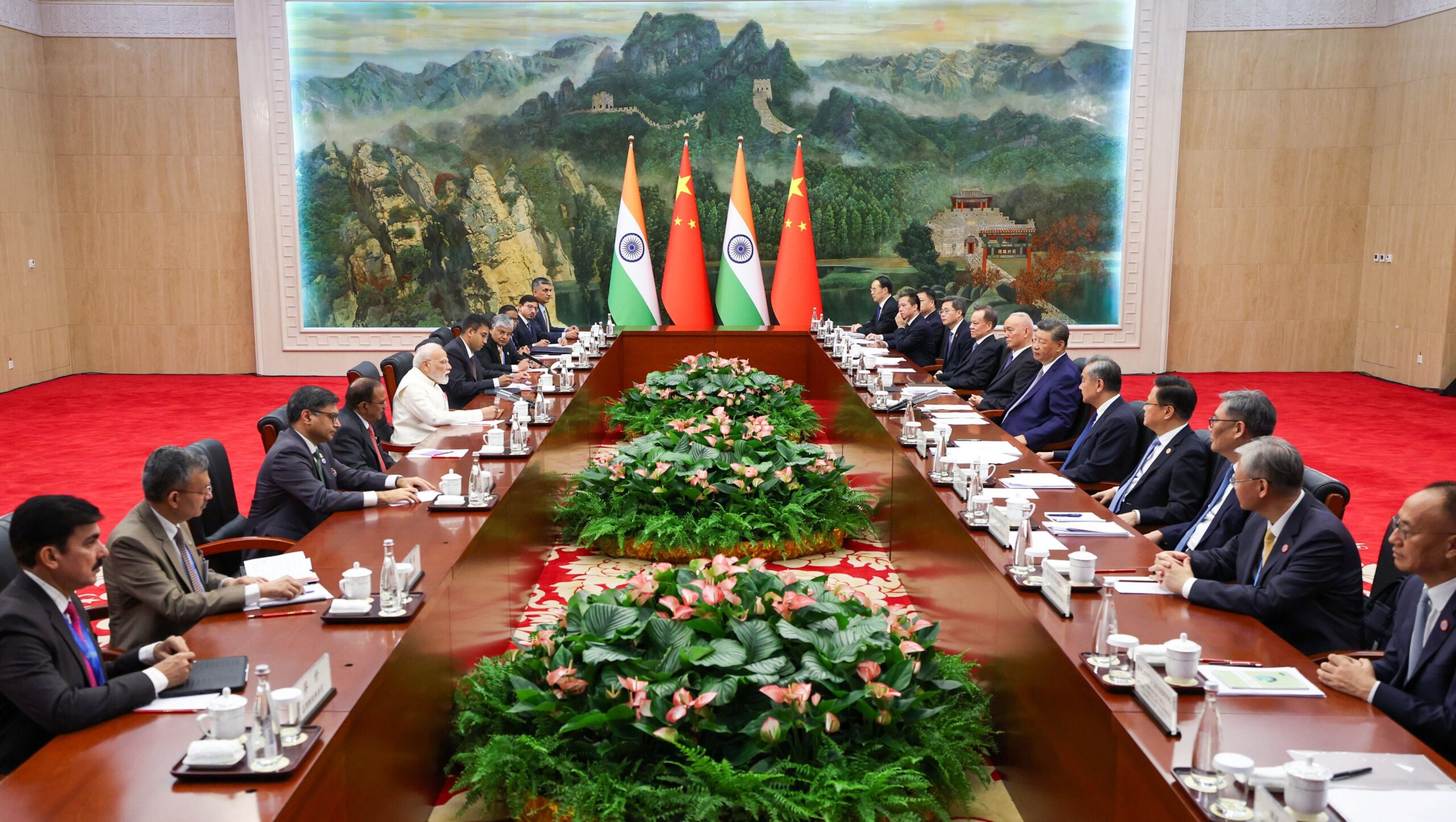
In the aftermath of the Shanghai Cooperation Organization (SCO) Summit, India and China entered a transition in their relations, characterized by measured diplomacy and engagement. Prime Minister Narender Modi visited China after a seven-year hiatus, attending the summit in Tianjin, which is a symbolic gesture that both countries intend to move beyond border frictions and geopolitical rivalry. Both countries’ leaders during the summit publicly articulated themselves as “partners, not rivals”.
The leaders’ statement at the summit further shed light on the current philosophy of the India-China relationship. Modi underscored the need for an “atmosphere of peace” and mutual respect, stating that differences should not lead to disputes, thereby calling for dialogue rooted in trust and sensitivity. Xi Jinping called the two nations pivotal actors for shaping a new multipolar world order. It is urging a perspective that sees India and China as “partners, not rivals.” He also stressed that economic development between the two countries will be the central pillar of resetting, while maintaining the border disagreements, which will not overshadow broader cooperation. Collectively, these statements by leaders indicate a mutual recognition that collaboration is essential for regional stability, development, and the ability to meet global challenges. However, understanding the situation requires pragmatic measures rather than an outright reconciliation.
A significant post-SCO development has been the resumption of direct passenger flights, thus reducing the dependency on third countries to increase business, tourism, and people-to-people contact. Additionally, India has reopened tourist visas for Chinese citizens and resumed the Kailash Mansarovar Yatra pilgrimage route. The border trade, which was suspended due to security concerns, is set to resume operation via key passes at Lipulekh, Shipki La, and Nathu La, aiming to revive local economies and improve cross-border commerce. Diplomatic mechanisms, such as the Special Representatives’ dialogue on the boundary dispute, which resumed in August 2025, remain crucial for preserving stability along the Line of Actual Control (LAC).
It has been observed that economic recalibration has occurred against the backdrop of both countries’ complex trade relations with the United States, which, in mid-2025, imposed higher tariffs on goods, prompting the need for diversified partnerships and strengthening regional cooperation. Economic engagement has started to gain momentum with China easing export curbs on key Indian imports such as rare earth minerals, fertilizers, and tunnel-boring machines, as they are essential for India’s infrastructure projects and industrial growth, as per reports of emerging private-sector collaborations, with Indian conglomerates exploring joint ventures in battery manufacturing partnerships with Chinese electric vehicle firms. Both governments have discussed addressing India’s trade deficit with China by creating a more balanced and sustainable economic relationship. It underscored the potential for deeper integration in emerging industries despite unresolved strategic and trade imbalances.
Looking ahead, careful and essential steps are taken to construct a forward momentum in the relationship. At the same time, as they navigate sensitivities amid broader geopolitical pressures, both countries are committed to institutionalizing and regularizing diplomatic and military mechanisms to prevent escalations. Expanding economic cooperation while India continues to voice concern over cheap Chinese imports that are affecting the domestic market, and China is aware of India’s growing strategic partnerships. Through lowered trade barriers, regulatory facilitation, and joint ventures, particularly in the technology, green energy, and infrastructure sectors, the complementary sectors are taking steps to work together. People-to-people engagement has begun through restored air service, visa liberalization, and cultural initiatives aimed at building trust. To participate in multilateral platforms like the SCO and BRICS and work on joint collaboration on terrorism, climate governance, and trade fairness. It will also enable both states to demonstrate leadership in advancing the aspirations of the Global South. Managing external geopolitical pressures with strategic autonomy will thus remain essential, requiring nuanced diplomacy to insulate bilateral progress from wider great-power rivalries.
The developments following the SCO Summit 2025 underscore a notable diplomatic ease, characterized by a calibrated balance of competition and cooperation. The new developments taking place are based on the demand for continuous patience, persistence, and political determination from both governments, despite the reality of complex geopolitical dynamics. The public statements from both countries are aimed at implementing policy measures to reset and strengthen connectivity, as well as economic projects, and to reinstate dialogue mechanisms. How India and China navigate and uphold the relationship from now will impact the multipolar international order, regional security, and economic stability in the years ahead. The willingness to compartmentalize issues while fostering cooperation offers a positive indication for the most strategically significant relationships in international politics.