
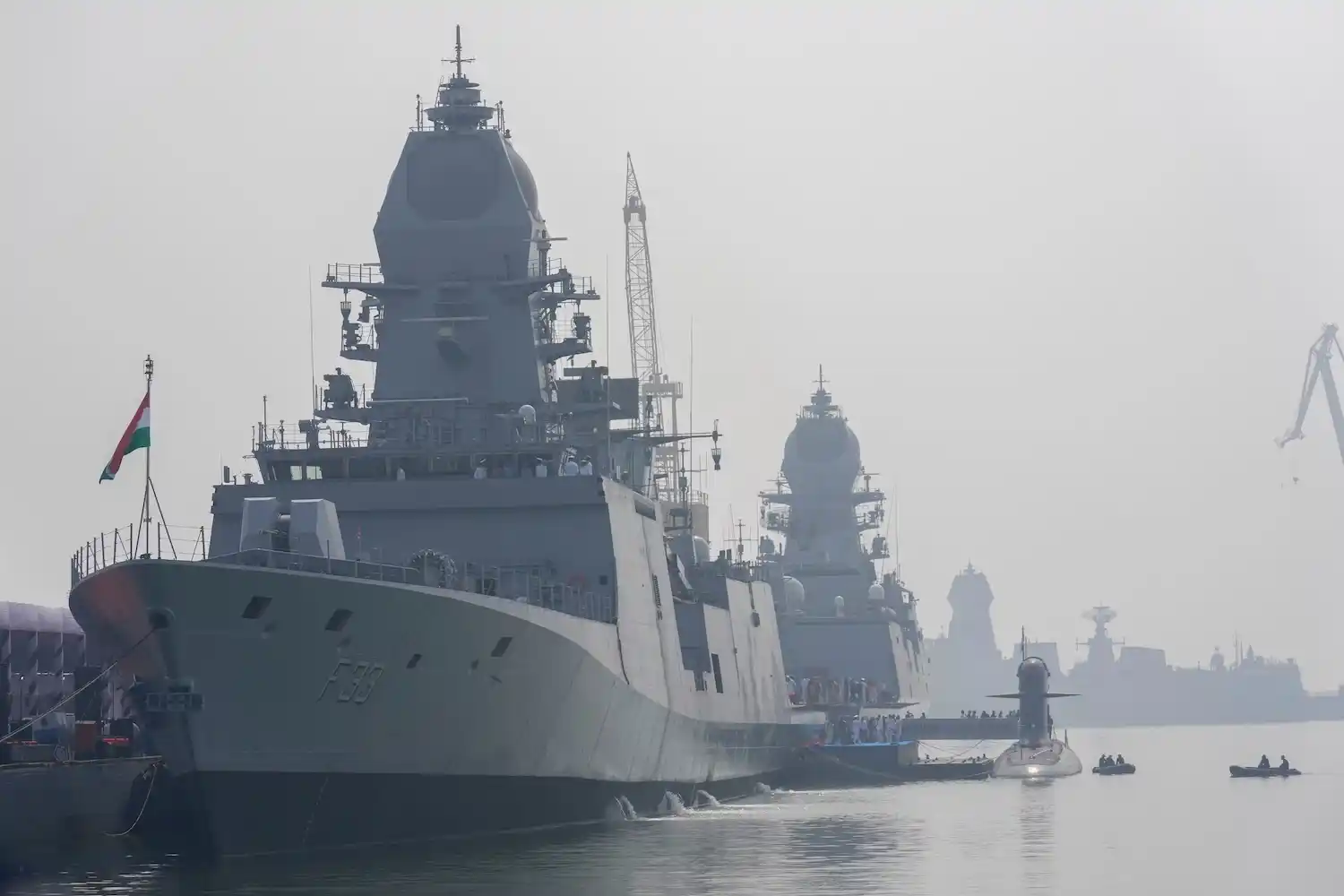
Amid growing turbulence in the Indian Ocean and shifting alliances across the wider Indo-Pacific, the Indian Navy is visibly expanding its maritime reach — from the Mediterranean Sea in the west to the South China Sea in the east. This assertive naval diplomacy comes at a time when external powers are stepping up activity in India’s maritime neighbourhood, testing New Delhi’s balance between engagement and vigilance.
Expanding Presence from East to West
In recent months, India’s naval outreach has gone far beyond traditional exercises. In August, Indian and Philippine warships conducted their first-ever joint patrol in the South China Sea, signalling solidarity with Southeast Asian partners amid rising tensions in contested waters.
Soon after, the indigenous vessel INS Nistar joined Pacific Reach — Singapore’s multinational submarine rescue exercise involving 12 navies, including China and Japan. Interestingly, the United States, a key Indo-Pacific power, was absent. American publication Newsweek described India’s participation as “China’s rival flexing submarine capabilities in contested waters.”
In the eastern waters, INS Sahyadri, a stealth frigate, called at Kemaman in Malaysia as part of an ongoing Indo-Pacific deployment. Meanwhile in the west, India broke new ground by holding its first joint naval exercise with Greece, following Prime Minister Narendra Modi’s visit to the region. This engagement took place amid rising Turkey-Pakistan cooperation, including Ankara’s reported support for Pakistan’s Operation Sindoor.
Strategic Partnerships and Cautionary Signals
As British Prime Minister Keir Starmer arrived in India, the UK’s aircraft carrier HMS Prince of Wales joined the Indian Navy in the Konkan exercise in the Western Indian Ocean. The manoeuvre underscores India’s growing network of defence partnerships — but also revives debates over the AUKUS alliance of the US, UK, and Australia, which some Indian analysts view as a military bloc operating outside India’s own strategic frameworks.
Complicating matters further, Turkey has emerged as a disruptive presence in India’s maritime vicinity — arming Pakistan and the Maldives with drones and warships, while President Erdogan repeatedly raises the Kashmir issue at international forums.
Against this backdrop, India is pushing ahead with Project 77, a ₹40,000-crore initiative to build nuclear-powered submarines domestically. By 2036-37, the Navy aims to field two submarines armed with 800-km range missiles, signalling a self-reliant and assertive maritime doctrine.
Troubled Waters in the Neighbourhood
The Indian Ocean is becoming a theatre of competing influences. China’s “research vessels” continue to dock in Sri Lanka and the Maldives, often suspected of surveillance. Recently, even the US, Japan, and Australia have sent similar ships, ostensibly for hydrographic studies. India, which has previously raised alarms over Chinese activity, now faces a delicate question: how to respond when the intruders are partners rather than adversaries.
Meanwhile, Pakistan has renewed outreach to Colombo, after India blocked a proposed Pakistan–Sri Lanka joint naval drill off Trincomalee earlier this year. These overlapping moves expose the strategic tightrope New Delhi must walk as it defends its sphere of influence in South Asia’s waters.
Building Ties Across the Indian Ocean
India’s diplomacy is also creating new anchors of cooperation. During the visit of Mauritian Prime Minister Navinchandra Ramgoolam, the two nations signed agreements on port development, hydrography, and helicopter support. This comes soon after Mauritius renegotiated its long-term lease for Diego Garcia with the UK — a deal that could reshape regional power dynamics, given the US military base there.
Elsewhere, Seychelles heads into a tense presidential run-off, with India watching closely as island politics could determine the fate of the stalled Assumption Island project. In Madagascar, public protests and the army’s growing political role add another layer of uncertainty to India’s extended maritime neighbourhood.
The Larger Geopolitical Canvas
India’s maritime resurgence unfolds alongside renewed great-power competition. The US, buoyed by its lease extension over Diego Garcia, is deepening its Indian Ocean footprint — potentially sidestepping India in regional affairs. Meanwhile, China has fortified positions in Sri Lanka’s Hambantota and Colombo Port City. Between these rival poles, India must assert its own leadership in the region it considers central to its security.
Adding complexity are emerging defence pacts such as the Saudi-Pakistan deal and Turkey’s economic zones in Karachi, which could recalibrate regional power balances. Even as Moscow reassures New Delhi over defence supplies, India remains aware of lingering sensitivities after its 2005 defence partnership with the US.
Navigating the New Maritime Order
India’s defence establishment appears clear-eyed about the challenges ahead. From the Mediterranean to the South China Sea, New Delhi’s naval engagements are not just demonstrations of reach — they are statements of intent. Yet, as Operation Sindoor’s legacy lingers and new global alliances form, India must guard against being drawn into others’ rivalries.
For a nation long seen as the anchor of the Indian Ocean, the message is unmistakable: India is no longer just watching the tides — it is steering them.

