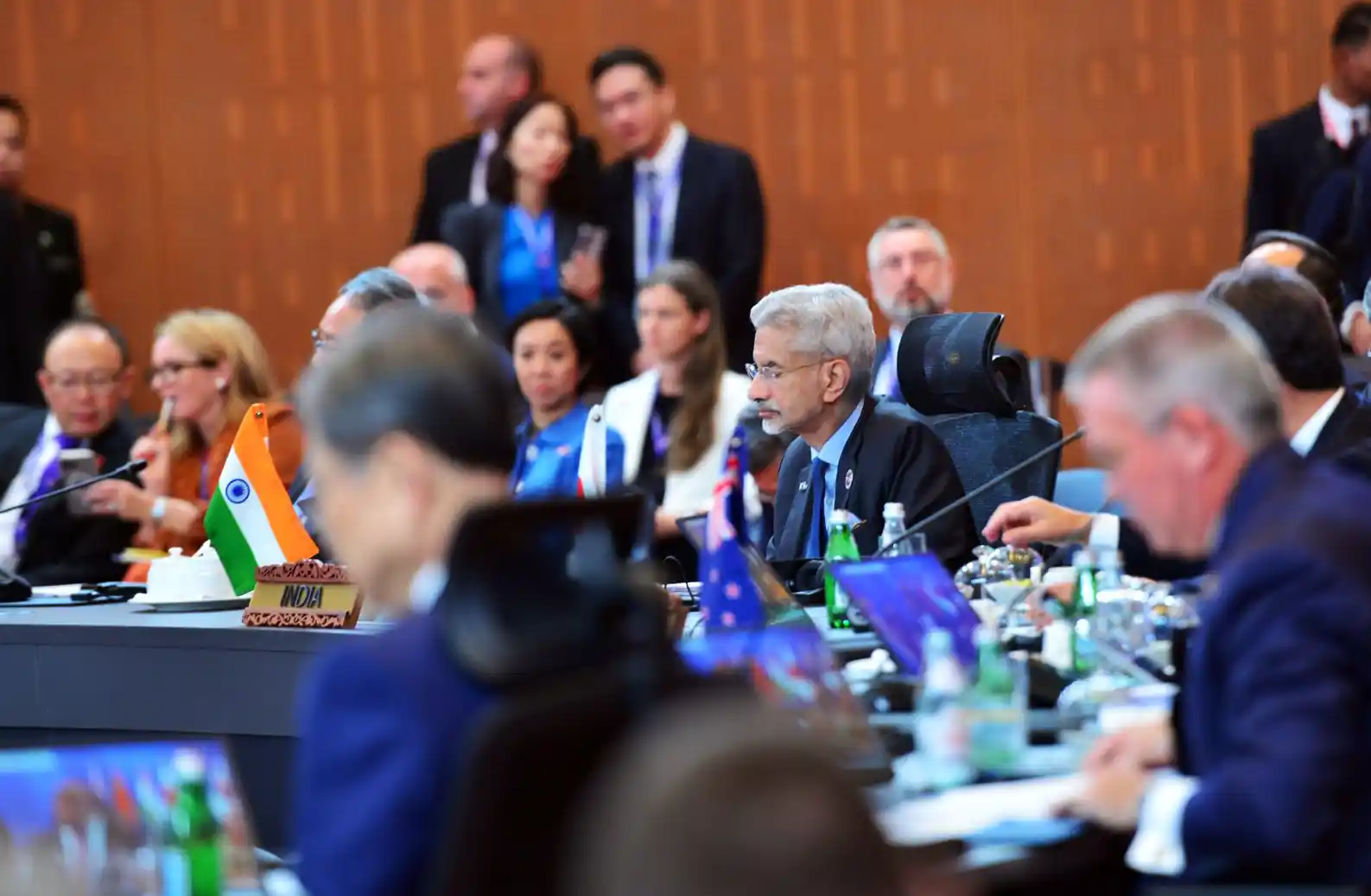
India’s External Affairs Minister S. Jaishankar’s statement at the 20th East Asia Summit (EAS) in Kuala Lumpur on October 27, 2025, perfectly captures New Delhi’s evolving approach to regional engagement in an increasingly fractured global order. His address was notable for its candid acknowledgement of today’s complexities, from supply chain fragilities to selective application of principles. The statement reflects India’s understanding that in a multipolar world, regional forums like the EAS offer platforms for practical collaboration even as global institutions struggle with paralysis and the great power competition intensifies. The EAM’s statement stands out for underlining three important aspects: the importance of multipolarity, India’s approach to regional conflicts, and the maritime cooperation dimension.
Firstly, Jaishankar’s framing of multipolarity as a reality “not just here to stay but grow” signals that India is at ease with a world order that is no longer dominated by singular powers or rigid blocs. His emphasis on contemporary concerns like ‘unreliable supply chains, competitive technology advancement, constricted energy trade, market distortions and selective application of principles’ highlights important features of the post-globalisation era. Thus, rather than lamenting this fragmentation or calling for restoration of some idealised past order, the EAM’s statement accepts these as given circumstances which require adaptation.
Moreover, the assertion that “change has a life of its own” and that “the world will inevitably respond to new circumstances” reflects pragmatic realism. This is not a passive acceptance but a recognition that resistance to structural shifts proves futile. Instead, Jaishankar outlined the inevitable responses, like ‘adjustments in strategy, recalculated interests, fresh understandings among nations and resilient solutions born from necessity’. Likewise, the emphasis on “realities of technology, competitiveness, market size, digitization, connectivity, talent and mobility” suggests that India views economic fundamentals as well as demographic advantages as determinative, rather than mere institutional arrangements.
For India, multipolarity offers opportunities that are constrained by bipolarity or unipolarity. It not only enables issue-based partnerships without binding alignments, but also allows leveraging of different capabilities across various domains. It equally provides space for middle powers to shape regional outcomes rather than just responding to great power dictates. However, Jaishankar’s acknowledgement that “principles are applied selectively and what is preached is not necessarily practiced” serves as both a critique of Western double standards and an implicit assertion that New Delhi will pursue its interests pragmatically rather than just ideologically.
Secondly, the statement’s treatment of ongoing conflicts demonstrates India’s careful calibration between principle and pragmatism. Welcoming the Gaza peace plan, while seeking an early end to the Russia-Ukraine war, positions India as supportive of conflict resolution without taking sides in ways that constrain its relationship with involved actors. This reflects India’s broader diplomatic approach that underlines the importance of maintaining engagement with all sides, advocating for peaceful resolution while simultaneously avoiding positions that would force binary choices between partners.
Furthermore, the stark language on terrorism, highlighting “zero tolerance”, “no room for ambivalence”, and the assertion that “our right of defence against terrorism can never be compromised”, stands in sharp contrast to the aforementioned measured tone on other conflicts. Such a differentiation in approach remains deliberate. While the Israel-Palestine conflict and the Russia-Ukraine war involve state actors where New Delhi seeks to preserve relations across divides, terrorism directly threatens India’s security. Thus, the statement essentially communicates that India will maintain flexibility on most issues, but considers counterterrorism as non-negotiable, implicitly referencing recent cross-border operations following the Pahalgam attack.
Thirdly, the maritime dimension in Jaishankar’s statement at the EAS reveals where India sees both a strategic imperative as well as a comparative advantage for itself. The announcement of 2026 as the ASEAN-India Year of Maritime Cooperation, the proposal for an EAS Maritime Heritage Festival at Lothal, and the commitment to host the 7th EAS Conference on Maritime Security Cooperation signal New Delhi’s intent to position itself as a central node in Indo-Pacific regional maritime affairs.
Such a maritime emphasis serves multiple purposes. It aligns with the Asean Outlook on the Indo-Pacific, providing common frameworks that many Southeast Asian nations value as bulwarks against coercion. It, moreover, leverages India’s geographical position and naval capabilities to offer practical security contributions without the political complications of formal alliances. It also creates regular institutional engagement mechanisms that sustain India’s regional presence, which are much beyond episodic summits.
In addition to this, the expansion of the Indo-Pacific Oceans Initiative membership suggests augmenting regional acceptance of India’s maritime role. The proposed Maritime Heritage Festival at Lothal, an ancient Indus Valley port, strategically combines cultural diplomacy with strategic messaging that subtly emphasises that India’s maritime engagement in the Indo-Pacific has millennial roots and not just contemporary strategic calculations. Such a historical framing may resonate well with Southeast Asian nations that remain wary of being trapped between competing external powers with no regional historical ties.
To conclude, the 20th EAS national statement reveals India’s regional strategy: acknowledge the inevitability of multipolarity, maintain principled flexibility on global conflicts while remaining uncompromising on terrorism, and anchor engagement through maritime cooperation. This approach may seem to lack the dramatic appeal of comprehensive partnerships or alliance structures, but it reflects a sober assessment of what works in a fragmented regional order where no single power can dominate and smaller actors resist being forced into binary choices. Whether this pragmatic incrementalism proves sufficient as geopolitical and geoeconomic tensions intensify remains the critical question facing India’s strategy for the region.