Seven decades ago, when India jointly organized the Asia-Africa Summit in Bandung, Indonesia, in April 1955, the urge was to project the resolution of the two great continents to jointly promote peace and co-operation in the contemporary world at the dawn of the Cold War era. Today, as the thunder of power struggles rumbles around the world again, India embraces Africa as a partner to promote new patterns of co-operation. India’s Viksit Bharat 2047 development mission corresponds to the African Union’s Agenda 63 mission, aiming to transform Africa into a global powerhouse of the future. Prime Minister Narendra Modi thus underlined at the last India-Africa Forum Summit held in 2015 that India’s development priorities and Africa’s ‘lofty vision for its future are aligned’. As India prepares to hold the 4th India-Africa Forum Summit later this year, the vision for Africa in India’s policy formulations deserves deliberation.
Africa in India’s Global South mission
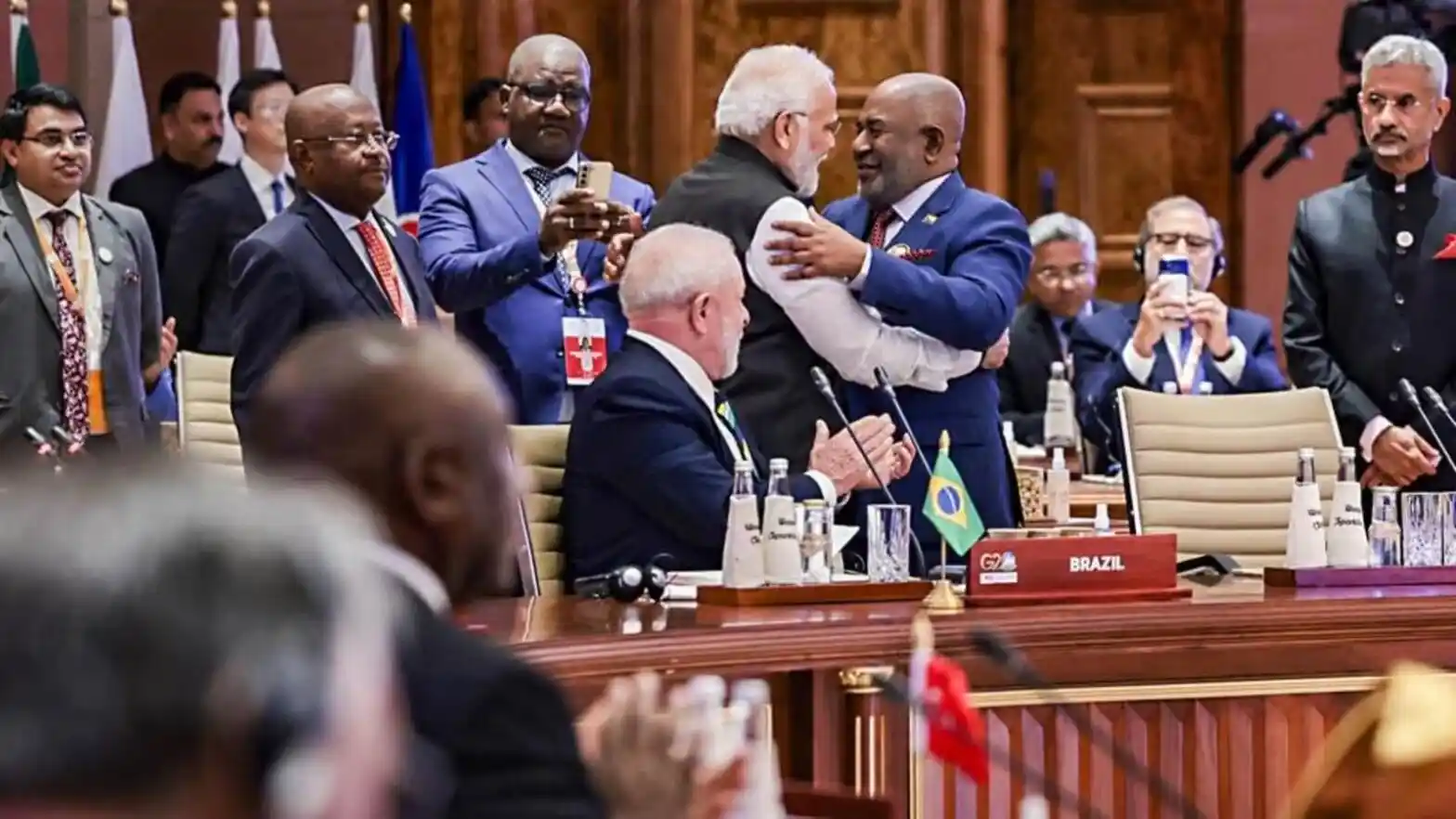
When Prime Minister Modi proposed the African Union’s (AU) full membership in the G20 in 2023, he was reflecting the geopolitical reality of the emerging world order, which is fast negating the one set up by the ex-colonizers post World War II. A resource-rich continent with 1.3 billion people, Africa can no longer be sidelined in the Global South’s mission. Inducting AU in G20 was a true gesture of ‘sab ka saath, sab sa vikas’ endeavour, asserting India’s mission to establish the rights of the neglected world like AU in the global platform as a ‘top priority’. And the G20 was the most appropriate podium since it is a significant international platform where the Global South meets the Global North to chalk out plans for global cooperation on global concerns. Till AU’s induction, South Africa was the sole representative of the diverse and vibrant continent in the grouping. The membership of AU was hailed as an opportunity to achieve clear strategic recognition at the global level of the enormous potential of Africa. When India’s Global South vision emphasizes strategic partnership with countries of the Southern Hemisphere for a more equitable and inclusive global order, AU’s presence in the G20 is indeed pivotal to the realization of the vision. The Global South is mostly composed of developing and underdeveloped countries plundered of wealth and dignity by colonialism. Both India and Africa share such a shameful colonial history and also a rich tradition of political activism against colonial rule. Therefore, the successful induction of AU at the G20 association under India’s presidency at the 2023 New Delhi Summit underlined the triumph of India as champion of the Global South mission.
Economic dividends of India-Africa closeness
India’s economic engagement with Africa gained momentum in the post-liberalization era. The motivating factor behind this interest was individual African countries’ craving for economic growth, boosting trade and investment. Today, Africa is rapidly transforming into a more integrated market with its economy projected to grow from 3.3% in 2024 to 4% by 2026. India has outlined 10 guiding principles of engagement with Africa, which include development partnership, attractive trade, and support for Indian investment in Africa. India-Africa bilateral trade reached $103 billion in FY 2025, with 17% year-on-year growth, with Indian exports to Africa accounting for $45 billion, and imports worth $58 billion. India is counted among the top five investors in Africa with nearly $ 75 billion in substantial investments. Indian business magnets like Tata, Adani, Reliance, and Birlas invest in Africa in sectors ranging from agriculture, hospitality, telecommunications, manufacturing, infrastructure, and energy. Interestingly, Indian entrepreneurs’ investments in Africa have been cognizant of providing jobs for the locals in the context of general complaints against Chinese investments taking away jobs from them.
Africa in India’s strategic framework
As the global economic power centre is returning from the West to the East, India and China are increasingly viewed as competitors to each other, especially in Africa. As the resource-rich African countries crave for investment for economic development, both India and China want to utilize the opportunity. However, when China’s engagement with Africa is characterized by its extensive infrastructure projects (under the BRI scheme) and robust trade relations, India’s policy in Africa is shaped by historical ties, cultural connections, capacity building, and human resource developments, emphasizing education, healthcare, information technology, and agricultural development. Even the nature of investments of the two competitors also varies, with India’s more decentralized and collaborative strategy, focusing on building local capacities and fostering sustainable development as opposed to China’s top-down approach, characterized by large-scale infrastructure projects and substantial financial outlays leading to rapid transformations but also controversy regarding neocolonialism and dependency. Indeed there is competition which the Chinese claim as ‘complementary’. The strategic connotation of the competition is, however, reflected in India’s association with Japan-sponsored Japan-India-Africa Business Forum to promote collaborative efforts between the public and private sectors of Japan, India and Africa. This is certainly an extension of the horizon of India-Japan strategic collaborations against growing Chinese assertiveness. Nevertheless, Africa might detest associating with any strategic competition like Southeast Asia, which resents taking sides in the US-China rivalry.
Apart from economic strategy, Africa also features in India’s larger Indo-Pacific strategic formulations. As the Indian Ocean Region’s net security provider, India is in a collaborative mission with the Indian Ocean littoral states of Africa. The large-scale maritime exercises with African countries under Africa-India Maritime Engagement (AIKEYME) aim to enhance interoperability with the navies and maritime agencies. Bilaterally, India partners with key Indian Ocean littorals in capacity building like with Mauritius and Madagascar and boosts defence cooperation with Tanzania. The Western Indian Ocean is increasingly becoming pivotal to India’s maritime security framework given its strategic location connecting the southeastern coast of Africa to the broader Indian Ocean with pressing challenges in the maritime domain, including attacks on merchant shipping, piracy and hijacking attempts. Besides, the surging Chinese presence in African ports motivates India’s further engagement with the African Indian Ocean littoral states.
A partnership of potentiality
Post-1947, when India was hailed in Africa for championing its decolonization mission, its diplomatic skills eventually helped build a mutually beneficial partnership with African countries. And that partnership has gradually expanded in various directions, from the political and economic to the strategic. India and Africa together account for one-third of the world’s population, teeming with youthful energy and untapped potential. Both aspire to empower the Global South mission as the old world order struggles to sustain itself. On the other hand, both are brimming with vibrant economic potential and partnership prospects, while emerging geostrategic realities are driving them closer together.