
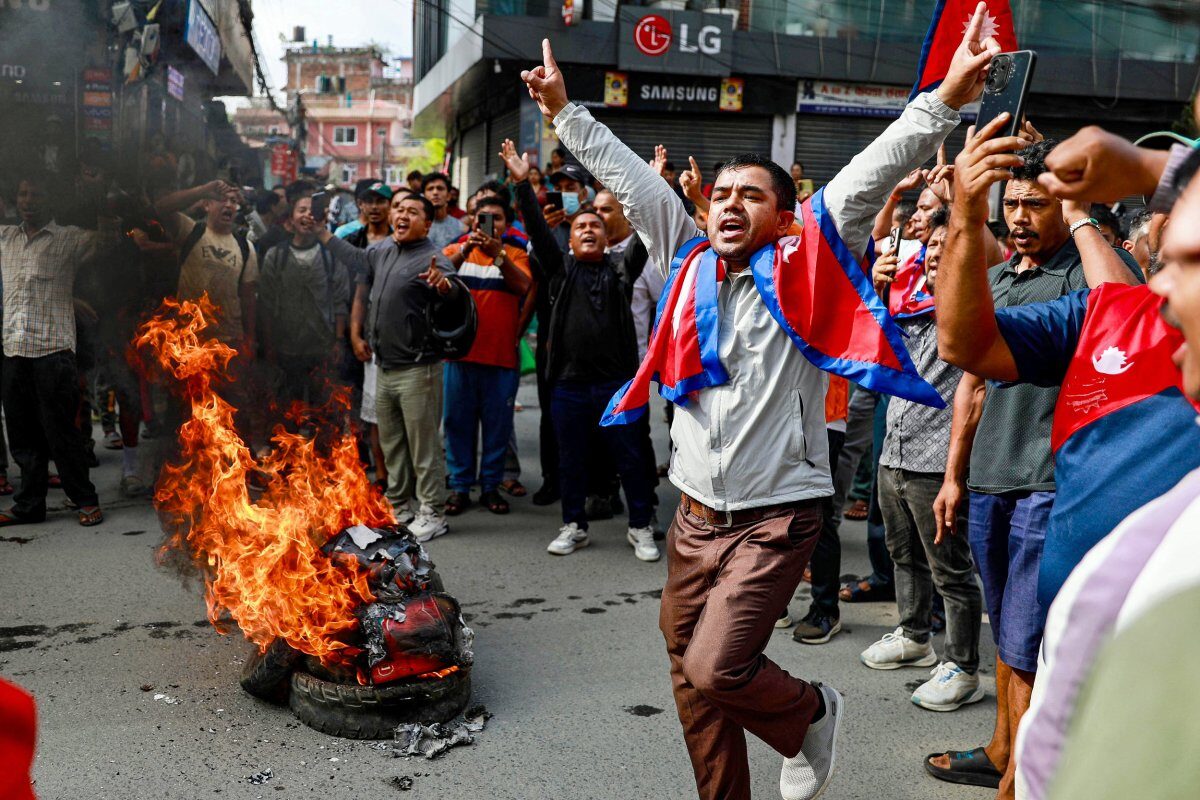
The Gen-Z-led movement in Nepal on September 8-9 has made headlines globally. The movement’s power was electrifying, forcing the elected government and Prime Minister KP Sharma Oli to resign and flee from Kathmandu. This is very similar to how events unfolded in Bangladesh a year back. However, what happened in Nepal could be considered the third phase of Nepal’s democratic evolution.
The first would be the 1990s democratic movement by the political parties that were banned by the Panchayat regime (1960-1990), which finally resulted in the establishment of a constitutional monarchy, followed by a decade-long Maoist movement (1996-2006), abolishing the Shah family’s monarchial rule, and the first democratic elections took place in 2008.
The Maoist guerrilla fighters, who fought against the Monarchy and the state for 10 years, joined mainstream politics and won the first democratically held elections in 2008. The first two movements were fueled by sheer discontent with the monarchy. However, the September 2025 Gen-Z youth movement was against the systematic failure of governance, corruption, nepotism, censorship, and freedom of speech through various means, including social media.
If the Maoists fought an armed rebellion, the Gen-Z movement was non-violent, against which the state machinery was used to quash it. Not sure if the Gen-Z youth who protested the ban on social media intended to overthrow an elected government, but the use of force by the leadership seems to have possibly changed the course of the movement, resulting in deaths, injuries, arson and damage to the public and private properties.
Nepal is now moving towards normalcy, with the army playing a constructive role in ensuring peace and stability, with the President appointing Sushila Karki, a former Chief Justice of Nepal, as an interim Prime Minister after consulting with Gen-Z representatives. This is the first time that Nepal has had a female Prime Minister in its 17 years of democratic history.
While for many loyalists of the old guard—the trio of Sher Bahadur Deuba of Nepali Congress, Pushpa Kamal Dahal alias Prachanda of the Maoist Centre, and KP Sharma Oli of Communist Party of Nepal-UML (CON-UML), who took turns ruling the country 2008 onwards, Oli’s resignation was unconstitutional, the new generation saw them as someone who promoted systematic failure of the country, and hence this situation.
Gen Z wanted a change of guard and institutional freedom to address the political instability, which included 14 Prime Ministers in 17 years.
But the major question remains: Where does the country go from here?
Issues before the Interim Government
Prime Minister Sushila is among the noted Chief Judges of Nepal who led a fierce fight against corruption during her tenure (2016-2017). In 2017, the Prachanda-led government tried to impeach her in the parliament, with a majority of lawmakers voting in favour of her impeachment, which was seen as a sign of the government’s political highhandedness. However, the court intervened, and she was reinstated as the judge.
Therefore, despite her age, her work in her past career seems to have made her the most appropriate choice for the top office.
As she completes three days in office, the first and foremost challenge before her is holding fresh elections in the next six months. Reportedly, March 06 has been set as the date for fresh elections. With the current state of affairs, the old guards of Nepalese politics have literally gone into hiding from the political scenario due to fears of public anger. Can they come out? It remains to be seen.
However, what will be interesting to see is whether the traditional parties can participate in the fresh elections. It would be nearly impossible if they were to contest in the existing form, as they still represent a failed face of Nepalese politics.
The traditional political parties face the biggest challenge of replacing the old guard and reforming themselves to meet present needs, which must be in sync with the Gen-Z movement’s objectives. Therefore, the least these political parties could do is pave the way for younger leaders.
Besides the elections, Prime Minister Karki will also have to investigate the violence, arson and damage that took place during September 08-09 across Nepal, including Kathmandu. Providing justice to the families of the more than 30 victims who lost their lives during the September protests. Conversely, investigating the misuse of state machinery, including the police, will be a further requirement during her days in office.
Above all, once the elections are over, a smooth transition of power from an interim to an elected government would be necessary to ensure political stability in the country.
But it will not be easy, and there will be technical and legal challenges. While the spirit of the Constitution remains intact as the President still remains in office, how would the new interim government carry out constitutional reforms if it had to do away with the coalition government, which had hijacked the spirit of democracy for more than a decade and kept political stability a distant hope?
Since the president has reportedly dissolved an elected parliament, amending the constitution will be difficult. Therefore, the government and judiciary may have to work in coordination to find ways to amend the constitution or reform the law and order in the country.
Aside from bringing new generation leadership to electoral and constitutional reforms and investigating protest-time crimes, Prime Minister Karki would also have to deal with the menace of corruption and nepotism—foundational issues of the protests led by Gen Z youth. There remains no doubt that the menace of corruption has engulfed Nepalese politics for decades, and when the Maoist-led movement helped found democracy, a fight against corruption was still an expectation, but then they became political.
Foreign Policy Crucial
Resetting Nepal’s foreign policy could also become part of her mission plan for the days in office. As a landlocked country between Asia’s two giant economies—India and China, Nepal has been attempting to strike a balance. However, relations with India took primacy because of shared people-to-people ties, culture, faith, economic engagements, and an open border. Also, because of Delhi’s historic role as a development partner of Nepal, India was in a better position than China.
Meanwhile, since the advent of democracy in Nepal in 2008, the political parties have had no qualms about using anti-India rhetoric to stoke ultra-nationalism, keeping Delhi on a watch to remain extra alert.
Interestingly, the Indian Prime Minister Modi was among the first leaders to share concerns over violence in Nepal that took place during the Gen-Z protests. On his X (formerly Twitter) handle, the Prime Minister wrote, “The violence in Nepal is heart-rending. I am anguished that many young people have lost their lives. The stability, peace and prosperity of Nepal are of utmost importance to us. I humbly appeal to all my brothers and sisters in Nepal to support peace.”
As a next-door neighbour with an open border, India’s security concerns with Nepal remain the topmost priority of the Indian security establishment. Any instability in Nepal always has a spill-over effect on India, be it a decade-long Maoist movement between 1996 and 2006 or the Madhesi movement of 2015.
With its security apparatus on high alert, India requested “all concerned to exercise restraint and address any issue through peaceful means” on September 09. It also took the lead in congratulating the appointment of the interim Prime Minister Karki. India added, “As a close neighbour, a fellow democracy and a long-term development partner, India will continue to work closely with Nepal for the well-being and prosperity of our two peoples and countries.”
While it’s too early to predict what direction Nepal’s foreign policy will take from here, India has conveyed its positive and constructive support to the people of Nepal. At the same time, China also released its position on political developments and congratulated Karki on his appointment.
Meanwhile, India may still have the advantage over China as it holds the proven record of helping Nepal in its democratic journey and reconstruction process. For the past seven decades, India has supported different regimes in Nepal, including the monarchy, democratic forces, and political parties, by sharing its political experiences in leading a country. India was a key player in facilitating talks between different parties during the Maoist movement in Nepal.
India’s contribution to Nepal’s politics has also been historic. The Indian Freedom Struggle inspired the emerging democrats during the monarchical era in Nepal in the 1940s, 50s, and 60s. To the surprise of many, traditional political parties like the Nepali Congress and different sects of the Communist Party of Nepal were founded in India and operated from cities like Kolkata and Banaras because such activities were banned during the Panchayati regime in Nepal.
Modi’s Address to the Nepali Youth from India
On September 13, Prime Minister Modi addressed a local rally in Manipur. Towards the end of his address, he spoke for a good two minutes about Nepal, congratulating the new leader and appreciating their efforts in nation-building. India rarely conducts its foreign policy publicly, and if Modi speaks, it shows the seriousness and importance of Nepal for India.
India follows a classic ‘quiet diplomacy’ in engaging with the neighbourhood and countries around the world. Against this practice, if the Prime Minister spoke on Nepal, it shows how critical Nepal is to India. The latter is also trying to be proactive at this time and engage with new and upcoming stakeholders of Nepalese politics—the youth.
Delhi’s proactiveness in engaging the Nepalese youth emanates from its past experiences, such as when India was targeted on social media on several occasions, and the youth actively participated. For instance, following disruptions at the India-Nepal border in 2015, hashtags like #BackOffIndia #GoBackIndia trended—a phase that made anti-India sentiments explicitly available in the public domain.
Similarly, in 2020, following Nepal’s claims on Indian territories—Lipulekh and Kapani—similar social media outbursts were seen channelling anti-India narratives. While the border dispute remains unresolved for Nepal, despite India making its position clear, India in any way would not want anti-India sentiments to again surface on social media platforms. Therefore, India has made an essential strategic call to reach the youth early.
On the other hand, China has been engaging with the Nepalese youth through educational, cultural and sports exchanges. Beijing may have a chance to base its engagements with Nepal on the youth. The importance of Nepalese youth for China also emanates from its strategic requirements in Nepal, especially keeping an eye on the activities of the Tibetan refugees in Nepal. With traditional partners like Maoists and the CPN-UML, China was able to put pressure on Nepal to monitor the activities of the Tibetan refugees and ban their activism and freedom-related activities in Nepal. By engaging with the youth, China would want to know what the future direction of a new government is on the activities of the Tibetan refugees living in Nepal.
Way Forward
From what is seen in Bangladesh, preparing for elections while carrying out reforms is an uphill task. A similar scenario could be seen in Nepal if the country runs into technical and legal issues. However, it was a Gen-Z youth-led movement, and political parties opening up to new leadership would be critically important. At the same time, ensuring fair investigation of the protest-time crimes would also make the role of international agencies like the United Nations crucial to ensure transparency. At the same time, the foreign policy direction of the interim government would very much determine the course of Nepal’s relationship with its two neighbours.
The opinions expressed in this article are those of the author alone and do not reflect the views of the author’s current or past affiliations in any form.

