
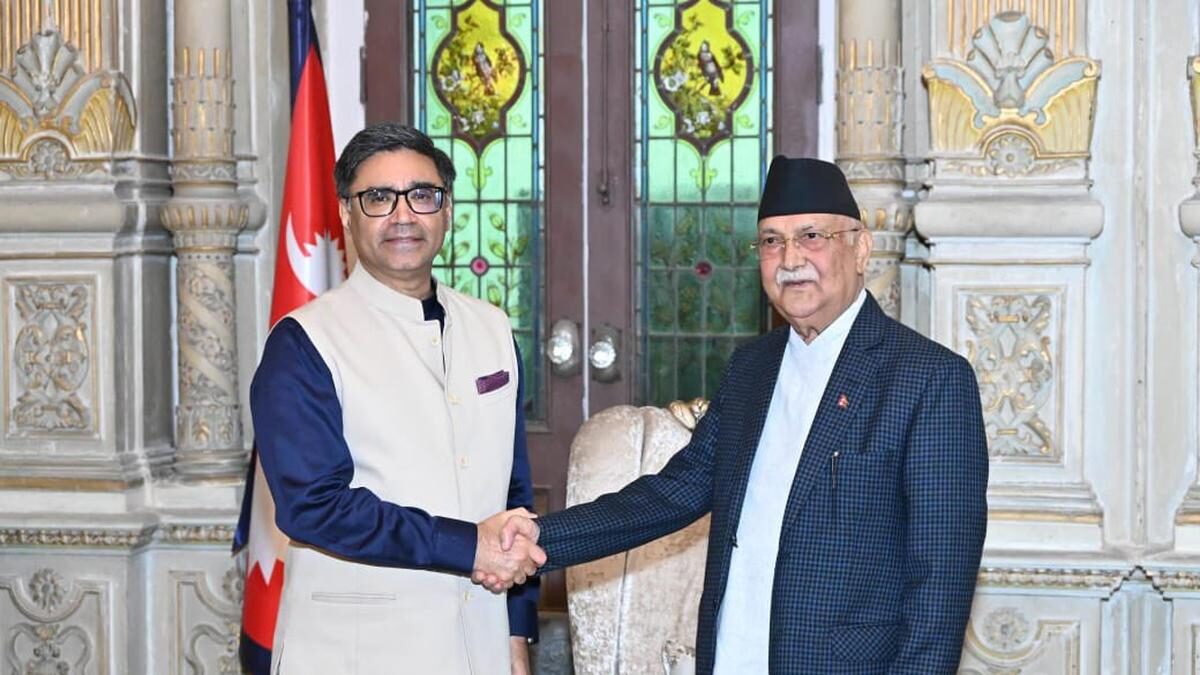
Foreign Secretary Vikram Misri visited Nepal from 17 to 18 August. His visit took place amid improving ties between India and Nepal, which had been marred by a diplomatic freeze since 2019, when Nepal unilaterally enlarged its political map, showing the Indian territories as its own. During his visit, the Foreign Secretary met with his Nepali counterpart. Besides this, he had major meetings with the Prime Minister KP Sharma Oli, the Foreign Minister Arju Rana Deuba, and the Chairman of the Maoist Centre Party—Pushpa Kamal Dahal alias Prachanda, and the Chairman of the Nepali Congress Party—Sher Bahadur Deuba. Meanwhile, the main agenda of Misri’s visit was to extend an invitation to Prime Minister Oli for a state visit to India and set the agenda for the same. The two countries are yet to announce the final dates of the visit, but the press release by Nepal’s foreign ministry on his visit confirms India’s invitation.
But as Oli prepares to visit India, why did India take almost a year to extend the invitation? KP Oli has been in office since July 2024, and as a matter of practice, newly appointed/elected Prime Ministers make India their first stop of diplomatic engagements. The Delhi chatter is that because Oli did not have an invitation from Delhi, in quest of making a state visit in the first year itself, Oli visited Nepal’s northern neighbour, China, in December last year, creating a media frenzy in India that Nepal had adopted a pro-China foreign policy.
Why did India delay inviting Prime Minister Oli?
One key reason for the delay in extending an invitation to KP Oli seems to be India’s annoyance at the rise of anti-India sentiments in Nepal since 2015, and more specifically, anti-India sentiments that the political Left has collectively used to invoke hyper-nationalistic sentiments in the country. Interestingly, the KP Oli–led Communist Party of Nepal–UML (CPN-UML) has, on several occasions, taken strong positions on issues involving India. Just a decade back in 2015,
To begin the 2015 disruptions at the India-Nepal border, which Nepal alleged was a ‘border blockade by India—an event that had majorly halted the relationship.
Notably, after taking office in 2014, Prime Minister Narendra Modi travelled to Nepal twice in 2014—the first one was a state visit, and the second trip was to attend the annual summit of the South Asian Association for Regional Cooperation (SAARC). These two trips had set the tone for a deeper diplomatic engagement between the two countries. Following Prime Minister Modi’s back-to-back trips to Nepal, Nepal faced a significant earthquake in April 2015, and India was the first country to respond by sending its rescue teams and humanitarian support under Operation Maitri. India’s goodwill approach and Nepal’s receptiveness were markers of India’s newly launched ‘Neighbourhood First’ policy and Nepal’s ‘India First’ policy.
However, less than a year later, Nepal’s internal dynamics—mainly the implementation of a new democratic republic constitution—profoundly impacted India. Why? Nepal accused India of supporting the Madhesis, people from Southern Nepal with Indian ancestry and deeper matrimonial ties with the bordering Indian states of Uttar Pradesh and Bihar. Madhesis demanded equal rights and fair political representation under Nepal’s new constitution, but peaceful protests turned violent. Since the movement was happening close to the Indian border, Delhi stated, “We are concerned that the situation in several parts of the country bordering India continues to be violent. (And) We urge that issues on which there are differences should be resolved through dialogue in an atmosphere free from violence and intimidation, and institutionalised in a manner that would enable broad-based ownership and acceptance.”
Disruptions caused by protests against the constitution in Nepal also caused commotions in the movement of trucks loaded with emergency and regular supplies from India, and hundreds of trucks lined up on the Indian side. While Nepal called it a ‘border blockade’ by India, Delhi denied the allegations and said it was an internal matter of Nepal. This episode further wounded bilateral relations. While the relationship was still recovering, Nepal raised a territorial dispute with India in 2019 over the Kalapani-Limpiyadhura-Lipulekh region.
After abrogating Article 370 in the Indian Constitution, India released a new political map in November 2019 showing the newly formed Union territories of Jammu-Kashmir and Ladakh. Nepal accused India of wrongly depicting the border with Nepal, as the Kalapani-Limpiyadhura-Lipulekh area belonged to Nepal. Even before negotiations could begin to resolve the issue, Nepal’s parliament hurriedly amended the constitution to include a new map showing the territories in question as its own, and India protested. Therefore, if Nepal’s 2015 accusation against India for blocking the border was more political in nature, Nepal’s unilateral act of amending the map became a matter of territorial integrity.
This 2019 territorial row reactivated the social media campaign in Nepal targeting India with hashtags like #BackOffIndia, #GoBackIndia, and #IndiaOut. Such campaigns exhibit that political leadership in Nepal often leverages issues with India for domestic electoral advantage, making it difficult for New Delhi to trust successive governments in Kathmandu fully. On territorial matters, India, on multiple occasions, has conveyed that Nepal’s “unilateral act is not based on historical facts and evidence. It is contrary to the bilateral understanding to resolve the outstanding boundary issues through diplomatic dialogue. Such artificial enlargement of territorial claims will not be accepted by India.”
In 2024, Nepal reportedly decided to print the controversial map on its new currency notes. In a media response, India’s Foreign Minister S. Jaishankar stated, “Unilateral measures won’t alter the ground reality.” It may not be easy to understand that raising territorial disputes with India has become a political compulsion for political parties in Nepal. Regardless of the leadership, political parties in Nepal will continue to infuse life into the matter, and this underlying dynamic continues to shape relations even today. The delay in extending India’s invitation to Prime Minister Oli can be seen in this context.
Can Oli be Trusted?
Meanwhile, as India prepares to welcome Prime Minister Oli, the territorial issues have again popped up, which may further overshadow the visit. After Misri returned to India on August 18, India’s National Security Advisor Ajit Doval hosted Wang Yi—the Foreign Minister of China and Member of the Political Bureau of the Communist Party of China Central Committee, on August 19-20. This was one of the key meetings hosted by India since the India-China border conflict in May 2020 at the Line of Actual Control (LAC). The two sides have agreed to normalise the relationship by opening up the border trade through Lipulekh.
However, a day after Wang Yi visited India, Nepal’s Ministry of Foreign Affairs made a press release titled, “Nepali land Lipulekh in relation to the question of the media on the subject of border trade between India and China”, stating “The above area is the subject of the Nepalese land, including the friendly state of China, which is not aware of the information.”
Noting this press release by Nepal, India’s Ministry of External Affairs stated, “Our position in this regard has been consistent and clear. Border trade between India and China through Lipulekh pass had commenced in 1954 and has been going on for decades. This trade had been disrupted in recent years due to Covid and other developments, and both sides have now agreed to resume it.” India’s response further adds that “As regards territorial claims, our position remains that such claims are neither justified nor based on historical facts and evidence. Any unilateral artificial enlargement of territorial claims is untenable. India remains open to constructive interaction with Nepal on resolving the agreed outstanding boundary issues through dialogue and diplomacy.”
The issues continue to be in the headlines of the Nepali media, and the social media looks divided on Kathmandu’s response. Meanwhile, Nepal has reportedly sent two separate diplomatic notes to India and China regarding the opening of the Trade route between them via Lipulekh. However, Nepal proposes to resolve the issue through discussions, raising the issue just before Prime Minister Oli’s forthcoming visit, which exhibits mounting political pressure. Before visiting India, Oli will also participate in the Shanghai Cooperation Organisation (SCO) in Tianjin, China, on 31 August-1 September, where the Indian Prime Minister Modi will also be present. There are likely indicators that Prime Minister Oli might raise the issue with both sides, but any conclusive results are unlikely.
What lies ahead?
Foreign Secretary Vikram Misri clearly indicated in the past one year that, despite the existing political odds, a comfort level had been achieved between Delhi and Kathmandu. At the same time, Delhi is aware of Prime Minister Oli’s unpredictability on the policy front with India, and the resurfacing of the territorial dispute is no surprise. But make no mistake, if Nepal has its position on territorial issues, so does India, backed by historical facts and treaties. Therefore, expecting an immediate resolution will be a distant expectation. In contrast, Nepal could have avoided reacting to a bilateral understanding reached between India and China because the Prime Minister Oli had a better chance to raise it when he met Prime Minister Modi in Delhi and avoided letting the territorial issues overshadow cooperation in trade, connectivity, energy and development cooperation. At this moment, one way forward would be for Kathmandu to agree to Confidence Building Measures (CBMs) on territorial matters. Additionally, continuing its cautious approach towards Nepal will be crucial for India.
The views and opinions expressed in this article are those of the author.

