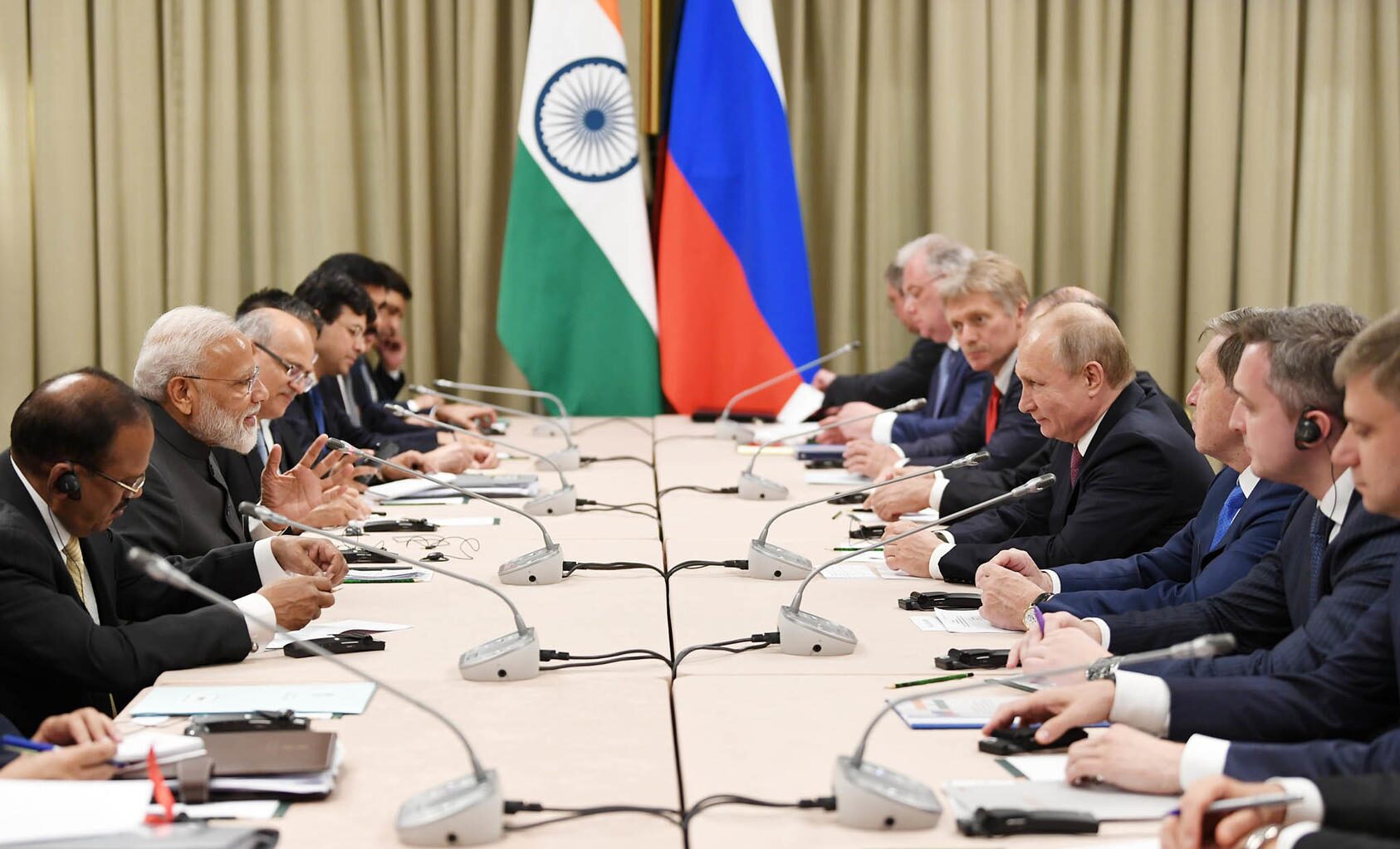
The ‘special and privileged partnership’ between India and Russia since its formative years has navigated through global complexities and geopolitical dynamics in international relations. The bilateral relations have evolved over the years, irrespective of changes in leadership, who have ensured robust cooperation in key spheres such as defence cooperation, including joint military exercises, military technological cooperation, and joint production, civil nuclear energy, space, cultural, economic, counter terrorism, cyber security, and energy. Notwithstanding, the two countries have ensured to focus on strengthening and insulating mutual interests, cooperation, trust, and understanding.
The annual bilateral summits at the leadership level, including ministerial level engagements and inter-governmental commissions and membership in global south organisations such as BRICS and SCO, have further enhanced cooperation between the two countries. The two countries have also undertaken several initiatives intensifying those spheres of cooperation that have been a weaker link, such as the economic sector. Initiatives such as the Eastern Economic Forum, the International North South Transport Corridor, and large-scale investments have resulted in bilateral trade reaching an all-time high of $ 65.70 billion in the FY 2023-2024, with crude oil accounting for the lion’s share of this growth. Russia’s strong condemnation of the Pahalgham terror attack and its support for India’s permanent membership in the UNSC speak volumes about the bilateral engagement between the two countries.
Amid the ongoing geopolitical turmoil, and the US call for imposition of tariffs for purchasing oil from Russia to pivot India away from its long-term ally, the recently concluded visit by National Security Advisor Ajit Doval to Russia on 09 August 2025 despite the call for imposition of 50% of tariffs on India from 21 August 2025 has only demonstrated political signalling and a reflection of strategic autonomy in its foreign policy conduct.
Evidently, India-Russia relations have remained vigorous due to relentless diplomatic efforts focusing on long-term prospects and strengthening the bilateral engagement further. Additionally, the two countries have a tacit understanding of non-interference in each other’s domestic politics and foreign policy behaviour. The leadership level interaction between India and Russia has been consistent, stable, and long-term, given the tenure of PM Modi (15 years) and President Putin (21 years), which put together is a reflection of 36 years of statesmanship.
Both leaders recognize that the India-Russia strategic partnership is at a critical juncture, necessitating a more robust approach to further engagement through new avenues of cooperation. Exploring new avenues of collaboration includes artificial intelligence, a substitute for Western IT technologies, the Arctic region, Africa, and regional cooperation, which could further enhance the bilateral engagement between the two countries.
Prospective engagement in AI, including formulating a framework for joint research and development that can act as a tool in critical sectors such as health, disaster management, and information war, is crucial. India is one of the leading forces in the IT sector with a large pool of skilled professionals. Russia, on the other hand, is also equipped with a pedigree of experts from various realms of knowledge, including physics, information technology (IT), mathematics, biology, and neurosurgery, who have experimented on projects related to artificial neural networks.
Russian manufacturers are in need of a substitute for Western hi-tech imports that include critical military components, microchips, communication equipment, computer components, navigation devices, etc. India could be a potential hub and a possible alternative, given India’s consumer base, favourable trade agreements, skilled labour force, and cost advantages, which will be of key interest for Russian manufacturers under the joint military technological cooperation and ‘Make in India’ initiative. With leading US companies such as Apple and Boeing exploring India’s manufacturing hub, Russia may also expand its interests in this sphere of cooperation.
With Russia calling for ‘Easternisation’ of the Arctic region, a prominent role of India is crucial, much in tune with India’s Arctic Policy in 2022, mainly focusing on science and research, climate and environment protection, economic and human development, transportation and connectivity, governance and international cooperation, and national capacity building. While India has, for now, shown a lukewarm approach to potential cooperation with Russia in the Arctic, the mutual benefits are indispensable, especially in digital connectivity, economic security, and the setting up of satellite receiving stations, etc.
The scholarly community has mooted the idea of a paradiplomacy between India and Russia in the African region in recent times. In line with strengthening a polycentric world order, the inclusion of an active African region alongside joint infrastructural development, healthcare, agriculture, cultural exchange, counter-terrorism, and capacity building is crucial. Given the significant presence of the Indian diaspora in the region and Russia’s renewed interests in Africa, the area provides a unique opportunity for India and Russia to extend their bilateral outreach beyond Asian geopolitical interests.
With President Putin set to visit India this year, it is crucial that the two countries not only traverse substantive new avenues of cooperation but also acknowledge the backlogs that exist, such as the delivery of two more units of S-400 defence missile systems, progress in the Vladivostok-Chennai trade corridor, and many more. There is also a notable absence of path-breaking agreements, despite the continuity in conducting annual bilateral summits, such as the 22nd annual bilateral summit. In the current geopolitical context, India-Russia bilateral relations could emerge as a force multiplier that fully encompasses all areas of bilateral endeavours and strategic goals. One can only hypothesize that, given India’s emerging economy and geopolitical footprint, India-Russia relations are based on long-standing mutual trust and mutual respect, a special and privileged relationship that continues to hold its relevance despite the growing complexities in international affairs.