The international system is negotiating a terrain of profound unpredictability. Strategic shocks that once seemed episodic now appear structural. The war in Ukraine has unsettled Europe and deepened global divides. China’s assertiveness continues to reshape Asia and test deterrence. And in the United States, political change has translated into erratic, whiplash foreign policy signals—posing new questions even for longstanding partners. In such an environment, clarity of purpose in foreign policy becomes an asset. India has chosen not to be reactive. It has reaffirmed what many others are now rediscovering: the wisdom of building multiple, resilient partnerships without being trapped by any one of them.
India’s foreign policy today is often summarised in a single phrase: strategic autonomy. But this is neither a rhetorical slogan nor a revival of old non-alignment. It is a disciplined, interest-driven approach shaped by experience. India does not stand apart from global power competition; it engages with it on its own terms. The practice of multi-alignment—deepening ties with the United States, Europe, Japan, Southeast Asia, the Gulf, and partners in Africa and Latin America—has emerged not out of hesitation, but out of real-time strategic calculation. It expands India’s space for choice, and choice is action as determined by the Indian interest.
Guardrails for a Turbulent Partnership
Nowhere is this more evident than in India’s approach to the United States under President Trump’s return. The India–U.S. partnership has strong foundations: convergent interests in the Indo-Pacific, a shared concern over China’s rise, and extensive cooperation in defence and emerging technologies. Yet, Trump’s style introduces volatility into strategic relationships. Trade penalties, tariff threats, and public pressure on India’s energy policy have created what I describe as “whiplash diplomacy.” The challenge, therefore, is to future-proof the partnership, not to retreat from it.
India will do this by building guardrails—institutional mechanisms that shield long-term cooperation from political swings. Defence co-production in India must be tied to secure supply chains and stockpiled spares so that sudden policy changes do not disrupt operational readiness. Technology partnerships must be anchored in legal frameworks that shield against political impulse. Deeper engagement with U.S. state governments—Texas, California, New Jersey, for example—can sustain economic momentum even when federal politics waver. And equally important is the discipline of separating lanes: disagreements on trade or energy should not be allowed to derail cooperation in deterrence and maritime security.
This is the statecraft that ensures a mature relationship that protects shared strategic outcomes even as it prepares for presidential mood swings.
China: A Contest That Defines the Decade
The other reality shaping India’s strategic conduct is the long-term contest with China. There is no ambiguity in New Delhi about the nature of the challenge. Relations have not returned to normal since the clash in Galwan. China’s military posture along the Line of Actual Control, its infrastructure build-up in Tibet, and its defence links with Pakistan leave little room for complacency. India continues to engage Beijing diplomatically, but engagement is not illusion. Competition has become embedded in the structure of the relationship.
For India, economic security has emerged as an equally critical front. The vulnerabilities exposed by Chinese dominance in supply chains—from pharmaceuticals to electronics—cannot be ignored. India’s strategy here is one of disciplined diversification: reducing critical dependence, building trustworthy manufacturing partnerships, and pursuing selective technological de-risking. This is visible in India’s outreach to Japan and South Korea for electronics, to the Gulf for energy transition investment, and increasingly, to Europe for advanced industrial capabilities.
Europe’s Quiet Arrival as a Strategic Actor
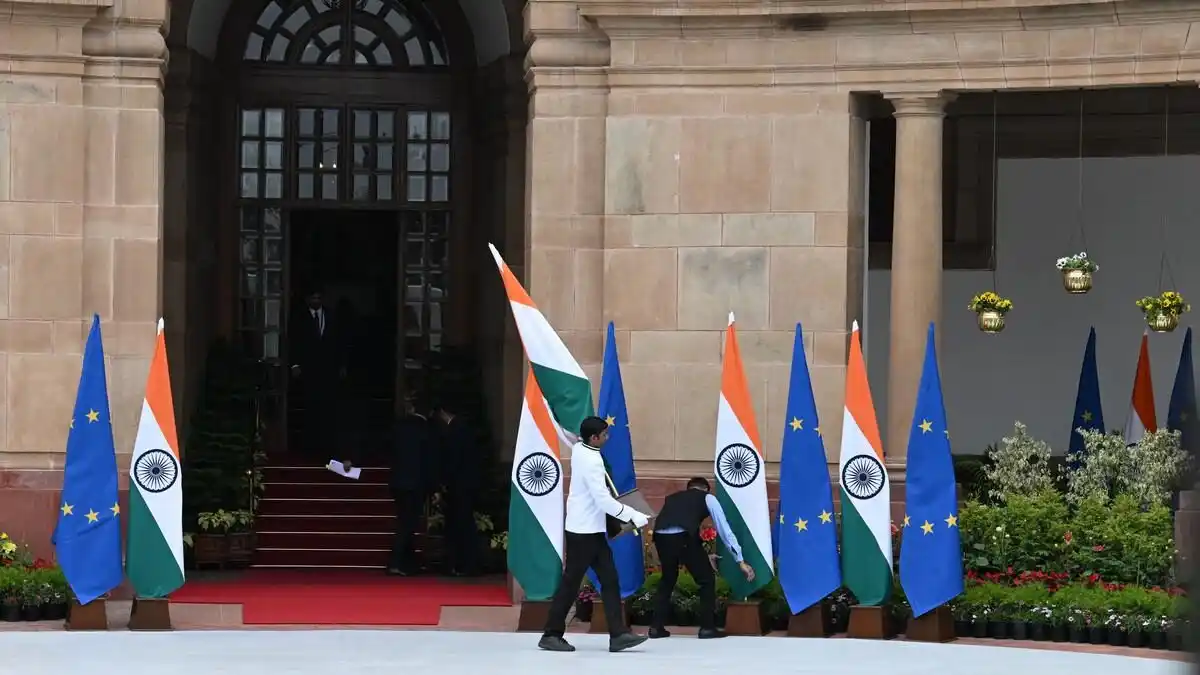
This brings us to a development of considerable significance: the emergence of Europe as a serious strategic partner for India. For much of the post-Cold War era, Europe was not seen as a geopolitical force. It was influential in trade, aid, and climate diplomacy, but hesitant in matters of hard security. That perception has begun to shift.
Russia’s invasion of Ukraine confronted Europe with a harsh reality: geopolitical peace cannot be assumed; it must be secured. Europe has rearmed. It has revised its energy dependencies. It has launched conversations on strategic autonomy and defence industrial resilience that would have been unlikely even five years ago. This transformation has not made Europe a military superpower—it will remain dependent on the United States for NATO’s deterrence architecture—but it has given Europe a new strategic sensibility, one that India can work with.
Europe’s changing attitude toward China has also brought it closer to India. There is now a broad recognition across European capitals that deep economic interdependence with Beijing carries strategic risks. Europe’s language has shifted from engagement to de-risking. This is not identical to India’s approach, but it is compatible with it. Both see the need to diversify supply chains, secure critical technologies, and prevent strategic vulnerability without closing the door to economic ties altogether.
Trump’s return has added a further layer. Europe no longer assumes the reliability of U.S. leadership. That does not mean it is turning away from the transatlantic alliance. It means it is preparing for a world in which it needs more partners. India fits naturally into that calculus.
Europe as India’s Next Strategic Frontier
If the Indo-Pacific is one anchor of India’s foreign policy, Europe must now become the other. This is not about choosing Europe over the United States or positioning Europe against China. It is about shaping a third pillar of strategic cooperation built on shared interests, not historical baggage.
There are clear areas where India and Europe can build a future-oriented partnership:
- Defence industrial cooperation: India seeks scale and self-reliance in defence production. Europe brings advanced technology without the political conditions that sometimes accompany American systems. Joint development of engines, sensors, air defence systems, and naval platforms should become a priority.
- Trade and manufacturing resilience: The long-awaited India–EU free trade agreement is important not just for commerce but for strategic credibility. Its success will depend on practical sequencing—mutual recognition of standards, realistic treatment of agricultural sensitivities, and a fair transition plan for Europe’s carbon border tax so that Indian exports are not penalised unfairly.
- Technology and standards: Europe is a regulatory superpower. Decisions made in Brussels shape global rules on data, digital markets, semiconductors, and artificial intelligence. India must engage proactively so that global technology governance reflects the interests of emerging economies, not just established ones.
- Connectivity: The India–Middle East–Europe Economic Corridor has the potential to reshape Eurasian trade flows. Realising it will require European investment, Indian manufacturing depth, and stability in West Asia. It is ambitious, but ambition helps define strategic turning points.
A Multipolar Understanding
Multi-alignment is often misunderstood as a reluctance to choose. In reality, it is a way of choosing wisely. It rejects dependency without rejecting partnership. It seeks balance without seeking isolation. It keeps Indian interests at the centre of Indian diplomacy.
Europe’s rise as a more confident geopolitical actor does not diminish India’s other partnerships; it strengthens them. It gives India an additional axis of cooperation in a world where flexibility is a strategic strength. With Europe, India can build a partnership grounded not only in trade or values but in a shared interest: preserving strategic autonomy in a world of tightening blocs.
India cannot drift with the tides of great power rivalry. It must navigate them with agility. That is the glidepath to success for Indian diplomacy today. A reliable partnership with Europe—built with patience, clarity, and purpose—will be central to that journey.