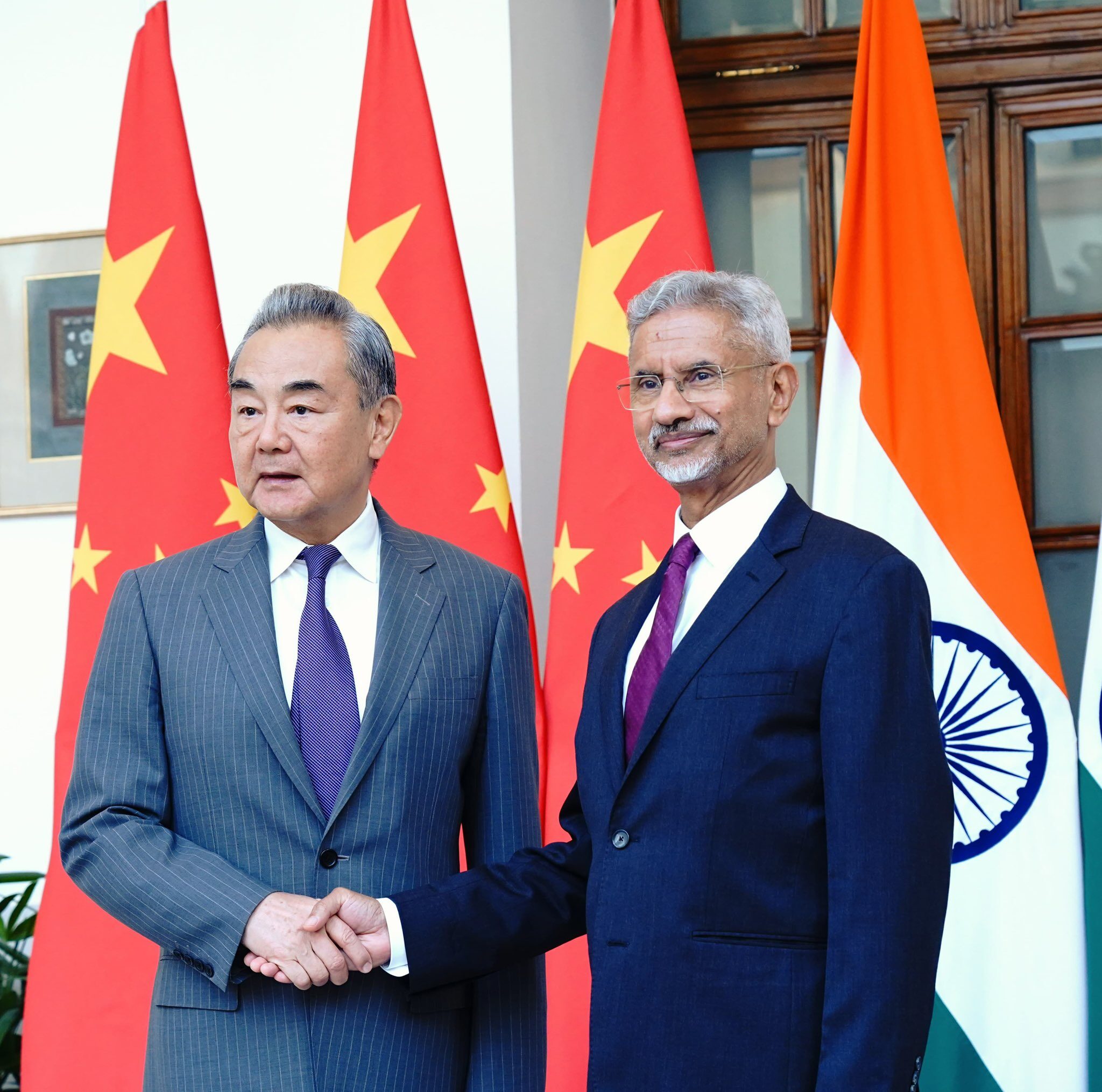
The India-China relationship has entered a phase of multifaceted engagement. It is marked by careful blending of growing cooperation, strategic advancements, and persistent complexities. Such a development in the relationship reveals its pragmatic strategy. Despite facing the complexities in the relationship, both countries remain committed to dialogue and balanced collaboration with competition, echoed in Indian External Affairs Minister Dr. S. Jaishankar’s statement that “differences must not become disputes, nor competition conflict.”
Strategic Engagement and Border Dynamics
Currently, Chinese Foreign Minister Wang Yi is visiting New Delhi for a three-day diplomatic visit and Prime Minister Narendra Modi’s planned attendance at the Shanghai Cooperation Organisation (SCO) summit.
The border patrol agreement of October 2024 marks another notable development, where the agreement was framed to initiate de-escalation and reduce tensions along the Line of Actual Control (LAC). Thus, it sets the stage for significant border management. While the permanent troop withdrawal has not dramatically declined, both countries have improved their border infrastructure with the intention of bolstering logistical capabilities in strategic areas. India inaugurated a mountain tunnel, and China enhanced its electricity supply near strategic border areas, which are emblematic of preparedness balanced with open diplomatic dialogues.
Economic, Multilateral, and Regional Cooperation
Reestablishment of direct flights between the two countries stands as a step towards rekindling people-to-people connections and smoother economic engagement. Similarly, the reopening of border trade points reignites local commerce and cultural exchanges. Such measures undertaken by both countries reflect the understanding of fostering trust at the grassroots level, which eventually supports broader bilateral stability.
Within the multilateral framework, both countries are involved in noticeable cooperation, such as the Shanghai Cooperation Organisation (SCO). Under the umbrella of SCO, the collaboration on regional security, counter-terrorism, and drug trafficking demonstrates a move beyond bilateral disputes. In June 2025, the defense ministers’ meeting in Qingdao epitomised the spirit of underscored shared commitment to crisis management and avoiding escalation despite strategic rivalry. These dialogues provide structured mechanisms for both countries to address their mutual interests while better managing differences.
Economic relations between the two countries, despite facing a long-standing imbalance, continue to evolve pragmatically. Despite facing the imbalance, both countries have demonstrated an awareness of expanding their economic linkage to mutual prosperity and the creation of an area for peaceful interaction. India’s ongoing regulation on Chinese investments in sensitive sectors coexist with dialogues around reducing tariff barriers and facilitating smooth customs processes. The reciprocal economic engagement acts as a stabilising factor for strengthening resilience against global supply uncertainties while remaining aligned with national priorities. Such an approach is embedded in strategic foresight.
China, with its expanding economic footprint in South Asia through projects on infrastructure and connectivity, is a counterbalance to India’s diplomatic outreach programmes and development collaboration with the neighbourhood. Thus, it creates a strategic environment where regional development is evolving. Such a parallel approach by both countries enables them to jointly recognise South Asia as a critical geopolitical region. Both countries engage in complex regional diplomacy, building alliances to achieve political stability and economic integration, while also keeping an eye on their respective strategic interests.
Security cooperation reflects the effort to juxtapose deterrence with diplomacy. The increase in military and diplomatic meetings has improved the line of communication. The significant discussions seen in such meetings are on border protocols, troop deployments, and procedures to avoid unintended escalations. The initiative to collaborate on intelligence sharing on transnational threats, such as human trafficking, holds a common security concern. Such an approach highlights the importance of peaceful stability for expanding cooperation between the two countries. However, the path remains cautious and incremental.
Cultural Linkages and Global Significance
Cultural and social exchanges, too, have begun to revive, such as the Kailash Mansarovar Yatra, which restored critical spiritual and cultural linkages. Such humanised exchanges foster grassroots connections transcending geopolitical calculations. Such restoration strengthens the ties organically through shared heritage, providing a soft diplomacy but potent for formal state-level negotiations.
The cumulative effect of these political, economic, military, and cultural developments shapes a more resilient bilateral fabric. The willingness for steady restoration of cooperation reveals that both countries recognise the need to move beyond past disruptions. The understanding is that immediate sweeping transformation is not what both countries are looking for; instead, they are building a framework that can accommodate disagreements while cultivating opportunities for partnering wherever feasible.
On the regional level, the impact of the steady ebbing of India-China tensions will be seen in the form of a positive contribution to the security environment of South Asia and the Indo-Pacific region. The stability will provide conditions for favorable multilateral cooperation, improving economic growth and security cooperation among neighbouring countries. In the future, the growing stability in the India-China relationship will have a ripple effect in neighbouring countries, supporting their seamless integration into global supply chains and addressing regional and international challenges, such as climate change and health crises.
Globally, the changes in the India-China relationship highlight the importance of nuanced diplomacy among rising powers. Their capability for constructive engagement despite having competing ambitions serves as an example for handling complexities in the multipolar international world order. The change in the relationship shows that competition need not be the fulcrum of conflict, but can be a cooperation rooted in mutual respect, and pragmatic interests can coexist with healthy rivalry.
Towards Balanced Coexistence
Furthermore, strategic restraint and gradual confidence-building efforts have been the highlight of the relationship in 2025, which made a significant turn for a sophisticated understanding of international relations, with both countries’ knowledge of the risk and cost attached to open confrontation, nurturing an understanding where dialogue serves as a stabilizing pillar. With such a development in the bilateral trajectory, it has the potential to influence the broader regional architecture, encouraging a framework of peace, stability, and growth.
The current ongoing India-China trajectory reflects a balanced coexistence where there is a willingness for complementarities along with navigating differences. In an increasingly interconnected world, the current nature of development in the India-China relationship can be taken as a valuable lesson for regional and global diplomacy, where relationships can be forged on competition coexist with cooperation.