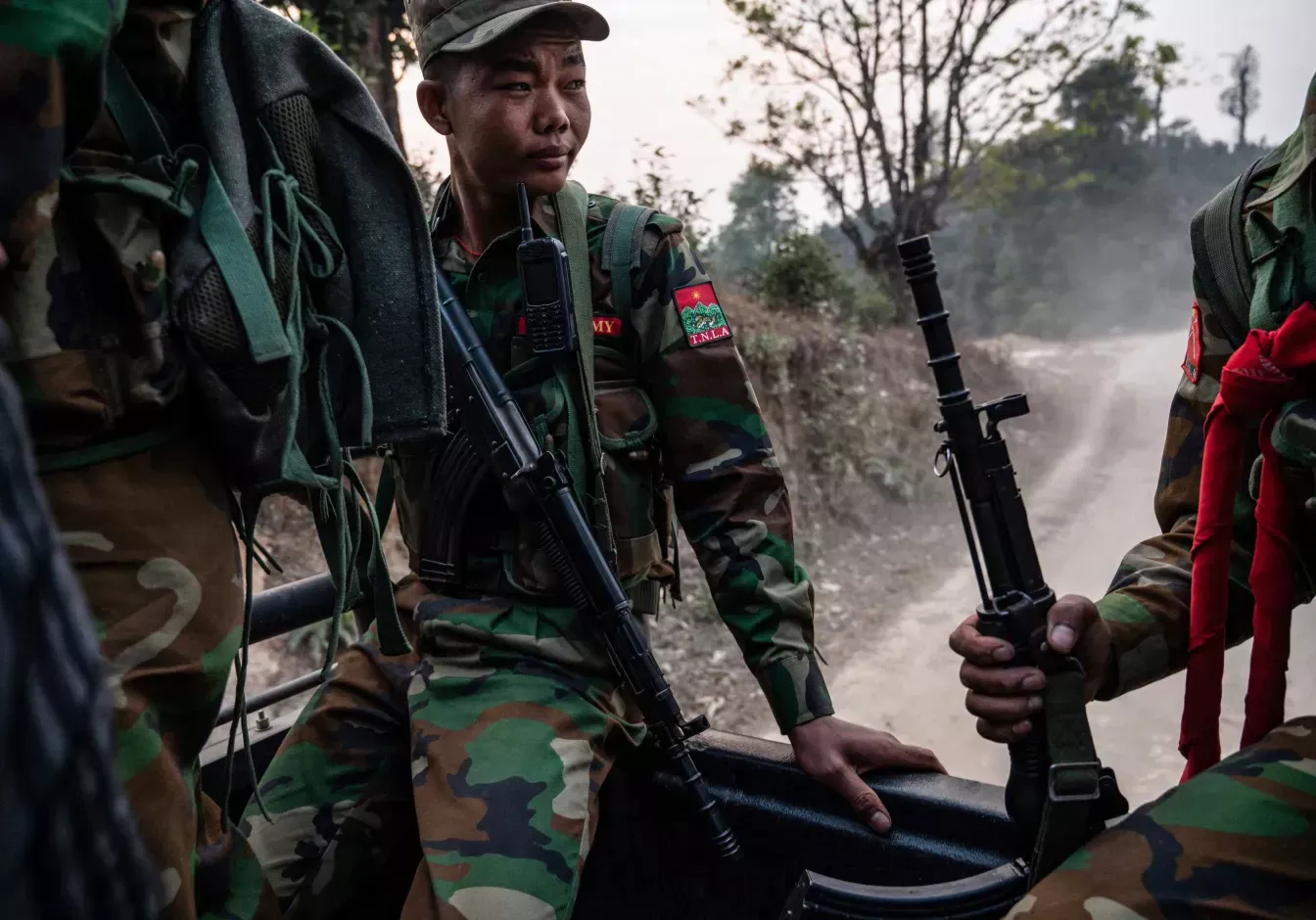
The recent arrests of six Ukrainian nationals, along with one US national, have sparked debate about the US’s covert activities along the Indo-Myanmar border. The suspected attempt at clandestine action is significant given two emerging concerns. The first is the post-election situation in Myanmar, and the second is China’s increasing push for the China-Myanmar Economic Corridor (CMEC).
US’s Stance on Myanmar
The US has strengthened its position regarding Myanmar’s military by imposing sanctions since the 2021 coup that overthrew the democratic government. Although initially criticising the Junta and sanctioning military leaders, the US increased its pressure within a year and expressed a desire to become more involved in Myanmar’s affairs. In 2022, the US passed the BURMA Act, which authorises targeted sanctions against Myanmar’s military regime and provides humanitarian aid to its people. Two key aspects of this act are offering humanitarian assistance and funding civil society organisations, which also enables the US to plan and carry out covert operations to monitor Chinese activities. This is not the first time the US has aimed to expand and improve its covert operations; the CIA’s Special Activities Division(SAD), now the Special Activities Centre(SAC), has been operating in Myanmar since the Cold War to conduct secret actions against China.
After the Communist forces won China’s civil war in 1949, the remnants of the defeated nationalist forces—the KMT Army—fled across the border into Myanmar. The CIA saw this as an opportunity to revive and rebuild nationalist forces and to open a second front against China. This was both a tactical and strategic move because the US was already engaged in the Korean War with China actively involved in fighting US and UN forces, which complicated the situation. Furthermore, the strategic value of this was also advantageous, as a second front would hinder China’s ability to expand its maritime presence in the future.
The CIA launched Operation Paper to fund and train nationalist forces and facilitated alliances between the KMT and local ethnic rebel groups (like the Karen and Shan), training them to fight alongside anti-communist Chinese forces. The CIA’s intent was clear: ignite a counter-revolution in China and engage them at a second front, i.e., Burma, now Myanmar. However, the CIA’s objectives did not yield desirable results and were considered a failed operation, as ethnic rebels and KMT forces were more interested in drug control than fighting the communists in China. The major setback occurred when the Burmese government learned about the operation—when the Burmese Army in 1961 intercepted communications and captured a plane conducting supply drops for the KMT.
The Burmese government viewed it as a violation of sovereignty and a threat to its security, which led Burma to move closer to Communist China for security guarantees.
During the Cold War peak, US intelligence agencies established listening posts and limited strategic presence to monitor and maintain relationships with ethnic drug cartels through the infamous Golden Triangle and, most importantly, intercept Chinese military communications.
US’s Intelligence Desperation In Myanmar
The desperation within the US strategic and security community’s intelligence sector is becoming clear, especially in light of the recent arrest of six Ukrainian nationals and one US national with a shady past as a mercenary. It is believed that he is illegally entering Myanmar through India to train ethnic rebels. If the CIA reactivates its clandestine operations, it could be driven by two reasons. First, China’s increasing strategic and economic influence, particularly after Myanmar’s elections and the accelerated development of CMEC. Second, an attempt to destabilise Myanmar’s junta and induce defections to weaken Chinese influence, as the junta has recently tried and failed to shed dependence on China.
The desperation of the US’s intelligence agency also stems from China’s active covert interference in US interests, especially in the Gulf. China seeks to position itself as an alternative power in the Middle East and, according to a recent statement by the CIA Director, even allegedly funds and provides strategic support to Iran. The aim of challenging US dominance through active interference has strengthened the case for countering China with systemic measures to reduce their influence because, for the US, a contested Myanmar offers a strategic space to counter China in the long term if it succeeds in staging tactical subversive and offensive proxy operations. However, the spillover of this covert face-off directly impacts India’s security calculus.
India’s Security And Strategy
The training of rebels and covert funneling of funds and weapons pose serious security risks, as they can complicate the Northeast’s security situation, especially in Manipur. These ethnic rebels, if funded and trained, could stir tensions in Manipur by reactivating ethnic conflicts and creating a complex web of arms and drug smuggling. As Myanmar is under watch for becoming a covert battlefield, India must set its priorities straight by pragmatically engaging with Myanmar.
India needs a sharper balance, putting equal weight on both ends by assertively negotiating to maintain strong bargaining power. Instead of a fragmented balance, it needs a sharper balance that can be leveraged through strong economic and logistical engagement with rebels to reduce their dependence on Chinese brokers who control them through weapons and trade supplies. For the Arakan Army, access to the Indian market via Mizoram is a strategic alternative to China and can further help India deepen its ties with the rebels.
On the other hand, maintaining influence over the Junta through continued intelligence sharing on the Rohingya militants and providing hardware and military aid to the Junta. But as generals are likely to be legitimised soon through elections, India must prepare to strategically intervene with both actors—no political or strategic pragmatic balance is required.
Rather, sharper, more ruthless or risky pragmatic actions are required, where India not only has strong negotiating power but also strong bargaining power. Following the elections, China will further expand its influence in Myanmar, which could also affect India’s influence and regional security. India must have all its negotiating levers ready, even if it has to use hard power.