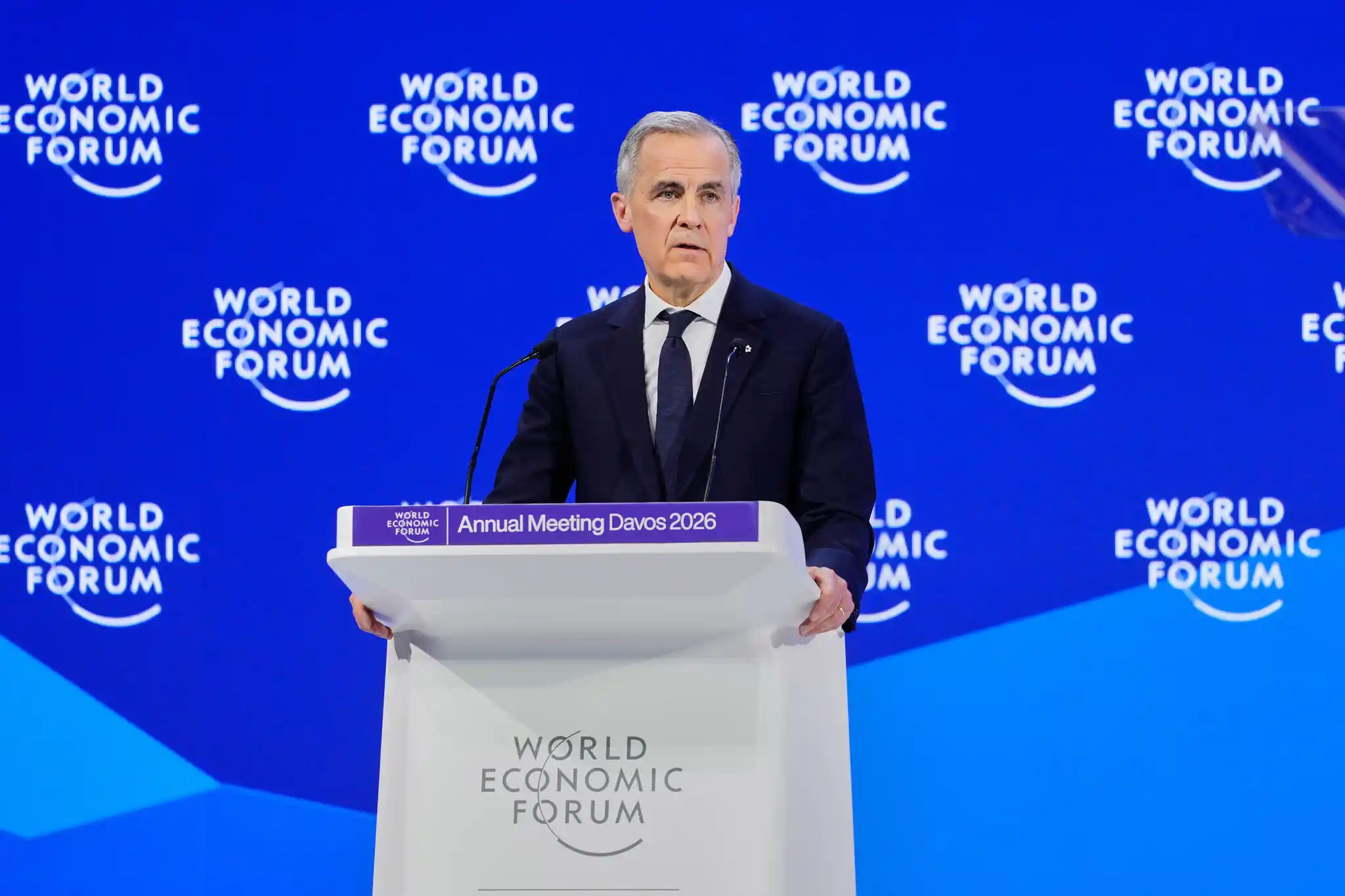
Canadian Prime Minister Mark Carney’s address at the World Economic Forum in Davos, delivered on 20 January 2026, marked a rare moment of intellectual clarity in contemporary international politics. Rejecting both the nostalgia of an idealised rules-based order and the cynicism of pure transactionalism, Carney articulated a doctrine of value-based realism: an approach that insists on honesty about power, commitment to core values, institutional strength at home, and pragmatic engagement abroad. Above all, the speech emphasised process over posture — rules over rhetoric, evidence over assertion, and outcomes over symbolism.
This doctrine provides a particularly relevant framework for assessing Canada’s recent handling of its relationship with India, a relationship that has suffered an unprecedented rupture following public allegations of the involvement of the Indian government in transnational criminal activity on Canadian soil. While the protection of sovereignty and rule of law are legitimate and non-negotiable objectives, the manner in which these allegations were introduced into the public domain at the level of the highest elected people’s representative, without publicly substantiating them through evidence or due legal process, raises serious questions about coherence between Canada’s stated values and its foreign policy execution.
The public inquiry in Canada, conducted by the Hogue Commission, made reference to India in relation to interfering with Canadian elections, without recognising the institutional distinction between diaspora political participation and state-directed electoral interference. The Indian diaspora should not be automatically conflated with the government of their country of origin. Routine engagement by Indian diplomats with members of the Indian diaspora should not, in itself, be construed as interference in Canada’s democratic processes. The lesson emerging from this episode is not that Canada should dilute its commitment to rule of law, but that foreign policy must be anchored in evidence-based legal processes rather than allegations, however grave.
Allegations, Rule of Law, and Proof
At the core of Carney’s Davos doctrine is the insistence that legitimacy flows from institutions, not proclamations. The rule of law is not simply invoked; it is demonstrated through procedure, adjudication, and evidentiary standards capable of withstanding scrutiny.
Canada’s public-naming of the Indian government in relation to alleged transnational crimes represented a significant escalation in diplomatic practice. Such allegations, by their very nature, carry extraordinary consequences: reputational damage, diplomatic downgrading, erosion of trust, and long-term strategic fallout. Carney’s framework would therefore require that claims of this magnitude be anchored to demonstrable legal processes—prosecutions, judicial findings, or independent inquiries — rather than remain suspended in the ambiguous space between intelligence assessment and political assertion.
By naming the Indian state without presenting publicly testable evidence or allowing the legal process to run its course, the then Canadian leadership created a rupture that was both profound and extraordinary in its scale. The absence of adjudicated culpability transformed what should have been a legal matter into a geopolitical confrontation. This is precisely the danger Carney warns against when he cautions middle powers not to substitute performance for substance.
Rule of law demands patience. Foreign policy credibility depends on restraint. Allegations, however serious, cannot substitute for proof.
The China Contrast
The contrast with Canada’s approach toward China is instructive. Despite well-documented concerns over human rights, coercive diplomacy, foreign interference, and national security risks, Canada has increasingly pursued a calibrated, pragmatic re-engagement with Beijing. A recent prime-ministerial-level visit underscored Ottawa’s recognition that disengagement from a major power is neither realistic nor strategically beneficial.
Canada’s China policy reflects precisely the value-based realism Carney articulated: firm articulation of concerns, coupled with sustained engagement, economic pragmatism, and diplomatic discipline. Differences are acknowledged, but they are managed through structured dialogue, multilateral coordination, and careful sequencing, not through public rupture absent legal finality.
The question that inevitably arises is why a similar pragmatism was not applied to India — a democratic partner, a critical Indo-Pacific actor, and a country with which Canada shares extensive people-to-people ties. If engagement with China can proceed despite systemic disagreements, then the decision to publicly rupture ties with India on the basis of unresolved allegations appears inconsistent with Carney’s Davos doctrine.
Consistency, as Carney emphasised, is not optional. It is the foundation of credibility.
Complexity of Foreign Interference
The findings of the Hogue Commission underscore a critical but often overlooked reality: foreign interference is not a binary contest between innocent democracies and malign external actors. Rather, it is a complex, multi-directional phenomenon shaped by diasporas, lobbying ecosystems, intelligence activity, and domestic political incentives. Notably, references to both China and India within this discourse highlight the risks of over-generalisation when systemic challenges are treated as state-specific indictments.
This complexity should have injected greater caution into Canada’s handling of allegations against India. When foreign interference is recognised as a structural challenge rather than the exclusive conduct of any single state, policy responses must be anchored even more firmly in evidence and legal process. Singling out one country in the absence of judicial determination risks politicising a problem that demands institutional solutions, not rhetorical escalation. As Carney’s Davos framework suggests, “naming reality” requires consistency of standards, not selectivity of attribution.
Exploiting Diplomatic Rupture
One of the most damaging consequences of the rupture has been its exploitation by extremist secessionist elements advocating Khalistan, with alleged external support, as has been suggested in various security assessments. These groups seized the moment to internationalise their agenda, deepen antagonism toward India, and fracture the Indo-Canadian community internally.
This exploitation was not incidental; it was opportunistic. Allegations against the Indian state, presented without judicial closure, created an enabling environment in which extremist narratives gained legitimacy by proximity. What should have remained a narrow legal matter metastasised into a broader political mobilisation that undermined social cohesion within Canada itself.
Carney’s doctrine is explicit that sovereignty and legitimacy begin at home. Allowing extremist intimidation, glorification of violence, and targeted harassment under the expansive shield of freedom of expression undermines the very values Canada claims to defend. Freedom of speech is not a licence for hate, intimidation, or the celebration of political violence, particularly when such activity strains international relations and endangers domestic harmony.
A pragmatic foreign policy requires domestic discipline. Values cannot be selectively enforced.
Canada’s legal framework rightly protects freedom of expression, but no democratic system treats this freedom as absolute. Hate speech, incitement to violence, and organised intimidation fall outside protected speech precisely because they corrode the democratic order.
In the context of Canada–India relations, the tolerance of overtly anti-India activities, including threats, intimidation, and glorification of violence, has created the perception of selective permissiveness. From a Carney-style realism perspective, this represents a failure of internal governance rather than a triumph of liberalism.
A middle power seeking strategic credibility must demonstrate that its domestic legal order is capable of distinguishing dissent from destabilisation. Limiting anti-India extremist activity does not require abandoning freedom of speech; it requires enforcing the law as written, without political hesitation.
The Central Lesson
Carney’s Davos speech repeatedly returns to a central idea: legitimacy flows from truth, and truth emerges from institutions that work. Foreign policy grounded in allegations rather than evidence is inherently unstable. It invites escalation, empowers spoilers, and weakens the moral authority of the state deploying it.
In the Canada–India case, the sequencing was inverted. Political consequences preceded legal conclusions. Diplomatic rupture preceded judicial determination. The result was strategic damage without institutional closure.
A value-based realist approach would reverse this sequence. Allegations would be tested through courts, commissions, or jointly agreed investigative mechanisms. Foreign policy responses would be calibrated, reversible, and proportionate — not declaratory and final. Engagement would continue where possible, even amid disagreement.
Roll Back Rhetoric, Restore Process
Mark Carney’s Davos doctrine offers Canada a way out of the impasse with India, arising due to unsubstantiated allegations. That path is not one of capitulation, nor of rhetorical hardening, but of procedural discipline.
Until legal processes conclude and culpability is established, allegations must not substitute for policy. Suspending the diplomatic and political operationalisation of public accusations pending judicial resolution would not represent weakness; it would signal confidence in the rule of law. Limiting extremist activity under existing legal provisions would not undermine democracy; it would protect it. Re-engaging India pragmatically would not erase differences; it would manage them responsibly.
Foreign policy, as Carney reminds us, is not theatre. It is the disciplined alignment of values, institutions, and interests. In a fractured world, middle powers cannot afford to confuse allegation with evidence or posture with principle. Canada’s challenge now is to ensure that its commitment to rule of law is not merely proclaimed, but practised — at home and abroad.
Only then can value-based realism move from doctrine to durable statecraft.