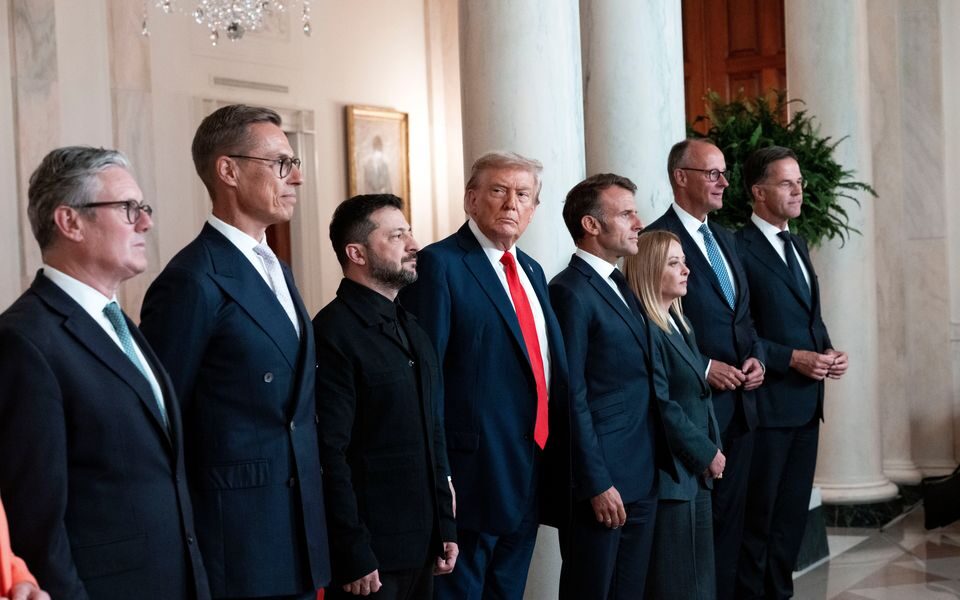
The Washington meeting of 18 August 2025 where the US President Donald Trump hosted Ukraine’s President Volodymyr Zelensky and other European leaders: NATO Secretary General Mark Rutte, European Commission President Ursula von der Leyen, French President Emmanuel Macron, British Prime Minister Keir Starmer, German Chancellor Friedrich Merz, Italian Prime Minister Giorgia Meloni, and Finnish President Alexander Stubb at the White House. This marked a sharp turn from the earlier optics of the Alaska Summit of 15 August 2025, where Trump hosted the Russian President Vladimir Putin, which had resulted in outrage and unease in Kyiv and other European capitals alike.
The events of 18 August 2025, on the contrary, appeared to restore inclusivity in the U.S. approach to resolving the crisis in Europe, where Zelensky was provided with a central seat, the European leaders reentered the room, and Trump signalled at organising direct talks between Putin and Zelensky and even a trilateral meeting after that. For Ukraine and Europe, the Washington meeting could be considered a partial corrective, as it reassured them that Ukraine’s fate would not be sealed without its participation, contrary to the optics during the Alaska summit between Trump and Putin. Moreover, substantive issues such as security guarantees for Ukraine, an alternative to its NATO membership, and the question of a cease-fire were raised.
Nonetheless, Trump downplayed the need for a cease-fire as a precondition for negotiations to stop the Russia-Ukraine war. This stance of Trump contradicted German Chancellor Friedrich Merz’s insistence on a ceasefire as a credible first step for lasting peace. It aligned more with Putin’s preference of keeping talks going even amidst conflict. Furthermore, sharp divisions persisted even on the question of territory, where Zelensky underlined the Ukrainian constitutional limits that do not permit ceding of territory. At the same time, Trump insisted on some territorial “compromise” for ending the ongoing war. Therefore, one can observe that though the optics changed from Alaska to Washington, the fundamentals remained more or less the same.
What does the Washington meeting signify?
At first, the Washington meeting underscores the fact that the U.S. remains the indispensable convenor of peace in Europe, especially with respect to ending the Russia-Ukraine war. Ukraine’s demand for agency in conflict resolution and European protestations aside, it is evident that the U.S. sets the diplomatic tempo. Besides, by convening a meeting in the White House, Trump reminded allies and adversaries alike that the U.S. remains an indispensable actor for diplomatic negotiations concerning conflict resolution.
Secondly, it highlights the unpredictable fluidity that exists in Trump’s approach. Where Alaska portrayed his approach of bilateral bargaining with Russia, Washington depicted a multilateral setup with the U.S.’ allies. Through this fluidity of approach, Trump attempted to demonstrate a firm control over the peace process as he could alternate between exclusivity (as seen during the Alaska talks) and inclusivity (as seen during the Washington meeting), whatever suits the U.S.’s political as well as diplomatic needs.
Thirdly, the meeting also underlined the fact that European powers cannot be sidelined and they will be a party to long-term peace on the European continent. Leaders of France, Britain, Germany, Italy, and Finland, along with NATO and the European Commission, ensured their relevance by strongly reasserting themselves in Washington. But it was also evident during the talks that their role in the European security architecture remains tethered to the U.S. leadership.
Finally, the meeting showed that even though Ukraine possesses agency in deciding its own path to peace, such agency remains conditional. Any leverage on the part of Kyiv largely depends on how much support the U.S. and its European allies are willing to provide. This phenomenon was underlined by Trump’s references to territorial compromise even when he was reminded by Zelensky that it went against the Ukrainian constitution.
Key Takeaways for India
The Alaska and Washington summits reaffirmed the U.S. centrality in the geopolitics of the 21st century. Despite the existing frictions in the transatlantic alliance, the U.S.’s role remains pivotal to European security, and it will continue to be so. Thus, even when the European powers are seeking greater autonomy, they remain restricted by American power. For New Delhi, it is essential to note that managing ties with Washington remains crucial, as its reliance on trade and strategic matters would limit its strategic maneuvering, though minimally. In this context, New Delhi may balance its strategic autonomy and the current fluid geopolitical environment.
In addition to this, the Washington episode showed that the European leaders have learned from their past experiences of the U.S. unpredictability under the Trump administration and have subsequently devised a more assertive posture for the meeting. They seemed to have come prepared as they were observed speaking the American President’s ‘language’, portraying gestures that resonated with him. They even thanked him profusely. Moreover, they attempted to frame security in trade-friendly language and constantly insisted on meaningful security guarantees instead of just reassurances from the U.S.. By doing so, Team Europe managed to secure a verbal pledge of support from the U.S. and also positioned itself as a credible actor in Ukraine’s defence.
Trump is transactional and is often swayed less by abstract principles than by personal rapport and concrete ‘winning points’ that he can exhibit to his domestic audience as well as to the world. The European leaders learned this, praised his role in conflict resolution, spoke in terms he valued and emphasised what he can gain politically by accepting and executing their agenda. India is facing new U.S. tariffs and should consider that confrontation would risk escalation and silence risks of marginalisation. It should, therefore, combine firmness, concerning its core interests like market access, sovereignty and strategic autonomy, with diplomatic framing like jobs, fair trade and visible reciprocity that appeals to the current U.S. administration. This would ensure protecting its economic space while still sustaining its broader partnership with Washington.