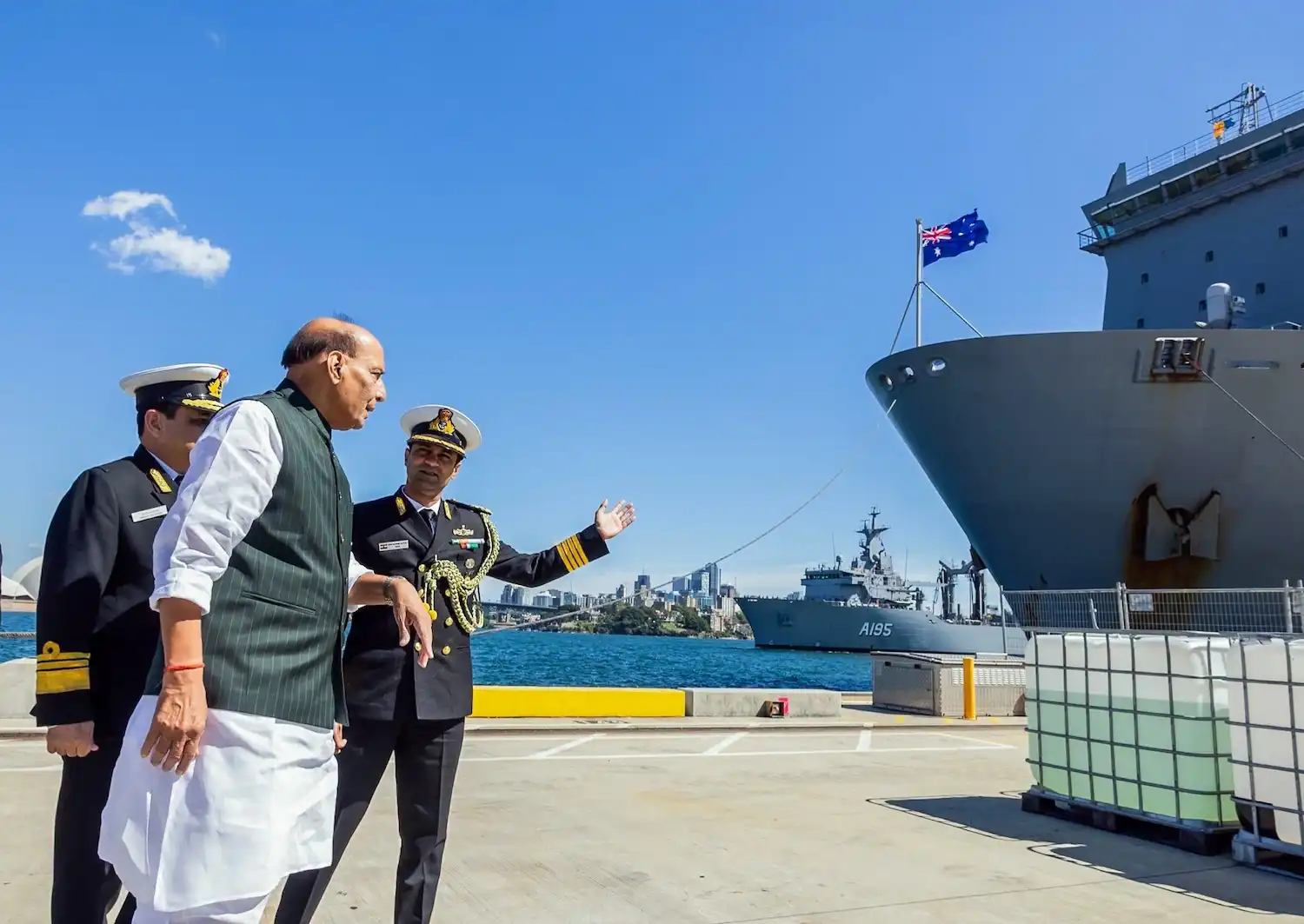
The visit of the Defense Minister Rajnath Singh to Canberra on 9 October 2025 was a definitive step in consolidating the strategic partnership between India and Australia. “Our cooperation is based on trust and shared responsibility for regional peace,” Singh stated in remarks posted on his official X account after meeting Australian Defense Minister Richard Marles.
New Agreements and Strategic Ambitions
During the visit, both sides signed three major defence agreements: the Implementing Arrangement on Mutual Submarine Rescue Support and Cooperation, a new information-sharing pact on maritime security, and a framework for annual Joint Staff Talks to deepen coordination across all military branches. The Australian Department of Defense made a definitive joint statement that the agreements “reflect an expanding scope of strategic alignment and operational readiness between our nations”.
The ministers also endorsed the Joint Maritime Security Collaboration Roadmap, which is designed to enhance domain awareness and joint operations in the Indian Ocean and the South Pacific. Canberra invited Indian shipyards to undertake maintenance and refit work for Australian naval vessels deployed in the region. Both sides described this as a practical symbol of mutual confidence. Singh and Marles also announced an upcoming Defense Industry Roundtable in Sydney and the creation of a Joint Working Group on Research and Materiel, which will expand cooperation into defense manufacturing and technology.
Both ministers were clear that the deals were defensive and practical. In Canberra, Richard Marles made clear to reporters that the agreements would “allow our militaries to work more effectively with other partners in the Indo-Pacific”.
Within the Broader Framework
Although framed as a bilateral success, the Canberra dialogue fits squarely into the Quad’s strategic architecture that links India, Australia, Japan and the United States. India’s participation in the Talisman Sabre exercise earlier in 2025 — alongside U.S., Australian, and Japanese forces — paved the way for the new agreements. The frameworks signed in Canberra, including submarine rescue and aerial refuelling, will make it easier for Indian and Australian forces to coordinate more tightly with U.S. forces in the region when required.
It is clear that this interoperability places India–Australia cooperation within a broader American Indo-Pacific strategy. This raises questions about the degree of autonomy New Delhi and Canberra can retain in regional affairs.
Rajnath Singh, for his part, sought to underline independence. “India’s partnerships are guided by our national interests,” he told reporters in Canberra. “They are not directed against any country.” His phrasing clearly echoed India’s long-standing doctrine of strategic autonomy — cooperation without alliance — a principle aimed at balancing collaboration with self-reliance.
Beijing Watches Closely
But the tone among other Quad members is clear. In recent months, senior U.S. and Japanese officials have openly declared their intention to “counter Chinese coercion” and “ensure deterrence against Beijing’s assertiveness” in the Indo-Pacific. This rhetoric has become increasingly strident since the 2025 Quad security consultations. This shift towards overtly anti-China messaging among India’s partners highlights a clear divide between New Delhi’s cautious diplomacy and the more confrontational posture that is now shaping the Quad’s strategic narrative.
Beijing has already made it clear that it is not happy. Chinese state media and official spokespeople were quick to condemn what they portrayed as a further deepening of security ties aimed at countering China. Xinhua and other outlets clearly conveyed Beijing’s warnings about exclusive security groupings and the risks they pose to regional stability. This response is consistent with patterns seen after similar pacts in the Pacific this month, which Chinese officials publicly complained about as destabilising.
Balancing Opportunity and Risk
The new agreements are clearly advantageous for India and Australia: stronger logistics, greater maritime reach and improved deterrence. It is clear that they also tie both nations more closely to U.S. strategic priorities. This dual reality poses a dilemma. A closer partnership enhances security cooperation, but if U.S.–China tensions escalate, it risks feeding a regional arms race and reducing diplomatic flexibility.
Singh and Marles have made it clear that this cooperation is defensive and transparent, and it is not confrontational. But even as they spoke of peace and openness, the frameworks they signed fit seamlessly into Washington’s broader Indo-Pacific agenda. The challenge ahead is to ensure that India–Australia defence cooperation strengthens stability rather than amplifies rivalry.