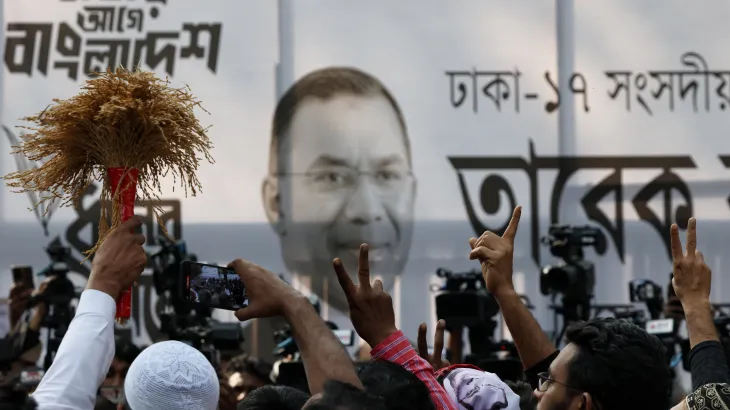
The Bangladesh Nationalist Party (BNP) has returned to power after decades, with strong electoral influence and numbers in the recently concluded Bangladesh elections, following the ouster of Sheikh Hasina in 2024. As India explores options for engaging with the new regime in Dhaka, it must pursue a broad set of engagements and clear priorities, given that New Delhi faces longstanding fears and frictions dating back decades.
The Game of Fears and Fiction
India saw two BNP regimes, first from 1991-1996 and second from 2001-2006. Both terms were headed by Khaleda Zia. After military rule ended in 1990, BNP was the first civilian political leadership to come into power after a decade of military rule. India prepared its engagement lines for the new leadership by building functional and neighbourhood ties, but Zia’s leadership drifted away from such engagement and instead pursued an assertive nationalist line that challenged India’s regional dominance and influence. The hyper-nationalism, which leaned more on transactionalism and Islamic hard-lining, limited New Delhi’s options for engagement and created new strategic and security challenges. Perhaps the first shocker came when Khaleda Zia made a blatant attempt to internationalise the Ganga water-sharing issue, which could have been addressed bilaterally, at the 48th UN General Assembly in October 1993, where she highlighted the “disastrous effects” of the Farakka Barrage on Bangladesh. This single move alarmed India and sent a cautionary message about Dhaka-Delhi relations, indicating that elements of good faith and a sense of bilateralism do not endure under BNP leadership.
In the second instance, India formally and informally proposed a land transit route, or “corridor,” connecting West Bengal to Tripura via Bangladesh. The aim was to bypass the long and difficult border routes. However, the BNP refused to consider the project and even tried to portray India’s proposal as a threat to Bangladesh’s sovereignty.
The situation worsened when Bangladesh refused to take India’s security concerns seriously. Anup Chetia, the General Secretary and a co-founder of the United Liberation Front of Asom (ULFA), operated freely in Bangladesh, carrying out anti-India activities along the borders with other insurgents, such as the National Front of Tripura (NLFT), with impunity despite India’s communications expressing concern and dossiers. The Bangladeshi government refused to cooperate. Chetia’s arrest came only in December 1997, after the BNP regime ended and Sheikh Hasina’s Awami League came to power. During the first term of the BNP, Indo-Bangladesh relations were strained and manipulated, with limited options for engagement and little strategic and economic leverage. The 1992 Tin Bigha Corridor lease, which allowed Bangladesh access to its enclaves, had little impact on building trust and cooperation. The relationship with Dhaka returned to normal only when Sheikh Hasina returned to power in 1997.
Another Hit
In 2001, BNP’s Khaleda Zia returned to power, triggering a reset in Indo-Bangladesh relations by reviving fears and friction, and perhaps, this time, shock and fear outweighed friction. The infamous Arms Haul in Chittagong in 2004, where a heavy, high-value arms cache was seized, was the largest arms seizure in the region’s history. According to an investigation that effectively took place under the Awami League’s government between 2009-2010, the arms were destined for ULFA. The BNP government did almost nothing to investigate the 2001 India-Bangladesh skirmishes and sided with the Bangladeshi Border forces. On the economic front, the earlier strong opposition to India’s economic projects and attempts to build economic partnerships continued.
India’s Tata Group proposed a $3 billion Foreign Direct Investment (FDI) package, the largest in Bangladesh’s history. After years of negotiations, the BNP government backed away, citing the need to “protect national resources.” The decision was driven by anti-India sentiment and was politically motivated, according to some reports, which also suggest that a high-ranking BNP leader demanded bribes for this deal.
Similarly, an energy project, the Myanmar-Bangladesh-India gas pipeline, which could have been crucial for regional energy security, was allegedly sabotaged by BNP by imposing stringent conditions on India that India wouldn’t have been able to accept, such as reducing India’s trade surplus with Bangladesh and India’s economic influence.
The Security Nightmare
The rise of Islamist fundamentalism during BNP’s second regime alarmed India, particularly the 2005 bombing incident in which 500 bomb explosions occurred at 300 locations across 63 of the 64 districts of Bangladesh by the Bangladesh-based Islamic terror outfit Jamaat-ul-Mujahideen Bangladesh (JMB). Islamist fundamentalism was growing, with leadership phenomena, including the Bangla Bhai, leader of the banned Jamayet-ul-Mujahideen (JUM), who aimed to establish a Taliban-style government in Bangladesh. The rapid growth of terror imprints in Bangladesh created a security nightmare, as some reports suggested JMB links to terror incidents in India, especially the outfit’s active involvement in arms smuggling networks across the India-Bangladesh border. Alongside strategic irritants, the BNP’s leadership created a security headache for India’s leadership, further straining ties and widening the trust deficit on both sides.
BNP Mindset
The Bangladesh Nationalist Party (BNP) has three key elements that drive its internal and external posturing and shape its mindset. First is an Islamic hardline approach, which fuels anti-India sentiment and is compounded by revived East Pakistan sentiments and by Pakistan’s attempts to cultivate strategic depth. Second is hyper-Bangla nationalism, which views India as a bully and a dominator rather than a big brother or a strategically valued neighbour. This hypernationalism is a significant factor shaping Bangladesh’s foreign policy under BNP leadership, as the BNP leadership seeks to project autonomy, which appears more polarized and ideologically driven than guided by strategic and pragmatic considerations.
Third is the China factor. BNP leadership believes China is a key partner, not only as an alternative but also as a counterweight to India. The long-running tensions in early BNP regimes show glimpses of these three aspects, and with the return, after decades, to the helm of power, these aspects are likely to intensify as hints gradually emerge post-electoral victory. The Prime Minister-designate, and BNP leader Tarique Rahman, has said that the “Bangladesh First policy” and a “forward-looking relationship” with Pakistan are to be considered. The most noteworthy statement came from Humayun Kabir, Foreign Affairs advisor to PM-designate Tarique Rahman, where he pressed on Sheikh Hasina’s extradition as a key issue for resetting ties with India and, according to a report, said that “intelligence agencies should stop dictating Bangladesh’s foreign policy”.
India’s Strategy For New Dhaka
India must prioritise dealing with Dhaka at two levels: strategic and security. It must be clear that there is little room for recalibration. A strategically assertive posture in engaging with the new BNP leadership will work, as Sheikh Hasina’s extradition issue will be a major strategic irritant that limits recalibration attempts. Therefore, India must proactively explore economic and political spheres or leverage points to, at best, contain Dhaka’s adversarial manoeuvring and safeguard India’s interests. The arguments for recalibration and wait-and-watch approaches have not yielded significant results in the past, and with the new BNP leadership, especially Rehman at the helm, hyper-autonomy and anti-India sentiments will witness a “strategic buildup”.
At the strategic level, India must leverage its long-term economic influence in Bangladesh, including trade in essential commodities, electricity exports, and supply chain management. In current South Asian dynamics, India holds a strong position in the geo-economic domain vis-à-vis Bangladesh and must use this leverage if Bangladesh tries to go too far. India’s negotiating style in leveraging this position should focus more on messaging than on direct action, using a transactional realism approach to signal to BNP that, without India or with anti-India sentiment, Bangladesh’s autonomy is at risk. In other words, India must be in a position to impose caution, not compulsion, on Dhaka when needed.
Similarly, on the security front, with Jamaat-e-Islami becoming politically active again and gaining influence, the terror threat becomes real not only for India but also for Bangladesh itself. The JMB outfit may attempt to re-establish its presence. Against the backdrop of ISKP struggling to position itself in the South Asian subcontinent, JMB’s strong connections with ISIS (often seen as an ISIS proxy in Bangladesh), and Pakistan’s desperate attempts to cultivate strategic depth in Dhaka against India, the threat becomes even more real and dangerous. Therefore, India must make clear to Dhaka at the security level that security cooperation is non-negotiable, and even in this case, New Delhi must be able to exercise strong caution with Dhaka.
In sum, India must leverage its economic and political strength to implement soft deterrence, combining preventive and re-engagement diplomacy, enabling it to negotiate with Bangladesh from a position of strength on both fronts. In both cases, from protecting its interests to maximising them, the onus should be on Dhaka.