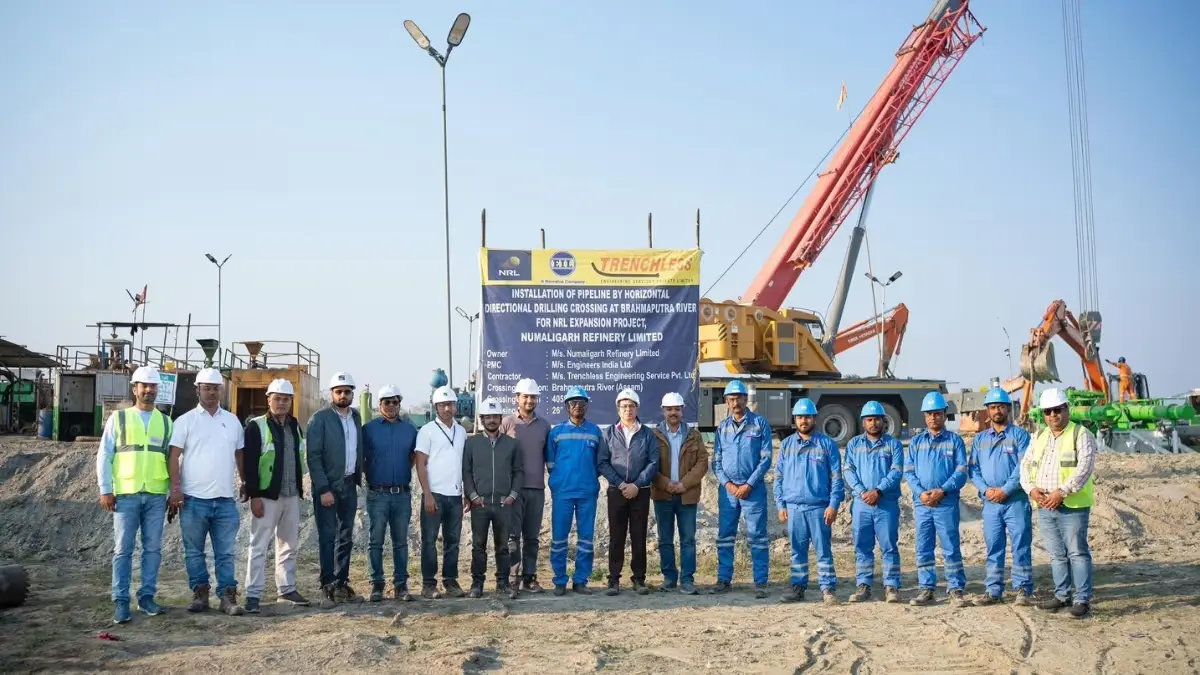
Last week, state-owned Engineers India Limited pulled off what many in the global energy industry thought bordered on the impossible: a 4,058-meter horizontal directional drill beneath one of the world’s most treacherous rivers, the Brahmaputra, for a 26-inch crude oil pipeline. This is now the longest HDD crossing ever achieved anywhere on the planet, eclipsing EIL’s own record of 4,027 meters under the Ganga on the same project.
The feat is not merely a triumph of Indian engineering ingenuity; it is the final, decisive hurdle cleared in the 1,635-kilometer Paradip-Numaligarh Crude Pipeline (PNCPL), a $3 billion-plus artery that will soon carry imported crude from Odisha’s Paradip Port straight to the expanded Numaligarh Refinery in Assam.
When the pipeline comes online later this year or early next, Numaligarh Refinery’s capacity will triple from 3 million to 9 million metric tons per year. More importantly, India will gain its first efficient, all-weather crude supply route to the Northeast, a region that has long been hostage to high-cost road and rail transport across flooded plains and mountain passes.
The strategic payoff is enormous. The Northeast currently accounts for barely 6% of India’s refining throughput despite sitting atop significant hydrocarbon reserves and hydropower potential. PNCPL changes that calculus overnight. Cheaper diesel and gasoline will flow to Assam, Arunachal, Nagaland, Manipur, Mizoram, Tripura, and Meghalaya. Industries that have hesitated to invest because of logistics costs will suddenly find the region competitive. Thousands of direct jobs in construction have already been created; many thousands more will follow in refining, petrochemicals, and downstream manufacturing.
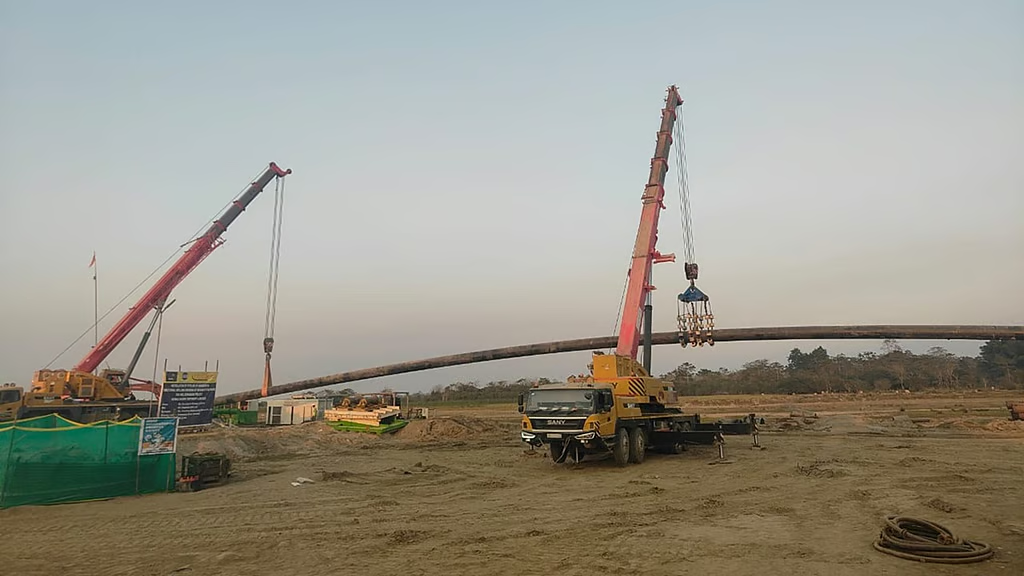
Geopolitically, the pipeline insulates the Northeast from disruptions in the Siliguri Corridor, the narrow “chicken’s neck” that connects the region to the rest of India and is close to China’s border. In an era when great-power competition is increasingly played out through chokepoints and supply chains, NRL has just built India a robust internal bypass.
The execution has been remarkably light-touch. Traditional open-cut trenching across the Brahmaputra would have devastated fisheries, displaced riverbank communities, and risked catastrophic erosion during monsoon floods. HDD avoided all of that. The river’s surface was never broken; navigation continued uninterrupted. In a country racing to meet net-zero ambitions, this is the kind of pragmatic bridging infrastructure we need, securing energy today while buying time to scale renewables tomorrow.
Perhaps the bigger story is what this says about India’s re-emerging technical ambition. A generation ago, the world looked to American, European, or Japanese firms for the toughest pipeline jobs. Today, an Indian public-sector company just set a global benchmark in one of the most geologically hostile environments imaginable, shifting sands, seismic activity, water pressures that would crush lesser designs, all while beating its own record twice in the same project.
This is what “Make in India” looks like when it actually works: not slogans, but a 4-kilometer hole drilled under a raging river by Indian engineers using largely Indian technology and Indian steel.
As Washington and Beijing argue over chips and rare earths, India is quietly stitching together the physical backbone of its rise. The Brahmaputra crossing is not flashy like a moon mission, but it may prove far more consequential. It is the sound of a rising power refusing to let geography dictate its destiny.