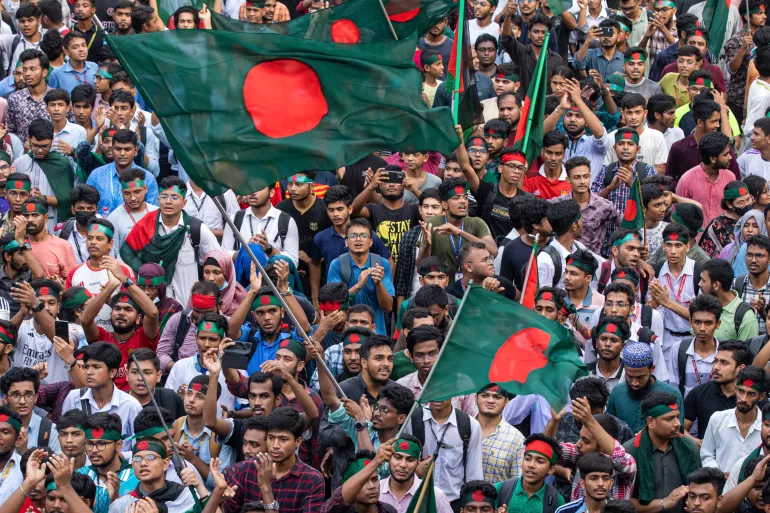
Greek philosopher Aristotle termed democracy the most perverted form of government, where many, as rulers, disregard the common interest. However, the aspiring leaders of Bangladesh appear to be competing with one another, vowing to serve the common interest in the context of the upcoming election scheduled for next week, on 12th February. This election bears immense significance both nationally and regionally.
Firstly, the upcoming election is being conducted amidst socio-political tension, deep polarization, and lingering fears of violence. The toppling of the elected Sheikh Hasina government in 2024 and the resultant near collapse of the state apparatus unleashed Mr. Hyde of the society whose wrath, like the evil persona of the 19th-century R.L. Stevenson’s classic’ Dr. Jekyll, wrote the macabre tale at the dawn of post-Hasina Bangladesh. Relentless attacks since then have scared the minorities ahead of the upcoming election. Added to this anxiety is the rise of the Islamist party Jamaat-e-Islami, which was banned by the Hasina government. Surveys suggest a neck-and-neck fight between Jamaat and Tariq Rahman’s Bangladesh Nationalist Party (BNP). The Islamist party made headlines after its student wing, Chhatra Shibir, won the student election in Dhaka University, defeating the BNP last September. If Jamaat turns victorious or even king-maker in the post-election Bangladesh, it might be a nightmare for not only Bangladesh but also India. The Islamist party reportedly fueled anti-India rhetoric to promote a new, “independent” Bangladesh rooted in Islamist ideology, removing secular foundations and historical ties with India. Such a government will be most welcome to the anti-India elements and hardliners within the country and their main patron, Pakistan. Islamabad is already cozying up to Jamaat leaders. There is a report surfacing about Lashkar terrorists landing in Dhaka last month by flight from Karachi.
The scheduled election is equally an opportune moment for BNP to reestablish its lost primacy in the national politics after two decades. The party is sanguine about electoral victory with a survey narrating growing support for the party and its leader, Tarique Rahman, for the premiership. Tarique returned last December after years in exile in London following the death of his mother and former premier Begum Khaleda Zia. His return has undoubtedly enthused BNP, which expects him to reshape the party’s policy, paving the way for electoral victory. However, the rise of once-ally-now-rival Jamaat is posing a serious challenge to BNP. To counter this, the BNP now wants to muster the support of the liberal-minded voters who abhor Jamaat’s ideology. Thus, Tarique Rahman emphasized ‘cooperation to build a Bangladesh safe for all, irrespective of faiths and regions’, in his speech on arriving in Dhaka on 25th December. Tarique has even called Jamat ‘new oppressors’, planning to hijack the upcoming election. This change of mood about its former ally underlines BNP’s urge to muster the support of the liberal minded voters of the country, especially those who traditionally voted for the Awami League. This veering away from the political legacy of his parents, understandably, is meant to fill in the gap of the Awami League, which is barred from contesting this election.
Tarique Rahman’s comeback has certainly put the Jamat-Yunus-Islamists combine under pressure, given the possible inclination of a larger section of voters for the BNP in the absence of the Awami League. Although Tarique is yet to be tested as an administrator, his leader-like speech pledging to restore law and order certainly is a hope for the masses fatigued with the regular mob violence and hooliganism unleashed under the nose of the interim regime. That the Yunus regime considers Tarique as a challenge was clear from the report attempting to thwart his return.
BNP’s change of mood under Tarique Rahman is welcome news for India, which does not have any memory of the BNP government, then in alliance with Jamaat, to cherish. That India wants to give BNP a chance now is clear from External Affairs Minister J. Jaishankar meeting Tarique Rahman in Dhaka on 31st December while attending Khaleda Zia’s funeral. Even the Indian Parliament’s condolences on the death of the former Bangladeshi premier carry a message for the BNP. The immediate concern for India is the continuous attacks on Hindus in Bangladesh, and Tarique’s pledge for action against the perpetrators and making Bangladesh ‘safe for all’ kindles hope for New Delhi. Another reason for India to invest in Tarique is that BNP is not aligning with Jamaat this time and is the only choice in the absence of the Awami League.
However, the circumstances under which this election is scheduled are vital. India’s pro-Awami League policies were highlighted as prime concerns in the Bangladesh media. Besides, even Tarique might not be too generous with India, given the current mood of his country. Also, he has been unambiguous about putting pressure on India over pending issues with Bangladesh, including water-sharing. India is cognizant of this recalibration of the ‘new’ Bangladesh’s India policy. What bothers India is the next government in Dhaka turning inimical to India’s security interests, which is a possibility in case the Jamaat-Islamist-Yunus combine emerges victorious or even as king-maker. Besides, the newly founded National Citizen Party (NCP), emerging from the womb of the anti-Hasina mission, if it turns equally strong, will be a concern for India since it minced no words in its manifesto on taking on India over a range of issues, primarily being the extradition of Sheikh Hasina. Its militant mood vis-à-vis India was also clear from its leader’s threat towards the northeastern states.
If the election happens as scheduled, resulting in whoever comes to power, it will not be the Bangladesh India that India has known for the last five decades, sans Awami League and Sheikh Hasina. The Awami League will expect Indian assistance for its re-entry in Bangladesh politics. Apart from restoring the Awami League eventually in Bangladesh politics, Sheikh Hasina’s political future will also bother India. It will be an obligation for both India and the future Bangladesh government to decide the former premier’s fate, which will be a challenge for both to handle. Further, the next government will badger India over its ‘dues’ and might exercise its ‘strategic autonomy’ in foreign policy, acting in cavalier fashion in respect to India’s interests. And all will be claimed to be done in the ‘common interest’ of Bangladesh.